
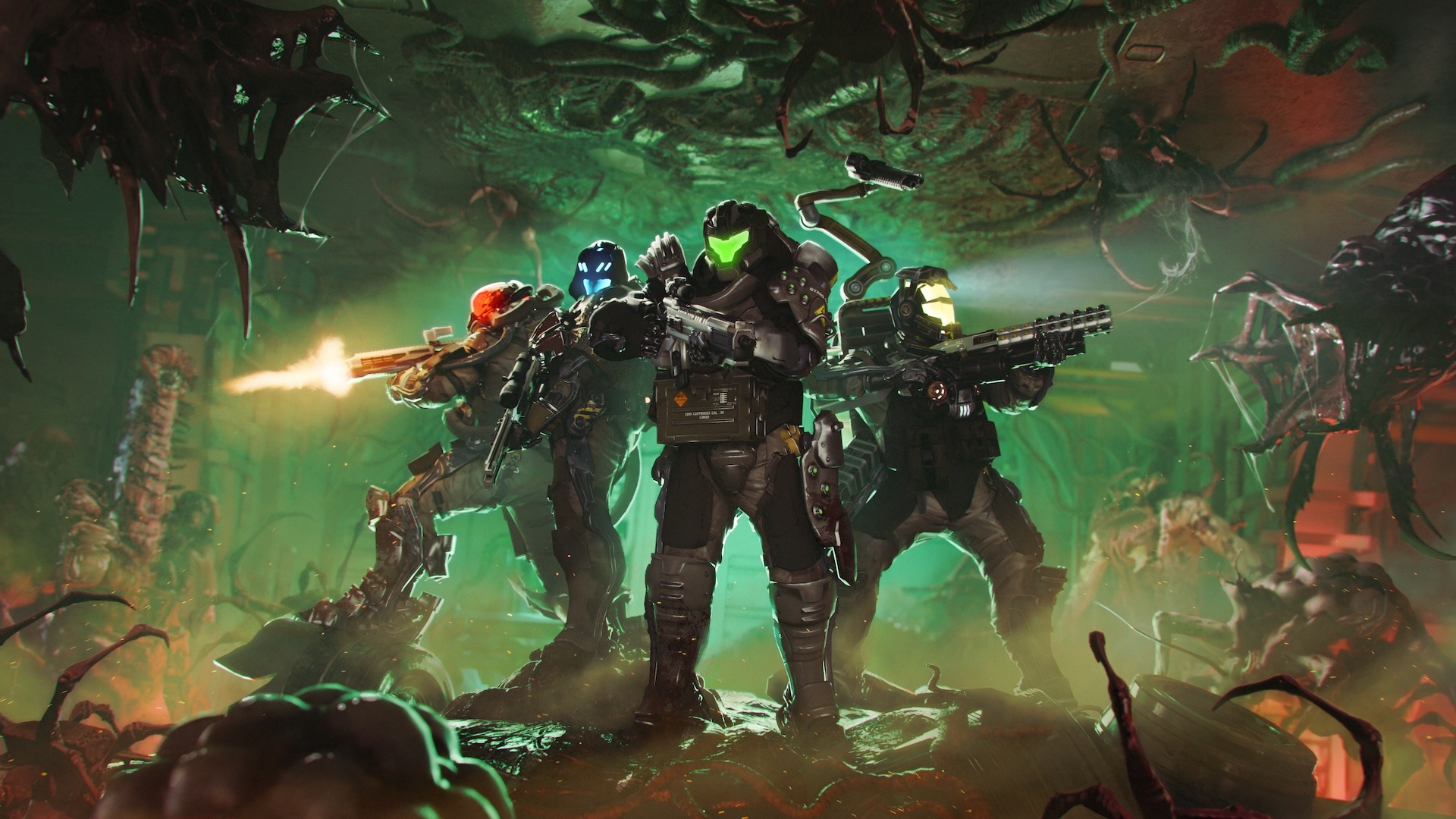

We saw a lot of great games at this year’s Gamescom, big and small, from massive studios to indie developers. I don’t think a single title disappointed us. To wrap up our Gamescom coverage—alongside the brilliant Dinolords you’ve surely read about by now, we’ve prepared our impressions of a fantastic twin-stick shooter: DarkSwarm. I have to admit, this might have been one of my most fun experiences at the show. The folks at Bitfire Games were incredibly cool; we were all exhausted, playing a co-op session with zero filters, completely letting our guard down. No insults, of course, but plenty of hilarious situations. Even though the game has a very serious tone, we shared a lot of laughs and had a blast. Let’s dive in.
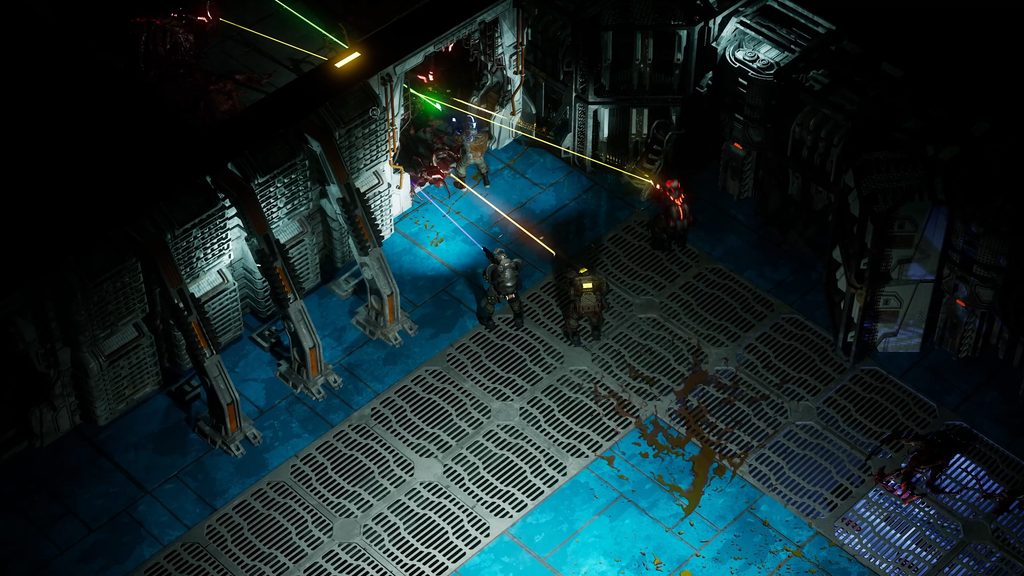
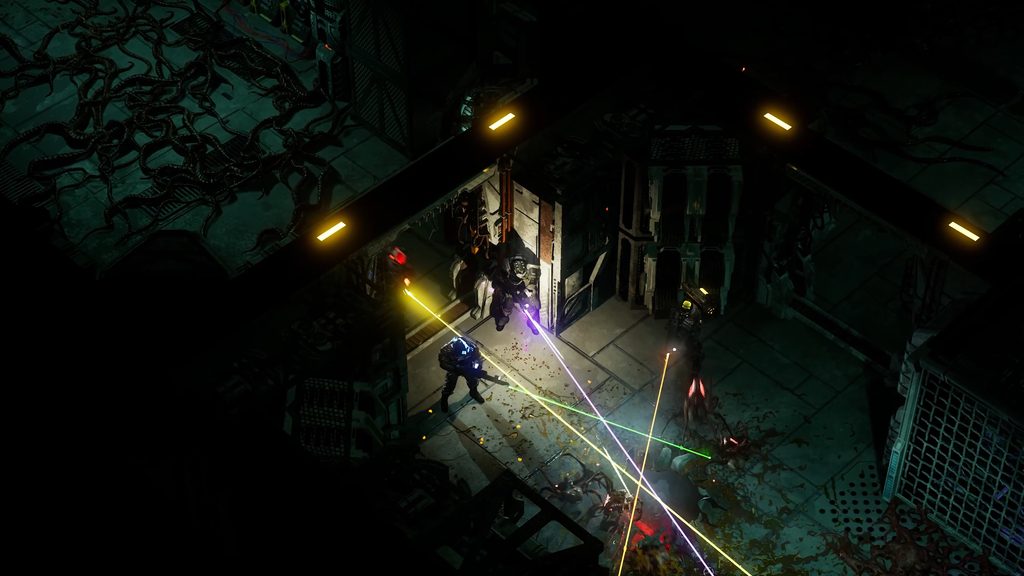
As I mentioned, DarkSwarm is a top-down cooperative shooter for up to four players where you take on the role of bio-printed mercenaries working for Death on Demand. You aren’t sent to save the galaxy for some noble cause, nor are you there for heroism. You are professionals paid to drop into infested colonies, get the job done, scavenge valuable resources, and try to make it out alive. The world is dark, futuristic, and clearly heavily inspired by the Alien universe, but the game doesn’t try to be a classic survival horror. This is much more about what happens when four people are handed a serious arsenal and dropped right into the middle of an alien horde.
And the horde is exactly what makes the biggest difference here. Bitfire Games managed to render a staggering number of enemies on screen at once—literally hundreds, maybe even thousands—and the developers claim the engine can handle even larger numbers. I have to admit, it looks more than impressive. When the screen floods with a swarm of enemies while you desperately try to reach your objective, it injects genuine tension and panic into the gameplay. As I told the devs, it reminded me heavily of World War Z, but obviously with a better top-down overview and seemingly larger swarms due to the perspective. That initial awe didn’t just fade after the first encounter; every single time those little aliens started pouring out of every vent in the level, it looked just as spectacular as the first. Even though the demo lasted only about 15 to 20 minutes, this spectacle never ceased to amaze.
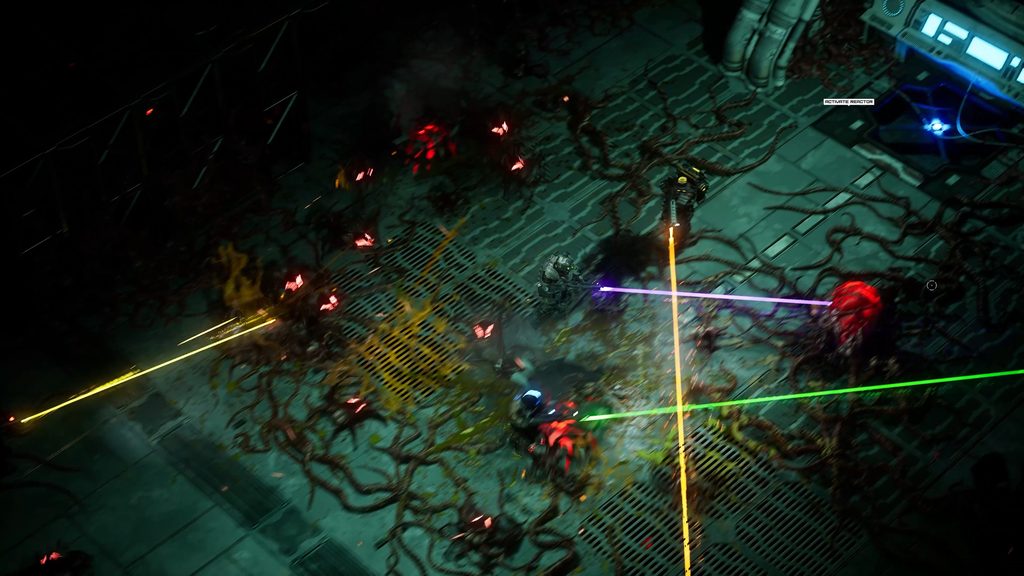
It’s not just there to look pretty and impressive, either. When you see how the swarm behaves, you realize it actively forces you to adapt to different situations. Instead of carefully picking off a few dozen enemies one by one, DarkSwarm frequently drops you into scenarios where the entire screen transforms into a living wall of hostiles. One segment of the horde tries to encircle you, another flanks from the sides, while smaller clusters climb over surfaces to apply constant pressure. Bitfire actually coded two distinct “swarm” behaviors: the massive horde that attacks directly, and smaller splinter groups capable of scaling objects. I have to admit, playing alongside the Bitfire Games team felt a bit surreal and unexpected. I know they knew exactly what to expect, but relying on habits from other games, I often found myself tunnel-visioning on one part of the level, trying to wipe out everything in front of me. Meanwhile, the devs were practically babysitting me, keeping the massive swarm surrounding us at bay—a swarm I was completely oblivious to. It’s not that the visibility is bad—it’s actually excellent—but when you focus too hard on one thing, everything else just slips past your attention.
DarkSwarm currently features four distinct classes, though they’ve undergone serious revisions during development. The dedicated Support class, for instance, was completely removed because earlier builds proved it was practically mandatory on higher difficulties. Bitfire Games’ current goal is to ensure no single class is mandatory; instead, each holds situational value. The Assault class is tailored for players who want to be right in the middle of the chaos—like me, for example—wielding a flamethrower and a minigun as primary tools. The Engineer can deploy a turret that can later be recalled as a drone, while the Infiltrator offers a completely different approach with a katana, railgun, and cloaking abilities. The fourth class rounds out the squad with its own unique skill set, but the philosophy remains clear: players should pick a class based on how they want to play, rather than being forced into a specific team composition by mission design.
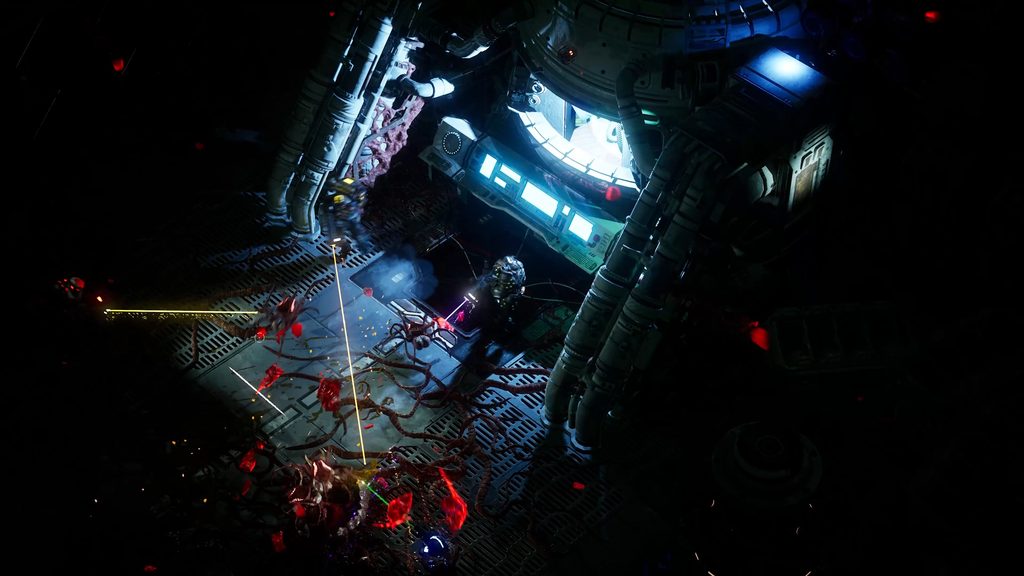
The game utilizes a modification system designed to allow extensive gear customization. Bitfire Games wants progression to be more than just a classic numbers game where, after a few hours, your gun magically does more damage. Instead, the idea leans closer to a system like Deep Rock Galactic: as you progress, you unlock a broader arsenal and more tactical options, rather than creating a massive statistical gap between veterans and newcomers. This is crucial for a co-op game. If one player is level twenty and another is just starting out, they should be able to play together without one practically carrying the other through the entire mission. The veteran player has more tools and a better understanding of the game, but they don’t become so overpowered that the new squadmate has nothing to do. The same goes for weapons; mods should enable diverse build crafting, rather than funneling everyone toward a single “best” gun. The mission structure itself is also heavily tailored for co-op. DarkSwarm supports one to four players and features drop-in/drop-out matchmaking mid-mission. Difficulty scales with the player count by increasing the sheer volume of enemies, rather than artificially bloating their health pools just because you brought a friend. The core combat feel remains intact; more players simply means a greater volume of chaos.
Visually, the game doesn’t try to mask its indie roots by stuffing the screen with an excessive amount of micro-details. Instead, it relies on a dark atmosphere, stark contrast, blood, biological growths, and industrial alien colonies to create a palpable sense that you’ve stepped into a situation completely beyond control. At Gamescom, I only got to play one level, which was specifically curated for the presentation so that all journalists had a uniform experience. However, if I remember correctly, the folks at Bitfire Games mentioned that the full game will feature procedurally generated levels. This means every playthrough will have a slightly different vibe. You can run a mission solo, then replay it with friends, and you’ll get a completely different experience. I have to admit, that sounds incredibly cool, though I’m curious to see how seamlessly it functions in practice.
Without diving too much deeper into the weeds, DarkSwarm, even though it wasn’t my very last appointment, sticks in my memory as an absolutely great experience. The standout feature is simply how brilliantly the game functions in a cooperative setting. Honestly, I can’t wait for this to launch so I can run through it with my friends, then tackle it with a different group of players, and so on. I firmly believe DarkSwarm will be a massive hit for co-op fans when it drops. We still don’t have a firm release date, but I’m sincerely hoping we see it early next year.
