


There is something truly special about games that try to recapture the feeling of a long-gone era. I don’t just mean the visual style or the music, but the very way games used to be designed. In an age where almost every major FPS features health regen, a massive arsenal of weapons, a dozen different abilities, and levels that mostly just usher you from one firefight to the next,or perhaps the inevitable open-world format, Agent 64: Spies Never Die does something entirely different and even a bit unexpected. Or rather, it decides to travel back in time, smash the button on its time machine, and transport us all back to the late nineties. This is a game that openly wants to be what GoldenEye 007, Perfect Dark, and similar Nintendo 64 FPS titles used to be, and it does it so well that within minutes you’ll feel like that hit on the time machine button was a complete success. But right there lies both the greatest strength and the biggest problem of Agent 64. When something so faithfully recreates a specific era, the question is no longer just whether it did a great job replicating the gameplay style and everything else, but whether the things that were charming and engaging in the late nineties are still equally fun today.

Agent 64 is the work of solo developer Replicant D6, and it essentially serves as a love letter to the classics that, I can safely say, defined the modern FPS genre. The game puts you in the shoes of secret agent John Walter, a veteran pulled back into the world of espionage following an attack that brings him into conflict with his old nemesis, Dominic Pulp. Pulp, who was presumed dead, returns with his schemes, and naturally, as is usually the case in these stories, the world is once again in peril. Walter has to blast his way through 14 missions, navigate various locations, gather intel, steal blueprints, hack terminals, rescue hostages, and do a ton of other things to save the day. Honestly, the story itself isn’t something that will keep you up until 3 AM trying to piece together what just happened, but it serves its purpose perfectly and fits right into that 007 mold. It is intentionally crafted as a typical 90s spy thriller, complete with secret organizations, a grand villain, revenge, saving the world, and a protagonist who looks like he’s been through more adventures than is healthy for one person. And honestly, that is perfectly fine. Agent 64 isn’t a game trying to be a serious political thriller; above all else, it wants to give you the feeling of popping a cartridge of some lost, unreleased N64 shooter into your console and starting a brand new campaign, completely hyped and thrilled to play another GoldenEye-like title.
That genuine feeling of being transported to better times kicks in as soon as you start the first mission and realize how they are structured. Agent 64 is not a standard FPS where the game just tells you to hold forward and shoot anything that moves and pops up in front of you. Every mission is a distinct level with its own objectives, and those objectives change depending on the difficulty you select. On the lowest setting, you might get a fairly simple task to push through a specific part of the map and escape. Higher difficulties, however, add new objectives requiring you to explore the map, find specific items, or complete side tasks. Sounds familiar, huh? At least to the older gamers like me. In short, this is one of the best ideas the game borrowed from the GoldenEye recipe, because it forces you not to view a mission as “done” just because you reached the end once. When you revisit it on a higher difficulty, the level suddenly gains a new purpose; you start paying attention to areas you previously just sprinted through, and you invest yourself in the game in a totally different way. And that is the beauty of it all, something that, realistically, very few games do today, if any.

When we talk about how this looks in actual practice while playing, it means Agent 64 isn’t a game meant to be beaten once, set aside, and treated with a “well, that’s it, give me the next game” attitude. Quite the opposite. First, you learn the levels, their layouts, where the enemies are positioned, and you try to complete the basic objectives. When you bump up the difficulty, things get far more interesting as the number of tasks increases, new parts of the level open up, and the game demands that you be much more careful, and in a way, more creative. It’s a system that feels a bit unusual today because most modern FPS titles have conditioned us to expect that “higher difficulty” just means enemies have more health or their bullets hit like a sledgehammer to the head. Here, a higher difficulty genuinely changes the mission itself. You don’t just get tougher enemies; you get a longer to-do list.
The shooting mechanics are perhaps the best part of this wonderful game for anyone who even slightly misses GoldenEye, and I honestly believe there are a lot of you. The movement is intentionally a bit clunky, almost like you’re sliding across the map. Aiming has that specific, weighty feel of old FPS games, and by clicking LT, you can aim precisely, just like in GoldenEye. Enemies react differently depending on where you shoot them, and the weapons lack the modern surgical precision we’re used to today. Instead, they behave exactly as if you were firing from the hip, right next to your waist, like in old-school spy movies. It might feel a bit weird at first, especially if you’re accustomed to modern shooters, but you very quickly begin to understand what the developer was trying to achieve. Agent 64 doesn’t want to give you a perfectly accurate rifle and flawless character control. It wants you to feel like you’re playing a lost N64 shooter that miraculously received modern resolution and support for contemporary hardware. Recreating that old feeling is crucial for this title, and I have to admit that Agent 64 does it absolutely perfectly; the developer’s goal was unequivocally met.
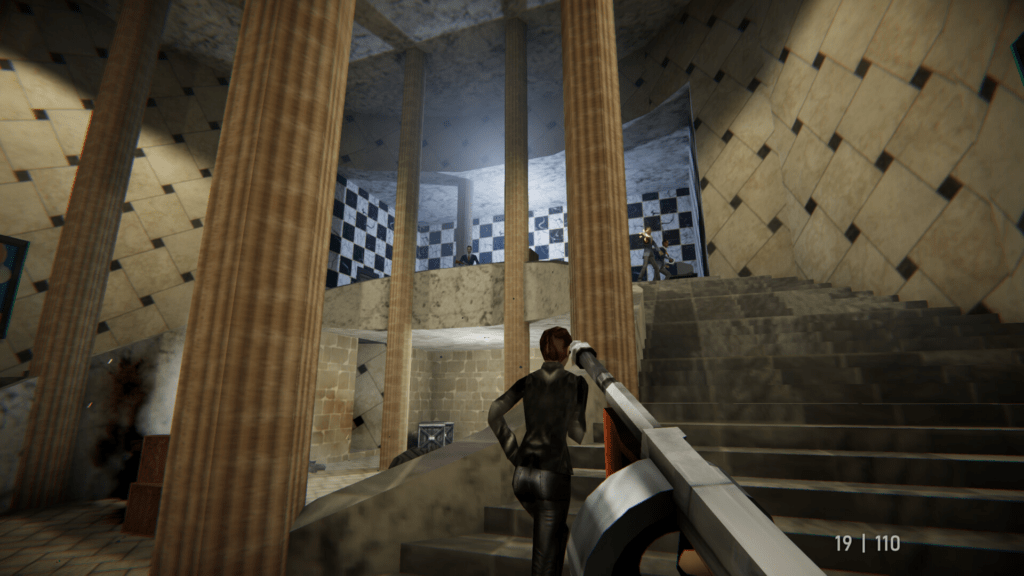
The weapon selection also perfectly aligns with the gameplay approach in this title. There are pistols, automatic weapons, shotguns, and other variants that heavily evoke the arsenals of Perfect Dark and GoldenEye. There isn’t a mountain of attachments, modifications, or stats you have to study. You pick up a gun, use it until you run out of ammo, and then move on to the next one. I have to admit, it serves as a beautiful form of therapy against modern FPS systems, and because of that, there is something incredibly simple and almost liberating about this game. Today, players are often expected to have a “build,” to know which weapon best suits their playstyle, and to constantly obsess over optimization. Agent 64 simply drops you into a mission and tells you to figure it out, so you just have to fend for yourself.
However, that “fend for yourself” aspect mostly stems from the fact that the character’s health system is, like everything else, totally old-school. If someone chips away at your health, it isn’t going to regenerate. You can find body armor that gives you extra protection, but there is no scenario where you hide behind a wall for ten seconds and emerge completely healed. There are also no mid-mission checkpoints, so if you die, you’re going right back to the beginning of the level. Now, I get it, it’s the old-school vibe, but I still think the lack of checkpoints is perhaps one of the rare things where players might, just might, raise their voices. For some, this will be exactly what they’ve been missing from classic FPS games, while for others (perhaps the majority), it will be an unnecessary frustration. Personally, I liked the idea, let the new gamers see how much we used to suffer, but I really wish this had been an optional feature, specifically for those who might quit if they lose all their progress mere seconds before the end of a level due to one moment of carelessness.
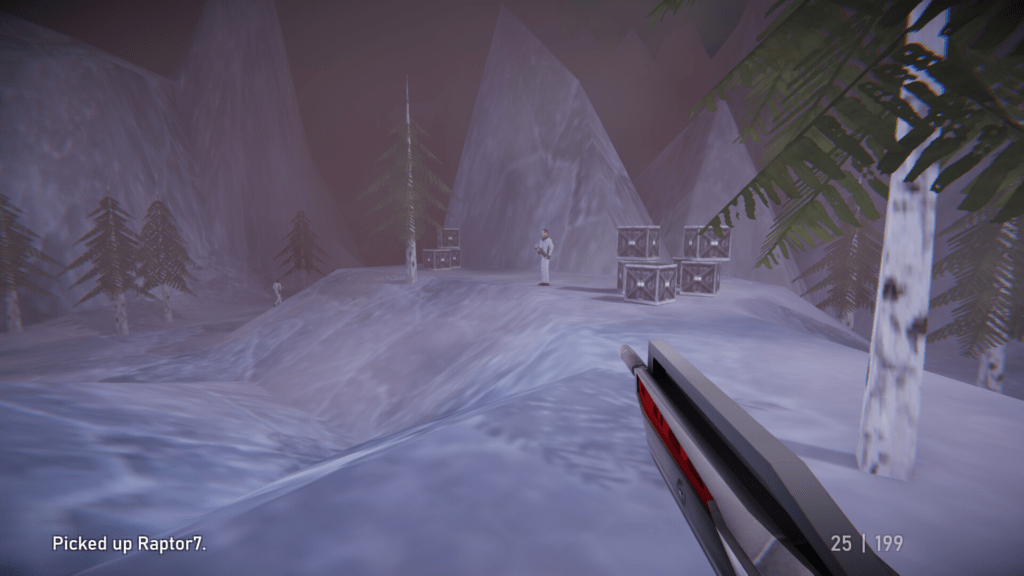
If you think about it, the lack of checkpoints isn’t inherently a problem if the levels are well-designed and not overly long, but having to replay an entire mission because you died a minute before the finish line can be exhausting when you’ve already completed everything asked of you. However, there is another minor issue regarding progression and this specific level design: the “Cyphers,” which kind of clash with the checkpoint-free system. Namely, after finishing missions, you earn Cyphers, and you need a certain number of them to advance through the campaign. This means that at a certain point, you simply cannot continue the story; you have to go back to previous levels and replay them to gather enough Cyphers.
This is where Agent 64 makes one of its stranger decisions. The idea of replaying missions isn’t entirely bad on its own, because fundamentally, the whole game is built around discovering new objectives and better routes on higher difficulties. But when the game practically forces you to do this just to continue the main campaign, what should have been an optional layer to the experience suddenly becomes a tedious hurdle. If you love mastering levels, improving your times, and hunting down every hidden objective, it probably won’t bother you. But if you just want to play through the campaign at your own pace, this can get pretty exhausting. Since I played the Halo: Combat Evolved campaign not too long ago, it reminded me of how Bungie handled level progression back then, with up to two checkpoints per mission, allowing you to load those specific spots to grab whatever you missed on your first run.
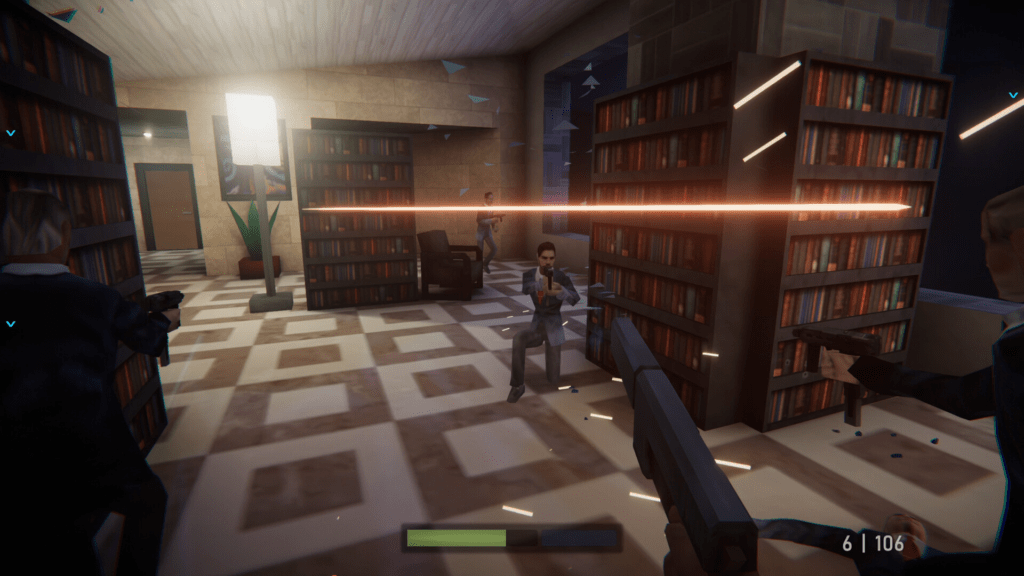
Beyond the story mode, Agent 64 features Paradox Mode, unlocked by completing challenges and beating the game under a predefined time limit. It brings over 70 different modifiers and cheat effects. You get things like big heads, faster or slower bullets, bottomless magazines, and a whole slew of other crazy tweaks that completely alter how the game is played. Then there are Contracts, which are remixed versions of missions with different objectives and pre-set Paradox modifiers. That is actually a seriously impressive amount of extra content for a retro FPS game. What I really loved about all this is that the game doesn’t try to hide its arcade nature. It wants to force you to replay a level, find a better route, and try again. If you ever loved the way old FPS titles gave players grades, extra objectives, and reasons to boot up the same mission again, you’ll find all of that here and you will enjoy it. If your goal is just to play the campaign once and move on, Agent 64 might start getting on your nerves very quickly.
One of the elements contributing to that whole replayability factor is, of course, the level design. And in this game, it’s a beautiful double-edged sword that I believe will leave many players divided. On one hand, anyone who enjoyed old-school FPS games, or even third-person shooters, that feature multiple objectives and force you to thoroughly sweep a level, pulling you in so deeply that you forget the real world around you, will absolutely love Agent 64 and its level design in every sense. But on the other hand, if you are someone who finds complexity tiresome, boring, or draining, then this game will push you away. I have to say, the design isn’t overly complicated or hard to learn, but it is different from what modern players are used to in today’s titles. And honestly, I can understand both sides. Agent 64 features interesting locations, you’ll pass through skyscrapers, nightclubs, museums, catacombs, and snow bases, but not every level is equally good. In some missions, you’ll truly get that brilliant feeling of existing in this world, where you can find alternate routes, explore the environment, and brainstorm how to complete your objective. In other sections, it all boils down to corridors and shooting. When the game leans into its espionage elements, it is far more engaging than when it just throws you from one firefight to the next. The problem is that the stealth isn’t developed enough to carry the game on its own.
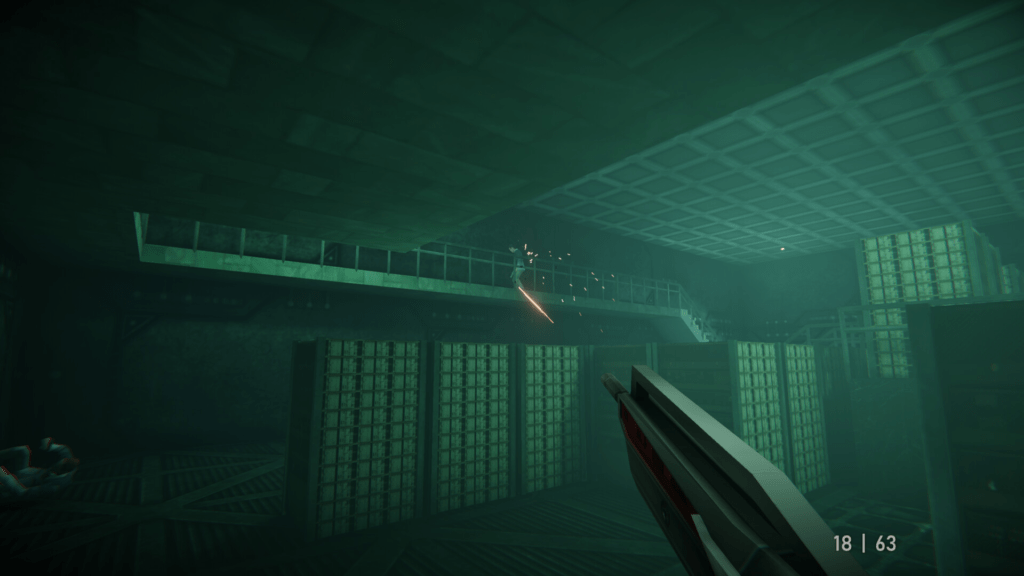
For instance, there are silenced weapons and situations where you can try to avoid drawing attention, but enemy behavior isn’t standardized enough for you to feel like you’ve genuinely become a secret agent. Sometimes you can quietly take out an enemy while another one standing relatively close remains completely oblivious, yet in other situations, opponents seem to react to things you’d never expect. Because of this, stealth functions more as an optional extra than a robust system. Still, when everything clicks, Agent 64 can be wildly fun. There is a specific satisfaction in entering a room, swiftly dropping two enemies, hiding, grabbing what you came for, finding a terminal, and then extracting through the same route before the situation spirals out of control. That is exactly what modern FPS games often forget: the feeling that you are the problem-solver, not just a soldier following a waypoint to the next shootout.
Multiplayer is another area where Agent 64 boasts far more content than you’d expect. The game supports local split-screen, online multiplayer for up to eight players, and the ability to add up to eight bots in certain modes. You’ve got Deathmatch, Briefcase, Zone, and Challenges, alongside deep customization options for lobbies, teams, weapons, rules, and Paradox modifiers. You can even save up to ten different presets, so if you want to create your own totally unhinged version of classic multiplayer, the game gives you plenty of room to experiment. I have to admit that the couch co-op and multiplayer might be the parts that most strongly evoke what made GoldenEye and Perfect Dark so special back in the day. It is hard to replicate that feeling today, when several people sit in the same room, each grabs a controller, and they start hunting each other across the map. Agent 64 brings that feeling back, only now you don’t have to fight against N64 hardware, a lack of controllers, or a tiny screen you had to share. If you have a crew that loves retro FPS games, this is probably the segment you’ll return to the most. I barely managed to gather a few neighbors to try this with me in local multiplayer, but I have to say it is simply fantastic, a totally different vibe because you are playing against someone sitting right next to you, someone you can elbow or glare at when they annoy you. Unfortunately, you just don’t get that in multiplayer games today.

When we talk about graphics, it is very clear what the developer was aiming for. Agent 64 looks like a lost N64 title that never got the chance to be published. The characters are intentionally blocky, textures are blurry, models have distinctly retro proportions, yet it is all merged with modern lighting and certain effects that even bring Perfect Dark to mind. The CRT filter is particularly interesting, further amplifying the illusion that you’re watching the game through an old tube TV. But, as with every segment of this game, nostalgia is a double-edged sword here too. If you love the N64 aesthetic, Agent 64 looks fantastic precisely because it looks “bad”, or rather, authentic to that era of gaming. If you dislike that period of early 3D, you’ll probably wonder why someone in the summer of 2026 made a game that looks like this. It isn’t a technical flaw, but a conscious decision, and it is vital to understand who this game is for. Agent 64 isn’t “retro-inspired” in the sense that it takes old ideas and molds them into a modern game. It is trying very hard to be a brand-new game that could have legitimately existed in that time period. The same goes for the audio. The lack of voice acting might seem a bit unusual for the year of our Lord 2026, but it is completely in line with the attempt to emulate the N64 era. The music follows the same approach, retro melodies that don’t offer too much complexity but fit perfectly into this retro-like title.
We would like to thank Replicant D6 for providing us with a copy of the game for review purposes.
Agent 64: Spies Never Die (PC)
When you put it all together, Agent 64: Spies Never Die is a very specific game. I believe it won't appeal to everyone, not even to every FPS fan, because some might prefer a more modernized retro shooter that takes old ideas and adapts them to contemporary standards. But if you grew up on GoldenEye 007, Perfect Dark, or TimeSplitters and miss exactly that type of FPS experience, Agent 64 offers something that is incredibly hard to find anywhere else today. Best of all, Agent 64 doesn't try to hide the fact that it wants to emulate the old classics; it wears that inspiration proudly on its sleeve, and it shows at every possible turn.
