
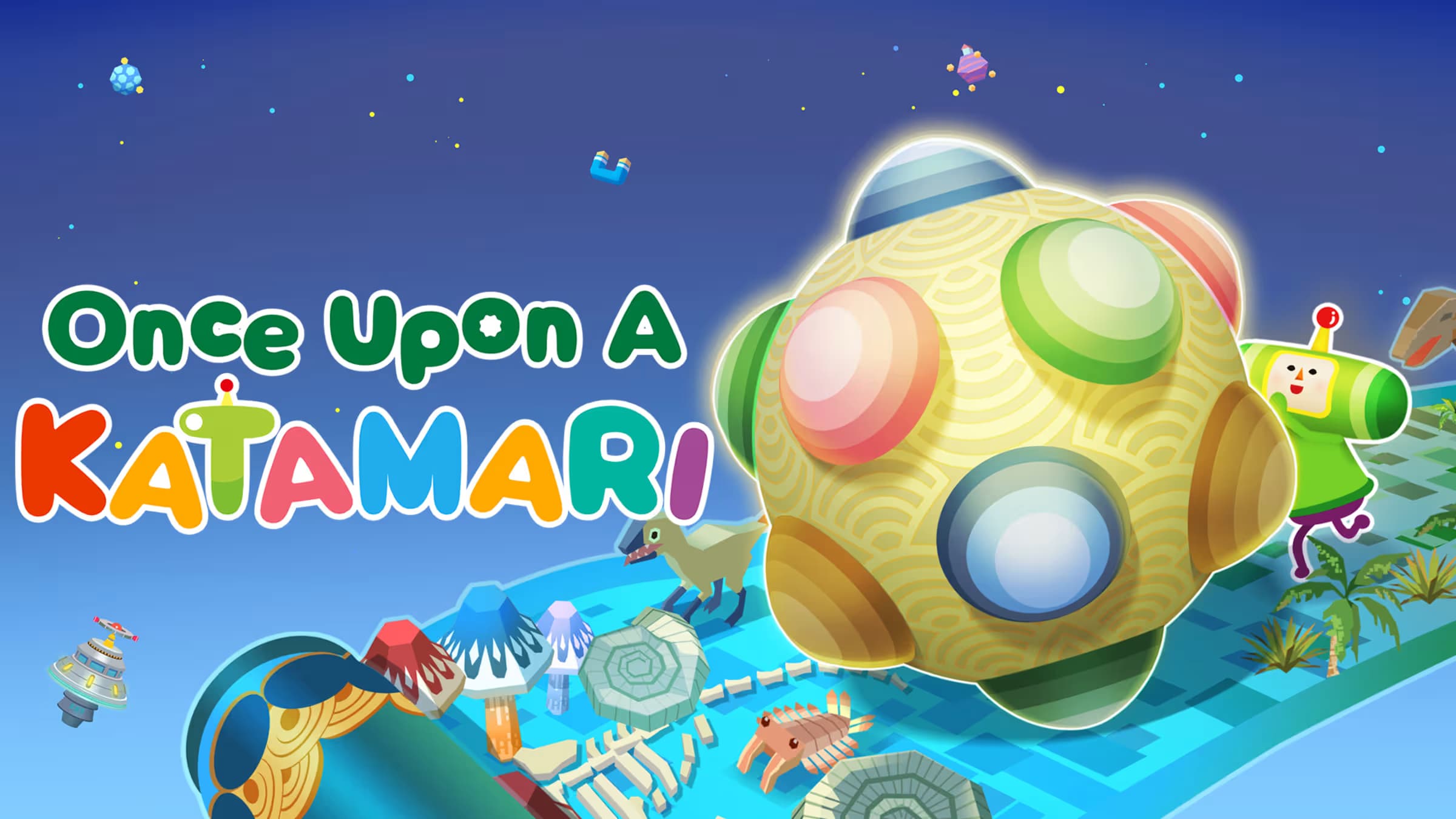

Whenever I talk about why I love video games so much, the KATAMARI Damacy series often comes up as one of my examples. Even more than 20 years after the first game had come out, there’s still nothing like it. It’s not just because Katamari games are so silly, Japanese, but because it’s a wonderful and powerful experience that can always force a smile on my face, even if I’m having the worst day ever.
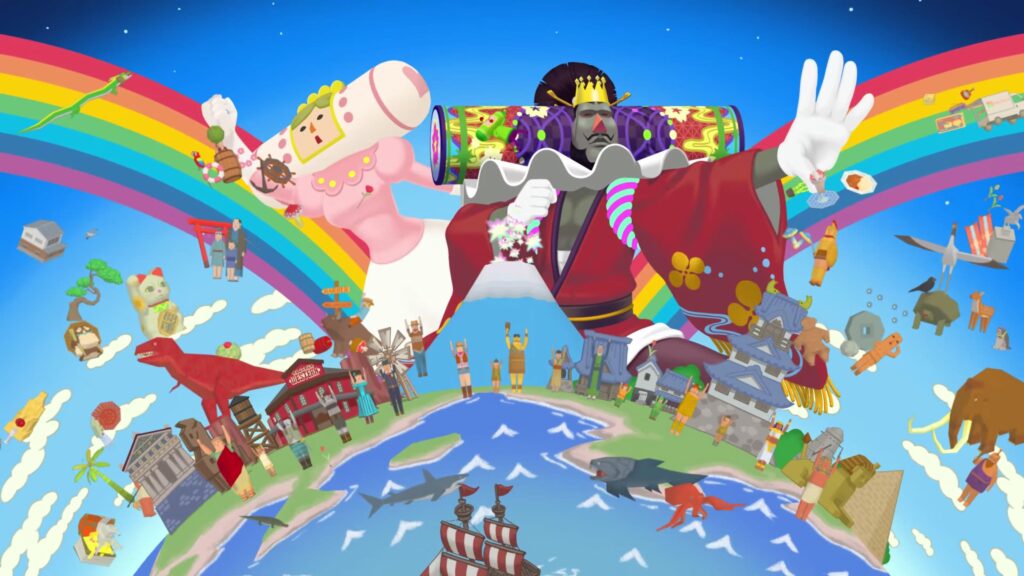
Saying I love Katamari games would be an understatement; I adore them. Even though, they haven’t changed in terms of gameplay, nor graphics for over 20 years now, they still offer an unforgettable, beautiful, funny, and almost therapeutic experience, with lots of love and goodwill sprinkled in. I’m happy to say that the same applies to Once Upon a Katamari, the newest game in the series.
Katamari Monarchy
If this is your first time learning about Katamari, brace yourselves because things are about to get weird. Our galaxy is ruled and protected by the king and queen of cosmos. Think of them as large regal creatures, about 100 times larger than our sun. Their job is to protect and care for everyone in the galaxy. However, like many royal families, they can be a bit stuck-up, posh, wasteful and even a little bit destructive.

In the very first Katamari game (Katamari Damacy for the PlayStation 2, 2004) the king and queen of cosmos danced around the galaxy. In fact, they danced so passionately, that they destroyed all the planets and stars. A similar plot device is used in Once Upon a KATAMARI: while cleaning their royal palace, the king started playing with a cursed scroll, which he tossed high into the air. The scroll opened and sucked up everything in the galaxy.
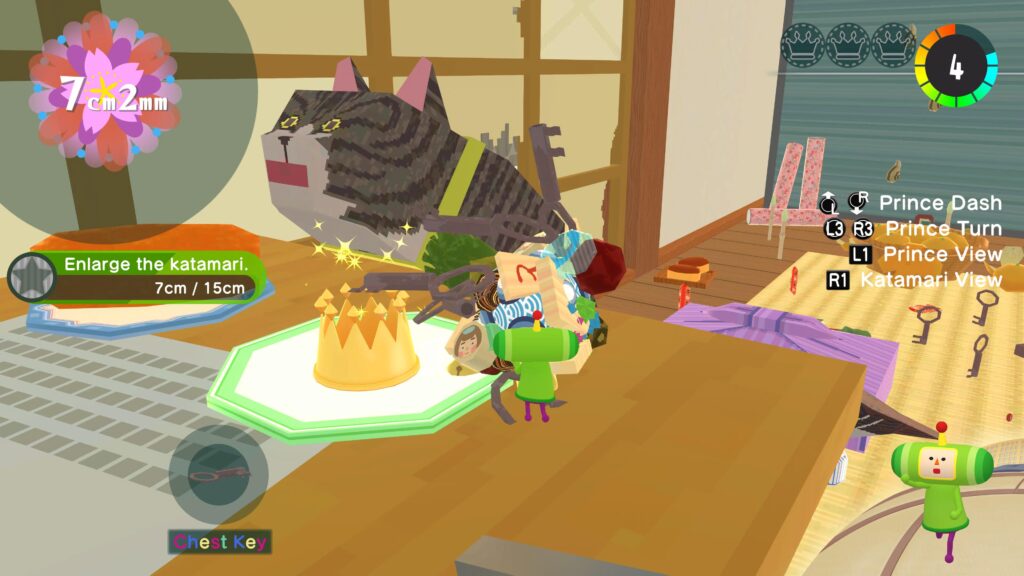
The solution to all of these problems are Katamari balls, but what exactly is a Katamari ball? It’s a sticky ball with a few blunt edges that rotates and collects everything smaller. Just like a snowball, the more it collects as it rolls, the bigger it gets. The bigger it gets, the more it can collect. You start by collecting tiny things, such as paper clips, sugar cubes, erasers but then slowly move on to pens, bottles, books, and so on. If you think it ends, there, OH NO NO NO, a Katamari can grow to enormous sizes, to the point where it can collect people, houses, continents and even planets.
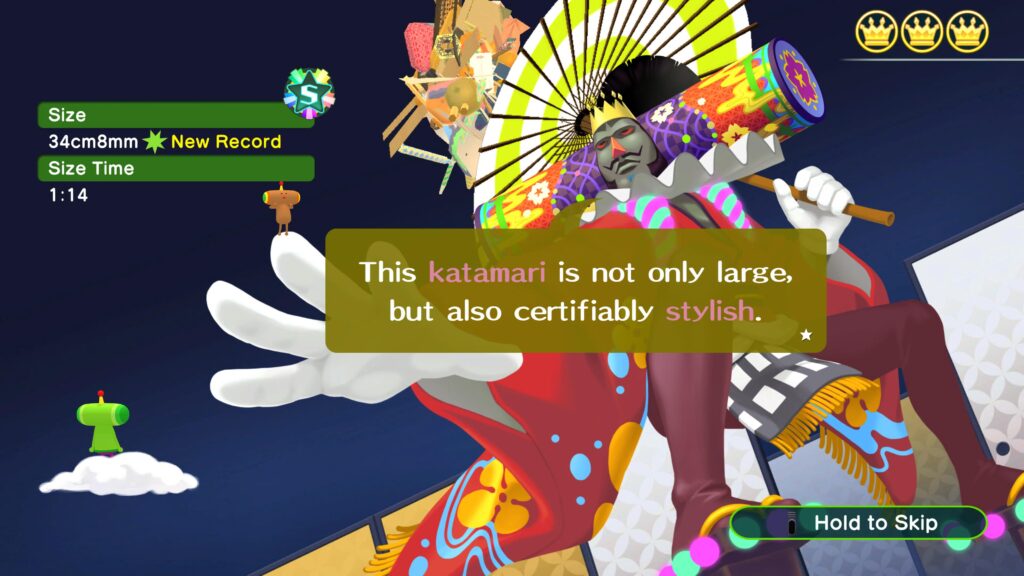
When a Katamari is made, the king of cosmos assesses it, turns it into a planet or a star and sends it into the galaxy, which is how we slowly rebuild planets, or in this case, repair history. It’s important that a Katamari is big enough, and that it has enough beautiful things so it can become a nice planet – but thankfully, the nicest things are all on planet Earth.
You play as the Prince (the son of the king and queen of cosmos) or one of his cousins, and it’s your job to roll these fantastic sticky balls and turn them into beautiful planets.
Everything gets stuck to a Katamari
Just like in previous games in the series, your job is to complete levels where you’ll roll Katamari balls. Most of the time, you’ll need to roll the biggest ones, but the game likes to bend the rules from time to time. For example, sometimes you’ll need to roll only specific types of items, or to collect a certain amount of them. Other times, you’ll need to get to the end of the level, or maybe even roll famous Greek philosophers into a Katamari, and NO, we aren’t joking, the game really is silly like that.
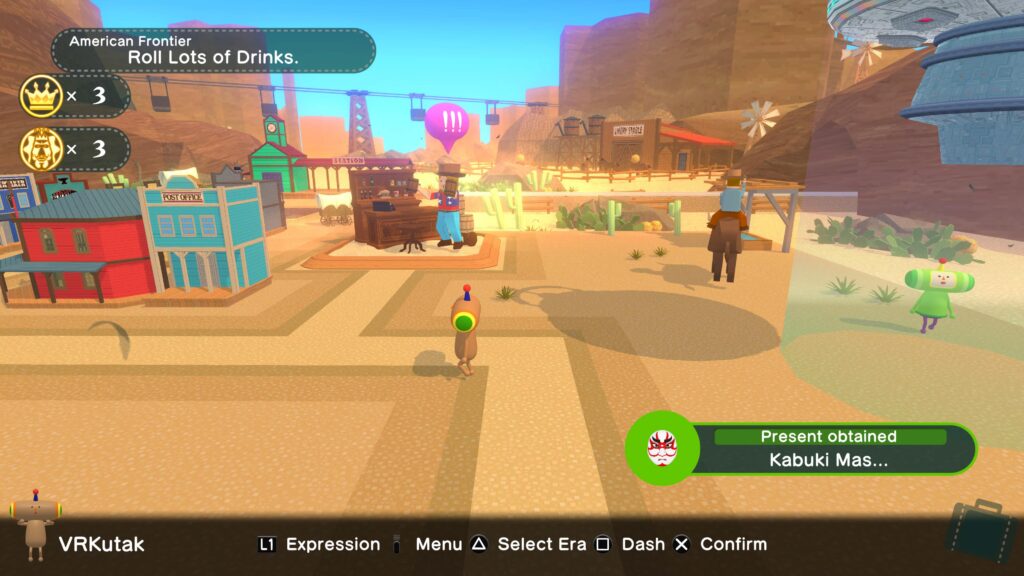
As you complete levels, you unlock new ones, challenges, cosmetics, and you progress the story. What’s interesting about Once Upon a Katamari is you also travel through different time periods. Since the cursed scroll sucked everything from the galaxy, it’s your job to travel through time and rebuild history. You’ll visit time periods such as Edo Japan, Ancient Egypt and Greece, the Stone Age, and many others. Each level only lasts for a couple of minutes and your are scored based on the size or the time it took you to complete a Katamari.
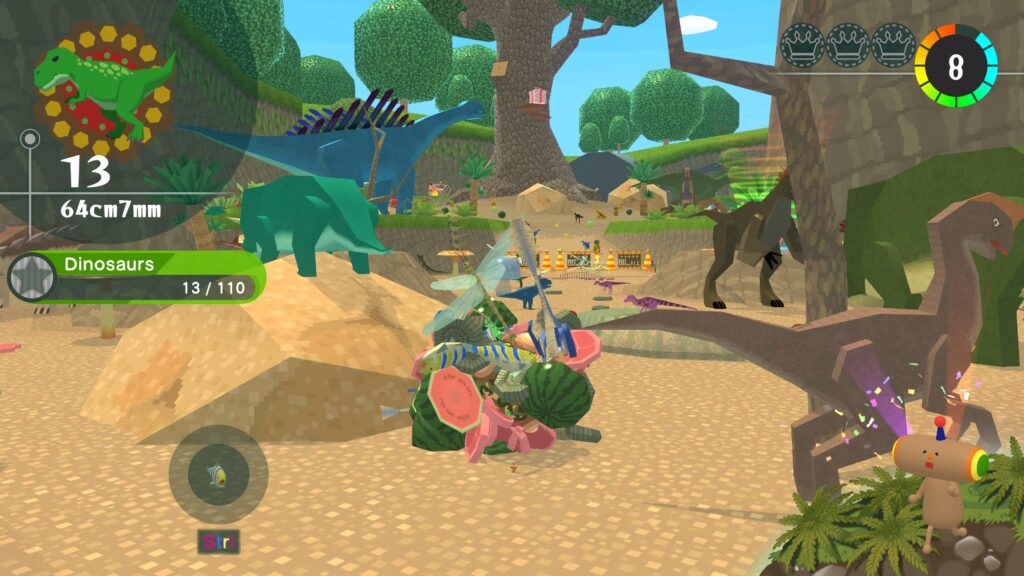
Because of the small time limit, expect that you’ll likely need to replay levels a few times. Sometimes you’ll want a better score, other times you’ll want to collect the hidden crows, or you may just want to listen to a specific level song again (Yes, some of them are quite catchy). Again, saying that rolling a Katamari is fun would be an understatement. It’s even fun to watch someone else play this game just to witness what kind of shenanigans will end up inside the giant sticky ball.
Tank controls for the royal family
When Katamari Damacy first came out, in 2004, it utilized the twin analog sticks on the Dual Shock 2 controller for precise tank controls. Each analog stick is used for one hand which pushes the Katamari ball. If you push up on the left analog stick, the Katamari turns right. If you push the right stick, the Katamari goes left. Only when you push both sticks up at the same time, will the Katamri roll forward. It might sound complicated at first, but this probably the best way to enjoy the game. However, even if you can’t get used to the tank controls, you can always switch to a simpler control method and move your ball with the left stick while you turn with the right one.
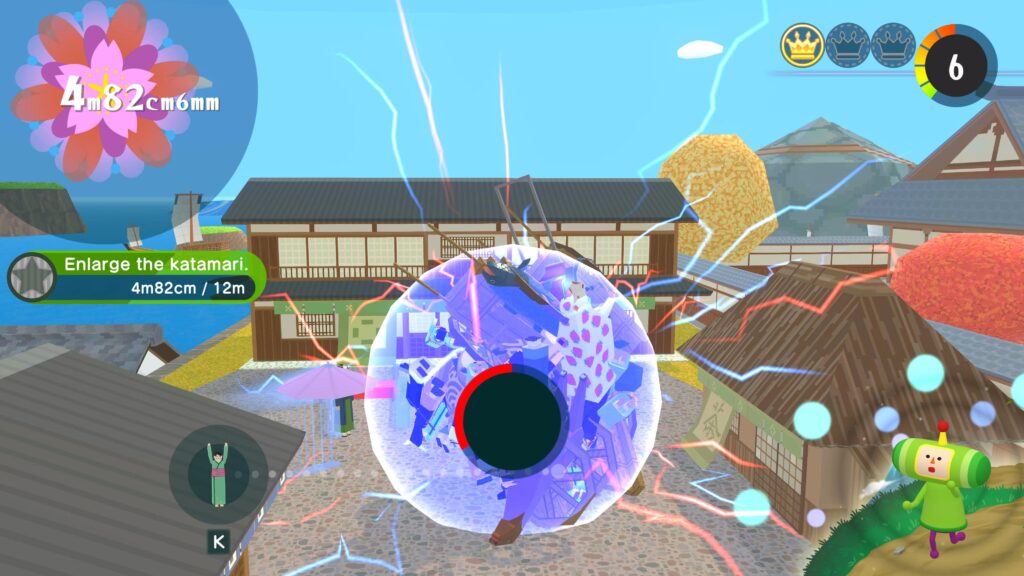
You can also press both sticks at the same time to do a 180 turn, or you can even rock them up and down to get a speed boost. I always found this control method for speeding up to be wonky, so I’m glad the devs added a way to just press the L2 (Left trigger) on the controller as an alternative input.
Once Upon a Katamari also has Power Ups. You’ve got rockets which speed up regular movement, a clock which freezes time for a few seconds, a magnet which attracts all smaller objects to your Katamari (my favorite) and a few others. These Power Ups aren’t necessary but they do add a bit more depth to the levels.
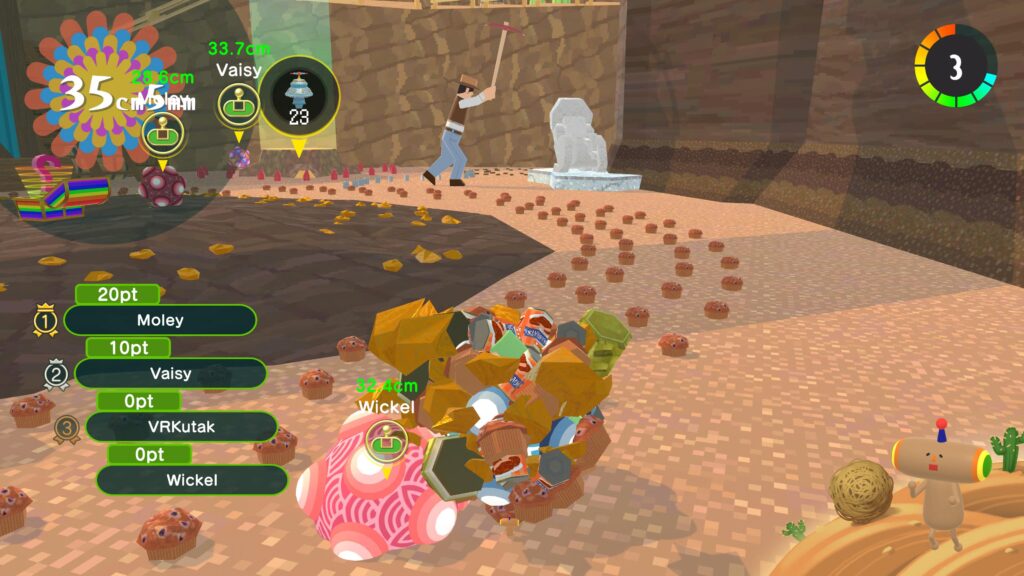
Just like in the last few games in the series, KatamariBall makes a return. In this PvP mini-game you can compete against CPUs or other players to see who can roll and score more points with their Katamari. Unfortunately, these tend to get a bit chaotic, as most players just end up trying to roll the competition into their own Katamari and forget about scoring.
The Iconic graphical style of Katamari games
Katamari games follow their royal traditions by using low-polly 3D assets. The original idea was to help the PlayStation 2 display all these items in one go, but now this graphical downgrade has become the iconic style of Katamari games. That and, if the game were more realistic, it would be kind of creepy, right? I mean, can you imagine rolling realistic people, animals and buildings into a huge ball…

When it comes to performance, the game runs at a stable 60 FPS, even on older harware, like the Nintendo Switch (one). This is all fine and dandy, but there’s one thing that’s been bothering me since the very first game, and the developers refuse to replace it, and it’s the UI. Almost 30% of the screen is used for the UI elements which are gigantic, even on a 4K display. You’ve got a huge chunk in one corner for the size of your Katamari, one huge chunk for where you see your character rolling one, and another chunk for the items you just rolled. But the absolute worst offender is the king of cosmos’s head when it pops at the very middle of your screen to give you tips or even tease you. All these UI elements combined kind of remind me of playing an MMORPG with a bunch of mods installed and I really wish I could turn some of them off. However, the UI is ALSO part of the (outdated) Katamari tradition.

Just like in all the previous games, you can switch from playing the Prince into one of his cousins which you can collect from different levels. You can also customize your very own Katamari character from the body parts you’ve collected, and even customize your ship’s living quarters.
Playing Katamari games, for me, is a unique experience. I always know I’m supposed to roll the ball, that I’ll see silly sights and items, and it makes me happy when I withness my Katamari grow from a tiny marble into a giant ball (of destruction… or maybe love). Simply put: Katamari games make me happy, and I’m glad that this tradition is still alive and healthy, even though it hasn’t changed in more than 20 years now.
Once Upon a Katamari delivers yet another familiar and traditional Katamari game that offered a fun and enjoyable experience. Even though the gameplay of the series has remained the same for over 20 years, this is one of those rare cases where things really don't need to change. If you're a fan, you'll know exactly what you're getting. If you're a new player, have fun rolling your first Katamari balls, and do listen to the king. He may be a bit dramatic, but his heart is in the right place.
