

I absolutely love the Xbox 360 and PlayStation 3 era because it was the time we witnessed the most wild experimentation in the gaming industry. Development teams simply weren’t afraid to pitch and execute crazy ideas. That was also the exact moment we started getting bite-sized games that were unbelievably addictive, the kind you could literally play forever. Geometry Wars, Echochrome, flOw. These were all tiny, yet utterly fantastic games. I genuinely miss that simplicity sometimes. Because while these games may appear simple on the surface, they were notoriously difficult to truly master, maximize your high score, and squeeze out every last drop of what they had to offer. That specific magic of small, perfectly crafted games has somewhat faded, with everyone hyper-focusing on delivering massive, bombastic blockbuster experiences instead. That is exactly why it is always a joy to stumble upon a brilliantly unique game that feels like it was cooked up 10 or 15 years ago, hiding incredibly complex and highly entertaining mechanics beneath its retro surface. Faraway is exactly that kind of title, and over the past few days, we had the absolute pleasure of playing this fantastic gem on the Nintendo Switch 2.

Faraway is the brainchild of Steph Thirion, an independent designer who single-handedly created this entire project, including the programming, design, and music. If you are heavily into mobile gaming, that name might ring a bell, especially for those who remember his 2009 cult-classic Eliss. Even though this game looks exceptionally straightforward, Faraway is by no means an overnight creation. Steph actually had this idea 15 years ago, and it has taken until now for it to be fully realized and delivered to a broader audience. The indie game landscape has changed drastically since then, so it is a perfectly valid question to ask if such a rigidly minimalist concept can still capture people’s attention today. The answer, at least regarding the core idea, is a resounding yes. The real question is how willing modern players will be to adapt to how that idea is physically executed.
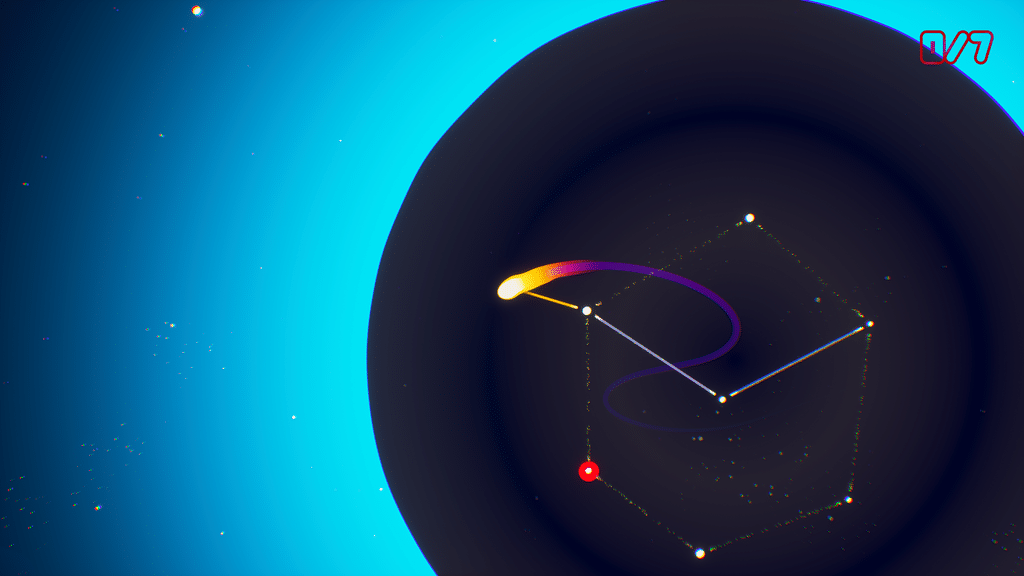
In Faraway, you assume the role of a shooting star desperately trying to prolong its fleeting existence. The cosmos stretches out before you, and the only way to sustain your journey is to connect with other stars and syphon their energy. As you streak across the void, you leave a trail behind you, and by linking different stars together, you draw geometric shapes and constellations. The larger and more complex the constellation, the greater the reward, granting you precious extra seconds to extend your life and chase a higher score. There is no traditional narrative here, no branching story paths, no hyper-realistic graphics, and zero complex control schemes. Everything is beautifully simple. Faraway, and I will likely repeat this a few times, is undeniable proof that a game utilizing the most basic concepts, visuals, mechanics, and presentation can stimulate you emotionally and intellectually just as much as a AAA titan. The sheer concept of playing as a dying shooting star, desperately racing through the cosmos to scavenge just a few more seconds of energy to survive and see what lies in the deep void, is genuinely endearing.
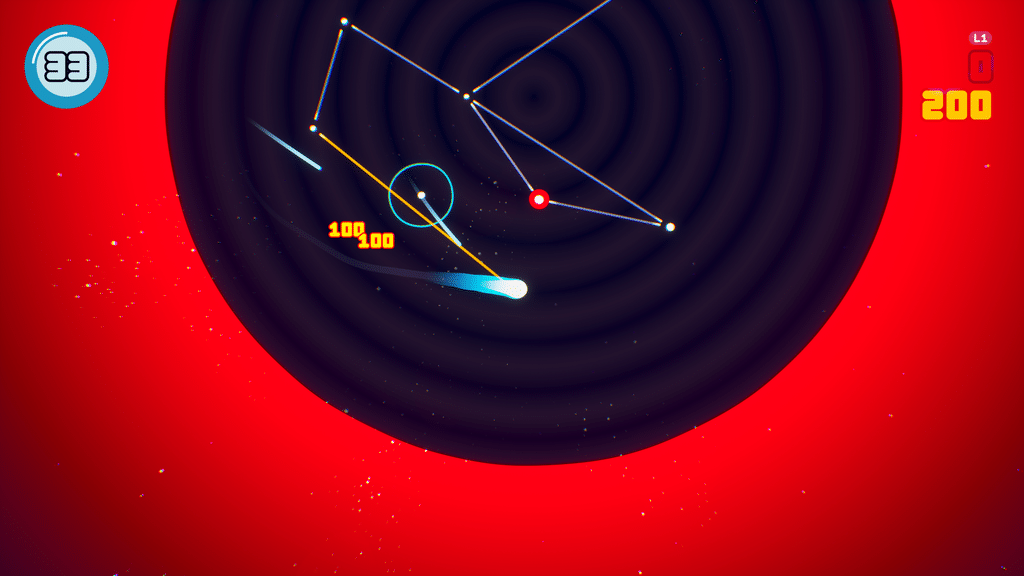
The core mechanic is dead simple, highly unusual, yet remarkably intuitive once it finally clicks in your brain. The star constantly propels itself forward, meaning you don’t steer it in a traditional sense. Instead, pressing a single button activates the gravitational pull of the nearest star, violently yanking you toward it and locking you into its orbit. As long as you hold the button, you continue circling the star. Releasing the button dictates the trajectory and momentum at which you fling yourself back into the void. In other words, you weaponize the gravity of surrounding stars to alter your path, build speed, and slingshot from one point to the next. The entire game is practically controlled with a single button, a highly bold design choice, but one that perfectly aligns with the game’s minimalist philosophy. That single input can literally be any button on your controller. I have to admit, it felt incredibly weird and alien at first, but once I grasped the physics, everything clicked beautifully. Let’s be real, the foundational mechanic isn’t mathematically complex, but you will quickly discover that immensely complicated puzzles are hiding right beneath that simplicity. And yes, I feel completely comfortable calling them puzzles.
Because when you look closely, simply flying through space isn’t the primary goal. The true challenge begins when you enter specific dense sectors packed with star clusters that you must connect to forge a constellation. Every time you latch onto a star, you draw a hard line connecting it to the previous one. This is how you gradually trace the shape of the constellation, but there is one massive catch, a golden rule of star-linking: you cannot cross a line you have already drawn. If your trajectories intersect, or if you accidentally fly out of the designated sector boundary, the constellation collapses. Because of this, you are forced to think three steps ahead, constantly calculating exactly where you will end up after your next slingshot release, and meticulously planning the sequence in which you connect the nodes. Because the more lines you successfully chain together, the more precious seconds you earn to keep your run alive.
What initially looks like a glorified game of cosmic connect-the-dots rapidly evolves into something vastly more engaging. It is not enough to just blindly tag as many stars as possible; how you tag them is what actually matters. The optimal strategy is to visually map out your connections before committing, ideally focusing on the inner core of the shape and carefully tracing the outer perimeter around what you’ve already built, assuming you actually can. Every additional closed loop you draw exponentially multiplies your score, granting x2 or x3 multipliers. Connecting every single star within a sector yields a massive completion bonus. This is where the true depth of the game lies. You can easily half-ass your way through a sector, tagging a few stars and moving on, but if you are hunting for a serious high score, you have to discover a vastly more efficient routing path. Eventually, you stop worrying about just hitting the next star, and start visualizing the entire trajectory in your head, plotting the mathematically perfect path to extract maximum value.
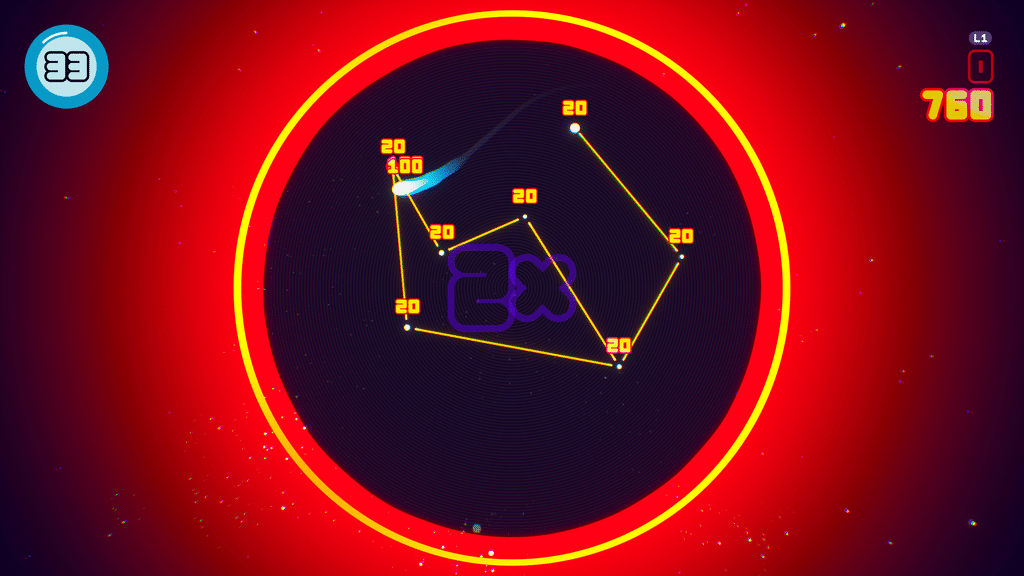
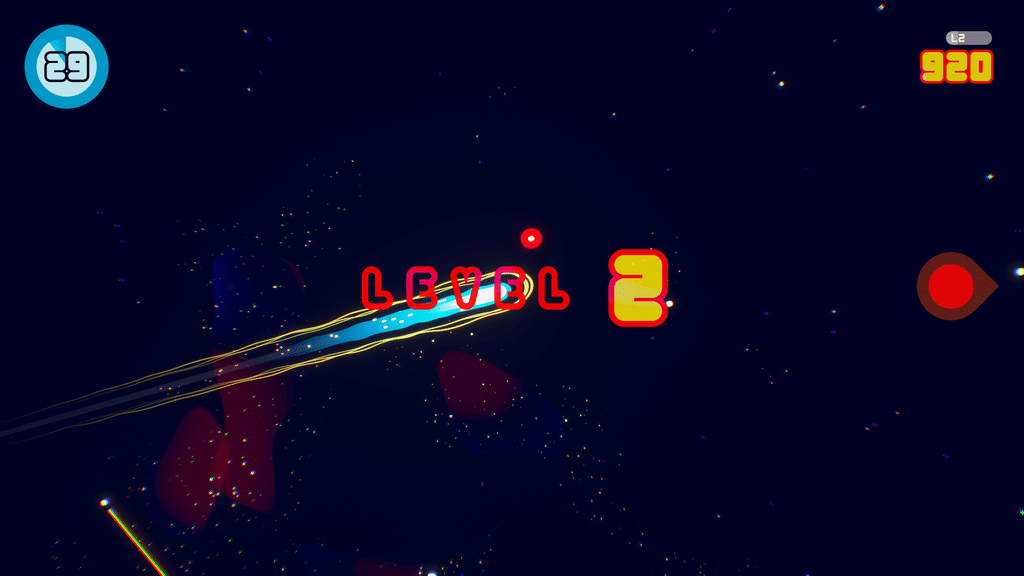
The game features several modes, the primary one being Faraway, which effectively functions as an endless runner. Every run starts from scratch, with the universe procedurally generating as you progress. As your score climbs and you push deeper, the sectors become significantly more demanding, and the sheer volume of stars you need to link increases. Simultaneously, the game speeds up, transforming what initially felt like a relaxing cosmic cruise into a fiercely intense test of concentration and reflexes. Because your time is strictly limited, you don’t have the luxury of staring at a sector for five minutes to analyze it. You have to react instantly, finding the razor-thin balance between how much time you spend hunting for the perfect shape and when to just move on. What I absolutely adore about this mode is that it isn’t just about chasing stars and high scores. The game actively forces you to rewire your brain and change how you think. Early on, you’ll probably feel incredibly proud just for surviving a sector, but you’ll quickly realize that simply surviving isn’t enough if you want a top-tier score. As I mentioned, you have to utilize every star, close your loops, and create as many inner cycles as possible without ever tangling your own flight path. A single split-second decision is the difference between a record-breaking run and a game-over screen. Because of this, Faraway shares that exact same addictive DNA as Tetris: the rules are elementary, but the skill ceiling is virtually non-existent. It’s also worth noting that the moment you enter a constellation zone, time, or rather, your energy, completely pauses, allowing you to link your shapes in peace.
Alongside the main mode, the game offers additional challenges titled Echoes and Ascent. These essentially act as a masterclass for advanced techniques, teaching you the intricacies of the mechanics, though not in the hand-holding way you might expect. Echoes presents you with predefined constellations, showing you the exact shapes you need to try and replicate. This allows you to heavily focus on understanding specific routing techniques without the crushing pressure of a ticking clock or the fear of ruining a perfect run. Instead of mindlessly chasing a high score, you are dissecting the core mechanics and figuring out the mathematically correct order to link the nodes. Ascent, on the other hand, demands that you take everything you just learned and flawlessly execute it. You are handed a constellation and tasked with finding the absolute perfect path in a single attempt, drawing as many closed loops as possible while utilizing every single star. These challenges are brief, but they can be diabolically difficult. Once you fully grasp what the game expects of you, you can clear them rapidly, but finding the actual solution is rarely straightforward. These secondary modes are a crucial piece of the package because they force you to think about the mechanics from a completely different angle, rather than just relying on muscle memory in the endless mode. I’ll admit, Ascent had me physically drawing shapes on a piece of paper trying to calculate the optimal route. I even roped my girlfriend into helping me, and we sat there brainstorming together on how to forge the perfect closed loop.
And this brings us to perhaps the only genuine flaw the game possesses. Because a single button activates the gravitational pull, the game algorithm determines which nearby star actually snags you. In 99% of situations, this works flawlessly. The problem arises when you fly into highly dense, clustered star groups, and things can get slightly messy. You might visualize hooking onto one specific star, but the game decides to violently yank you toward an adjacent one instead. You might have your perfect route mentally mapped out, just wanting to maintain your current trajectory, but the automatic gravity targeting completely derails your plan. I mean, you can technically mitigate this by aggressively bleeding your speed, inching toward each star at a snail’s pace, constantly monitoring the gravity lines, and only releasing the button when you are absolutely certain, thereby completing the constellation safely. However, there is another way to look at this. Perhaps that slight unpredictability is the exact challenge the developer intended. When the game refuses to let you execute your plan perfectly every single time, you are forced to learn how to operate within its rigid rules. Instead of fighting the underlying system, you have to understand it and dynamically adapt your movements. Slow down, speed up, stay calm, and constantly recalculate your next move on the fly. That specific approach can be immensely satisfying for players who love honing their skills, but it will absolutely alienate those who expect the game to behave perfectly predictably at all times. This is exactly why Faraway will likely trigger heavily polarized reactions. For someone like me, every new mechanical revelation, every new routing trick, and every clever way to squeeze a few extra seconds of life out of my shooting star is absolutely thrilling. For others, it will be deeply frustrating when they feel like the game simply “isn’t listening” to their inputs.
The visual presentation is incredibly minimalist, simply put, it is basic. Everything takes place against the pitch-black void of space, while the glowing stars, neon lines, and light flares create a stark contrast that is simultaneously simple and remarkably striking. If you happen to be playing this on an OLED TV or monitor, the sheer vibrancy of those tiny, glowing details will absolutely blow you away. But this is a game that flat-out does not need high-res textures, complex 3D models, or an overload of visual noise. Instead, it weaponizes pure color, light, and motion to perfectly simulate the sensation of hurtling through the cosmos. What I absolutely loved is that this visual style can become incredibly psychedelic, especially when multiple overlapping flight paths and lighting effects start weaving together across the screen. Crucially, all the visual elements are generated in real-time, meaning the presentation isn’t just window dressing, it is a direct, 1-to-1 reflection of your physical inputs. As for the audio, Faraway is dominated by a phenomenal blend of electronic tones, analog synths, and rhythmic beats that dynamically match the game’s tempo, heavily amplifying the feeling that you are trapped in a bizarre, abstract dimension. The music isn’t just there to fill the silence; it seamlessly syncs with your momentum and the sheer intensity of the on-screen action. I have to admit, it is incredibly cool. When you look at the whole package, Faraway manages to build a stellar, deeply immersive atmosphere using an absolute minimum of elements, an atmosphere that will live rent-free in your head long after you’ve put the controller down.
We would like to thank Annapurna Interactive for providing us with a copy of the game for review purposes.
Faraway (Nintendo Switch 2)
When all is said and done, Faraway is one of those rare games where the core concept is infinitely easier to explain than it is to actually master. Steph Thirion has crafted a flawlessly minimalist arcade experience governed by highly strict rules, yet offering a massive ceiling for progression and mechanical mastery. This is the textbook definition of an "easy to play, hard to master" game. Hurtling through space, hooking onto stars, and drawing constellations seems effortless, but the deeper you push, the more you realize how absolutely vital it is to understand every single trajectory and exploit every microsecond. If you appreciate arcade games built on dead-simple mechanics that demand serious time and patience to truly master, Faraway undeniably deserves your attention. Best of all, the sheer rush of dopamine you get when you execute a flawless sector and shatter your high score is incredible. Because of that, I genuinely believe anyone can play this, anyone can love it, and it is absolutely perfect for short, bite-sized sessions. But be warned: you might think it’s going to be a short session, right up until the cosmos completely swallows you in a never-ending quest to draw the perfect constellation.
