

Arc System Works is a company that has traversed a highly fascinating path over the last thirty-some years. Throughout the nineties, they were the challengers who, with their small but highly original Guilty Gear, took aim at fighting game giants like Capcom and SNK. During the 2000s, while they still hadn’t achieved massive mainstream success on consoles, they managed to assert dominance in Japanese arcades. Guilty Gear became a highly respected franchise among enthusiasts, renowned for its quality, deeply intricate combat system, and demanding execution. The situation slowly began to change during the next console generation when they developed an innovative 3D anime graphical technique and started making more accessible games. This landed them a lucrative collaboration with Bandai Namco, resulting in the fantastic Dragon Ball FighterZ. That was the tipping point for ASW to finally gain the reputation and respect they craved (and had long deserved), joining the ranks of the long-standing role models they had looked up to for decades.

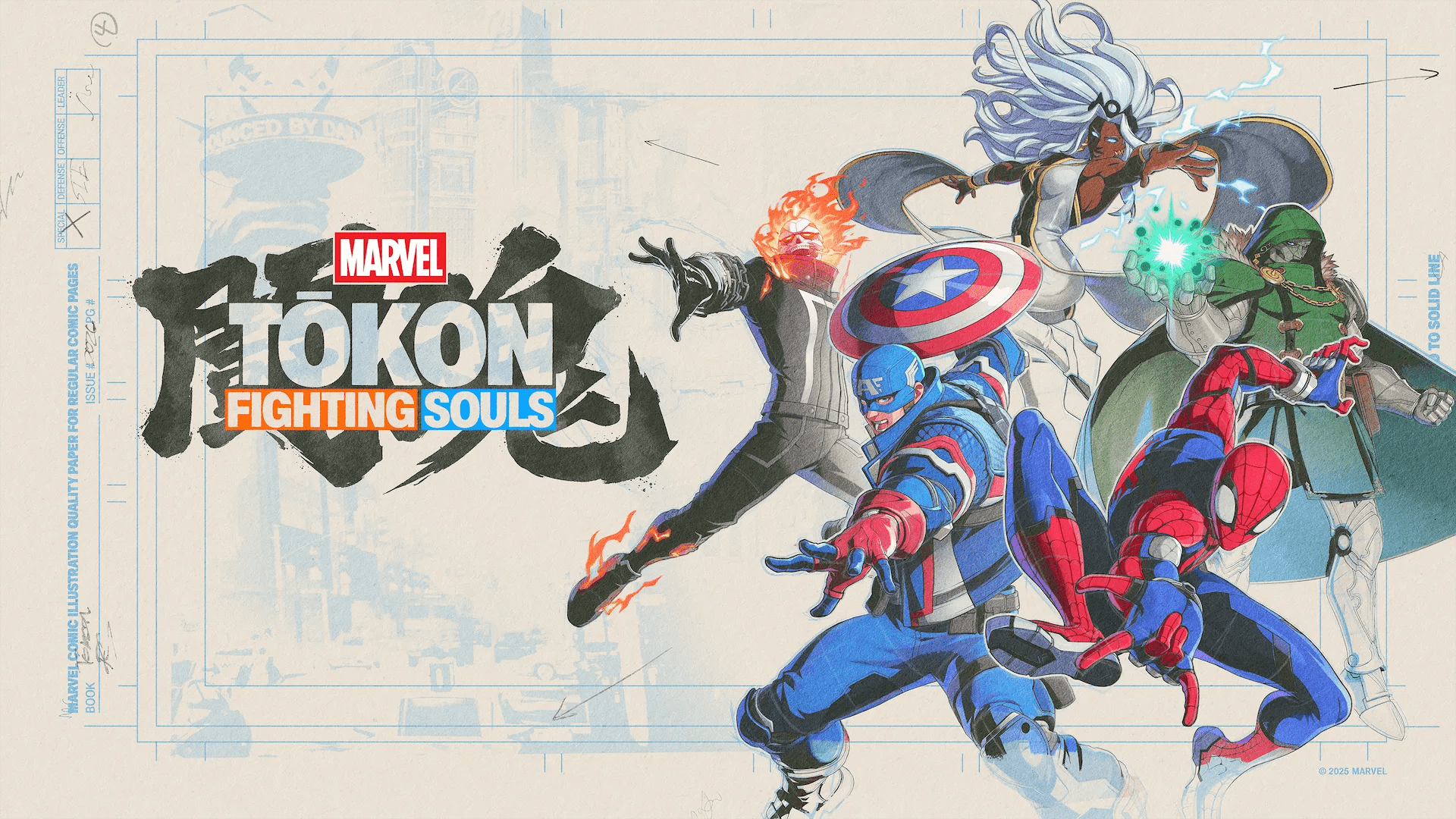
This ultimate rise brought them into a partnership with Sony, whose idea was to create a fighting game featuring Marvel comic characters, but with a distinct Japanese twist. The first thing that stands out is the visual design and art style. ASW earned their Ph.D. in 3D anime graphics a long time ago, and Tokon is an absolute feast for the eyes. The screen bursts with special effects, projectiles fly in every direction, and it’s not uncommon to see 5 or 6 characters on the screen simultaneously. That last point can occasionally impact visual clarity, as in the heat of battle, it isn’t always easy to differentiate exactly which fighter is currently active.
Tokon’s greatest virtue is its roster. Although 20 characters might sound a bit light for a tag fighter, they make up for it through selection and sheer variety. Naturally, there is the standard crew of fan favorites like Spider-Man, Iron Man, Hulk, Wolverine, and Doom, but you will also see a solid number of genre debutants such as Magik, Loki, Blade, Peni Parker, and Carnage. Furthermore, even the regular crew doesn’t always show up in their classic iterations. The title of Black Panther is held here by Shuri, and Ghost Rider is Robbie Reyes. And since the main directive was the “Japanization” of Marvel, the Iron Man armor now sports details that irresistibly bring a Gundam mech to mind. A special attraction is Deadpool, who uses his fourth-wall-breaking powers to “borrow” iconic moves from other famous fighting games.

The game’s premise is simple and doesn’t stray far from many other fighting games and anime tropes. A powerful fighter from deep space, none other than the Champion of the Universe, wants to test Earth’s mightiest heroes; if they fail to prove themselves, their planet will be wiped out. As is usually the case, the heroes divide into teams and measure their strength for the honor of facing the Champion. The Story mode is fairly straightforward, told through a mix of comic book-style panels and animated sequences, punctuated by occasional fights where you control your team.
Tokon features a standard control scheme consisting of Light, Medium, and Heavy attacks that traditionally string together in ascending order of power. However, what truly differentiates the characters, their main gimmick, is expressed through the ‘U’ button. For Spider-Man, it’s his webs, allowing him to dart across the arena quickly and snare opponents. Loki, being a trickster, can use illusions to deceive his opponent and bait mistakes. Perhaps the most interesting is the Green Goblin, whose glider is phenomenally integrated into his moveset.

As modern times dictate, the game also features a simplified control scheme baked directly into the standard one, a system ASW has utilized in their previous titles. Simply mashing a button of the same attack strength will cause your character to execute simple combos that end with a wall break or a stronger special attack, while individual special attacks are performed by holding a direction along with the special button. New players will also benefit from a highly detailed (albeit slightly exhausting) tutorial that meticulously explains all the fundamentals of fighting games, as well as the specific mechanics unique to Tokon.
What sets Tokon apart the most from other tag fighters is that the entire team shares a single health bar. In theory, at least, this should make things a bit easier since it’s entirely possible to play a whole match using only one character, leaving the rest to serve strictly as assists. Assist commands vary depending on how you positioned your team before the match begins (shooter, vertical, and assault), as well as how the situation develops mid-fight. You don’t have access to all your fighters at the start; only two are available. Additional fighters are unlocked if you successfully pull off a combo that ends by launching the opponent into another arena, or after losing a round.

Even though you can play the whole match with just one character, unlocking the others is crucial because it increases your health bar, grants extra uses of assist attacks, which are essential for covering the weaknesses of your active fighter, keeps the opponent under constant pressure, and maximizes damage output. Another highly important system mechanic is the Crossover, which allows a fighter under heavy pressure to repel the opposing team’s attacks. However, this comes with a risk, as the opponent can counter it with a Crossover Reflect, which “shatters” your team and temporarily locks out all your assists. This adds significantly to the combat dynamics; those moments when you manage to get into your opponent’s head and counter them at the perfect time are incredibly fun and can completely flip the outcome of a match.
The game’s depth, and what will largely dictate the meta and player skill expression, is most apparent in the fact that after an assist attack, the assisting character remains in the arena for a few more seconds. During that window, you can decide whether you want to fully tag them into the fight, activating your main character’s special attack during that time to cover the entry safely. All of this sounds complicated, and it is, but because the game is generally accessible and doesn’t demand top-tier execution, it provides the much-needed depth that dedicated players crave.

The multiplayer mode is designed in a style ASW initiated long ago with the Guilty Gear Xrd games, where you guide your chibi avatar through familiar locations from the Marvel universe, searching for open arcade cabinets to face off against opponents. In 2026, this might be a little silly since we now have entire generations of players who have never even seen a physical arcade cabinet in person, but it remains a charming and nostalgic experience.
Unfortunately, multiplayer is currently the most problematic aspect of the game. Matchmaking can sometimes take 10 to 15 minutes, and even when a match does start, the rollback netcode sometimes rolls back way too many frames for the experience to be enjoyable, especially if the PC version of the game is factored into the equation. This can be partially mitigated by turning off the crossplay option, but it doesn’t eliminate the issue entirely. The PC version is also plagued by numerous performance problems stemming from highly aggressive DRM protection. ASW has already stated they are working on it, but the damage is done; the first few weeks are critical for establishing a strong player base, and launch issues like these can cut the legs out from under a game that is supposed to live off its multiplayer for years to come.

We would like to thank PlayStation for providing us with a copy of the game for review purposes.
