


We’ve kinda gotten used to survival games where we’re the humans, intruders on some planet or in some environment. Most games boil down to that: a person stranded in a weird, unusual, or even everyday setting, just trying to survive. But hardly any game, if any, covers a slightly different angle on survival: how would an alien survive on planet Earth? Pretty intriguing setup, I gotta admit, and that’s the first thing that hooked me about Astrobotanica, the first game from Space Goblin Studios. A reversed perspective on survival and exploring the whole world, packed into a super chill, relaxing survival game.
As I said in the intro, in Astrobotanica you’re an alien who crash-lands on Earth in the distant past. All sorts of weird prehistoric creatures are still roaming the planet, along with plants not everyone knows about, and of course Neanderthals who are pretty shocked by your presence. You’re a Space Goblin (I’d like to think it’s a little blue space goblin because of the studio’s name) who’s come to explore our planet Earth, examine its flora and fauna, learn as much as possible about it, and of course, manage to survive. Though it’s not that simple, ’cause the main thing you gotta watch out for here is the air that our little alien can’t breathe. But let’s start with the most basic stuff: the gameplay.
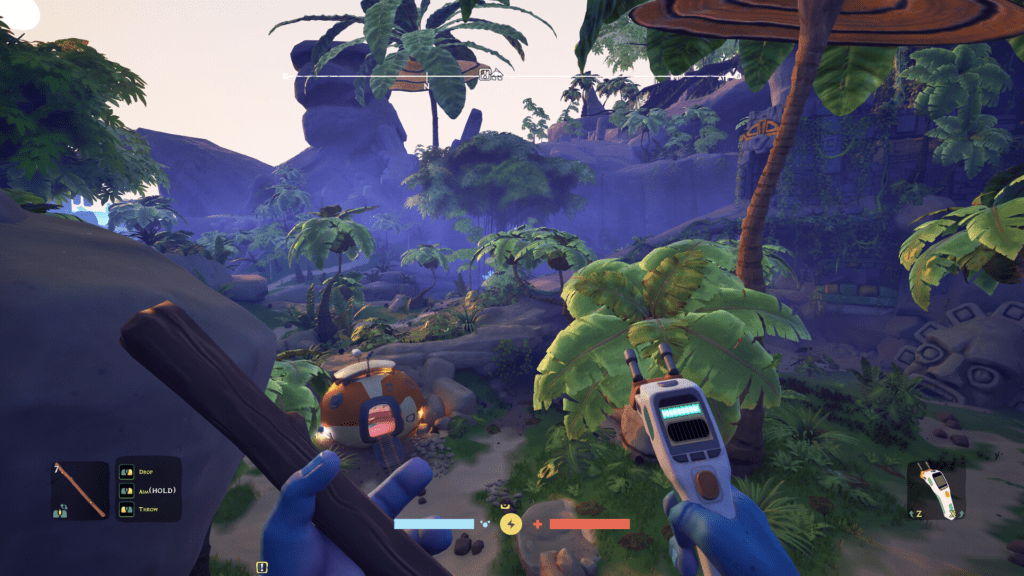
The gameplay in ASTROBOTANICA is a chill type of survival focused on science and botanical survival, not combat or hardcore resource grinding just to see the next day. Instead of chopping trees and mining rocks, you’re an alien botanist who scans, experiments, grows plants, and builds a base to survive on an oxygen-rich planet that’s poison to you. I played it before the full Early Access phase on the ROG Ally X console, and I can say it was a pretty smooth experience. Movement is nicely smooth and fluid, since it’s not some hardcore survival, everything’s relaxed; you’ve got time to explore, get to know the surroundings, and figure out what to do on this weird blue planet Earth. At the start, honestly, I had no clue what to do, which is probably normal for a survival game, but as time went on, I started grasping how things work. This might’ve happened ’cause the tutorial is kinda “weak,” if I can put it that way. Plus, the UI has some weird choices and doesn’t always give info in the best way, crucial info about starting survival on the planet that I needed to really get into the game. But like I said, once I sat down and spent a couple hours testing everything given to me, the enjoyment kicked in.

You start the game at the spot where your spaceship crashed, which also serves as your mini-base. At the beginning, you’ve just got a small scanner and a few square meters around the wreckage. The scanner shows you which plants you can harvest, what they do, and how to use them. You pick leaves, seeds, roots, anything that can turn into useful stuff. Wanna extend how long you can breathe? Immediately start making tonics that fill your lungs with CO2. One plant gives breathing gas, another boosts your strength so you run faster, a third heals scratches from thorns or poisonous spines. You mix it all in a little machine called the Medicine Maker (literally). Early game it’s simple: one plant for one tonic. But later it turns into real chemistry experiments where you combine multiple ingredients for stronger or special effects.
Once you get your bearings, you start building your base. No need to chop trees with an axe, you use what you find: stones, branches, even plants that grow fast and become walls or floors. Building is relaxed, so you can make a little garden, fence it off so animals don’t wreck it, add a bed for sleeping and shelves for storage. Over time your base becomes a real little paradise full of glowing plants that help you breathe and recover. The animals are cute, dodo birds, mammoths, tiny rodents, they don’t attack you directly, but if you don’t fence your crops, they’ll eat ’em or trample them. You can tame them with food, and then they help you, like birds bringing seeds from afar. The most interesting part is encountering Neanderthals. Primitive humans in small groups. When you find them, you scan ’em and see they’re sick or injured. If you wanna help, you gotta make the exact remedy: scan symptoms, try different plants till you nail the right recipe, then give ’em the tonic. Once you heal them, they become allies: give you tools, food, and even show hidden stuff. It’s not just “bring me three leaves”, it’s a real scientific challenge where you think about what each plant does.

Exploration is what pulls you forward the most. The island you’re on is huge, full of different landscapes: dense forests, sandy dunes, swamps, caves. Everywhere there are hidden things: stone totems, idols, tablets with puzzles. Most puzzles are with crystal orbs, you gotta push ’em to specific spots to open paths or clear fog on the map. You do everything without weapons, mostly using plants: throw ’em to stun attacking flowers or gaseous ones to light up dark caves. The best thing about all this is you’ve got so much to explore, so much to find, so many puzzles to solve, it’s unbelievable. When you start the game, you get that feeling like, okay this is pretty easy, simple, small game. But as time passes, you realize how much this “small” game at first glance has tons of stuff to complete, discover, explore. And then it becomes like a second life, and I don’t mean that in a bad way, but something that makes you wanna play, let go, and enjoy. No stress, no “must-do” or whatever, just casually walking prehistoric Earth and chilling. And all those puzzles you find are super cool, they introduce you to Neanderthal culture, the world’s rules from the prehistoric people’s angle; it’s all done so nicely and pleasantly.

You learn skills through the “P.R.I.M.A.L.” tree, which is also your scientific progress, kinda the goal of this game. Every time you discover something new or complete a task, you get knowledge points to spend on upgrades: run faster, harvest more at once, carry more in your backpack, better adapt to the poisonous air. Early on it’s tough ’cause the backpack fills up quick, but once you unlock bigger storage, everything gets easier and more chill. Everything’s kinda scientific and exploratory, no rush, no constant fight for life. It all boils down to studying plants, experimenting, building your little garden, and helping Neanderthals while slowly uncovering the island’s secrets. Early Access is still a bit raw, sometimes you get stuck ’cause of the weak tutorial, backpack’s too small at start, and occasionally the game stutters for a few seconds, but that feeling of being a real scientist shaping the world around you is incredible. And I think that’s the point of this title: relax with it, not chase and stress nonstop over whatever.
As for performance and the game’s overall look, this isn’t a title where the graphics need to be photorealistic, but it’s really pleasant and nicely stylised. At no point did I feel uncomfortable or had to comment like, eh this is kinda lame. The whole presentation is in a cartoonish style, which is totally fine for a game like this. The graphics are super pleasant, with great lighting, day-night cycle, and awesome shadows. I gotta mention I played it on ROG Ally X, not on a regular PC, and it ran great. Yeah, I tinkered a bit with the settings to lock 60fps, but it was worth it—’cause if I hadn’t played in handheld mode, I doubt it’d feel this smooth.

In the end, even though Early Access for Astrobotanica just kicked off, everything feels so nice and promising. Haven’t played a game in a long time that relaxed me this much. And you’re in a totally different role. Or rather, it doesn’t have to be an alien, because honestly, if we got teleported to the distant past, we’d be just as lost as our little blue goblin in this game. So if that “unrealistic” part bugs you, think how you’d be even more lost in the same situation and dive into studying the secrets of prehistoric Earth. And don’t forget to check out the game on Steam and add it to your Wishlist.
