


It’s always exciting when a major studio decides to create a brand-new IP. These days, actually, for years now, most companies lean heavily on their proven franchises, and Capcom is no exception. We have Resident Evil titles coming from every direction, Onimusha revived from the grave with remasters and a brand-new instalment arriving this year, and Mega Man getting a proper refresh as well, with both remasters and a new release. So yes, it’s all “new,” but still old, familiar, and safe. And in that sea of recognisable names, Pragmata emerged. A title first announced back in 2020, originally slated for a 2021 or 2022 release, only to completely vanish afterwards. Many of us assumed that was the end of it, especially since at the time it was Capcom’s first original IP announcement in eight years (as of 2020, since 2012). In today’s gaming industry, new IPs are rare, and that’s precisely why many believed Capcom had quietly killed Pragmata. Until last year’s Gamescom, when we finally got to play it, and I have to admit, even alongside titles like Resident Evil Requiem and Onimusha: Way of the Sword, Pragmata impressed me the most.
Mostly because it showcased something entirely new, different, and unconventional for a third-person shooter. At the time, we all assumed Pragmata was “just” that, a third-person shooter. Now, more than six months after Gamescom, we finally had the chance to play Pragmata in its pre-release period and see what the game truly offers, what it’s made of, and whether this could be Capcom’s first new IP in years to evolve into something bigger, maybe even a full-fledged franchise. So let’s start from the beginning.
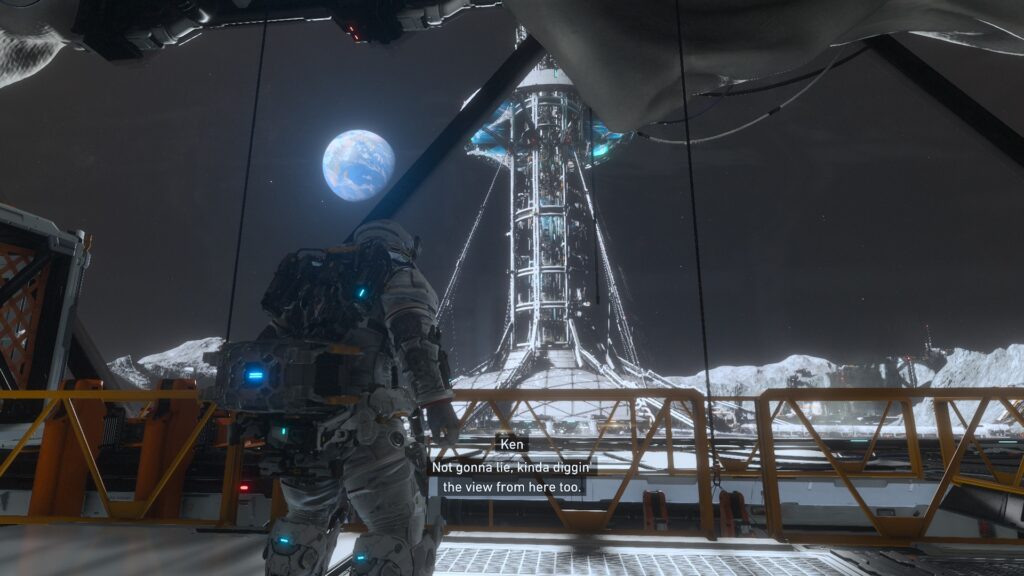
Pragmata takes place on the Moon. You are part of a team sent there to investigate why communication with a scientific colony has suddenly ceased. Humanity is in the process of building its first large-scale lunar colony, thanks to a resource discovered on the Moon. This material allows massive 3D printers to create virtually anything one could imagine. The material, called Lumofilament, is so versatile that it enables the construction of entire city replicas, forests, and other environments in order to make the Moon habitable. However, shortly after your team arrives, it becomes clear that something is very wrong. All projects have stopped. The people have vanished. And when a moonquake strikes, you are separated from your team, leaving Hugh alone to restore communication with Earth and find a way back home. At that moment, you realize that humanity’s primary helpers, the androids, have turned against you. Survival on the Moon will not be easy. But just then, your adventure gains an unexpected companion: an advanced humanoid android designated D-I-0336-7, or, as Hugh names her, Diana.
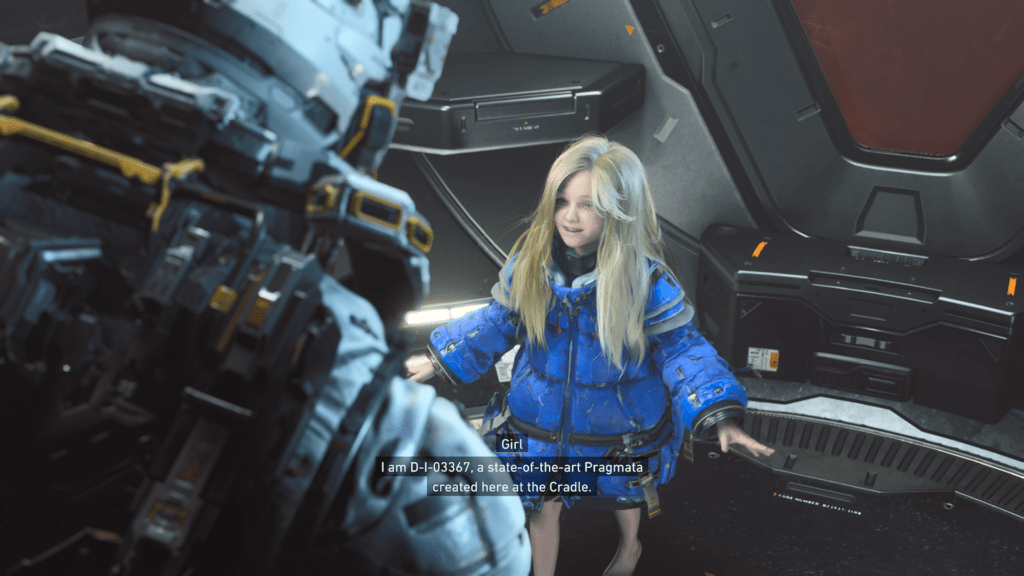
Diana and Hugh form one of the most interesting and genuinely heartwarming duos I’ve seen in a game. Hugh cannot progress without Diana, and Diana needs someone to teach her, well, everything. She was created as an android who looks like a seven-year-old girl, and that setup works perfectly, because a new AI that knows absolutely nothing about the world must learn about it somehow, just like a seven-year-old child would. Their interaction feels incredibly natural, to the point where both you and Hugh occasionally forget that Diana is, in fact, a small robotic being crucial to your survival. As time passes, Hugh teaches her about life, about Earth, about his habits and experiences, much like a father would with his young daughter. Their dynamic is warm, touching, and at times genuinely moving. Because of that, beyond everything else it is, Pragmata becomes a beautiful and surprisingly tender adventure centered on these two protagonists.
At its core, I found the story very compelling. Some elements are slightly predictable, but I really appreciated the environmental storytelling, the narrative told through the surroundings and everything you discover throughout the levels. You can find emails on terminals and computers once used by scientists, as well as holographic recordings of major events. These details further deepen and clarify what happened on the Moon before your arrival. Technically, you can complete the game without collecting all of this, but these elements provide valuable context and round out the bigger picture. They also unlock new dialogue between Hugh and Diana, allowing you to hear their perspectives on the events that took place before you ever set foot on the Moon.
Fundamentally, Pragmata is a third-person adventure infused with metroidvania elements, excellent level design, and strong action mechanics. Most players reading this have probably tried the demo or at least watched some gameplay, so you’re likely familiar with the basic rhythm. In order to destroy hostile androids, Hugh must rely on Diana, who has the ability to disable their defensive systems. This is done through a Grid interface that appears on the right side of the screen, resembling a puzzle, at least at first glance. Within the Grid are nodes you must reach or collect in order to disable an android’s defenses. Only then can you properly unleash your firepower. Even then, simply shooting anywhere won’t be effective, you must identify each android’s weak points.
The Grid puzzle system, which appears at the start and during combat encounters, is something entirely new and unique to this title. It fundamentally changes the game’s combat dynamics. Honestly, I can’t recall another shooter that has incorporated a mechanic like this, and made it work so well. Diana’s hack doesn’t last forever, so you must repeat the process during fights until the enemy is destroyed. I know this was a potential dealbreaker for some players, how could that remain engaging after the first few hours? The key is that as the game progresses, the puzzles grow more complex, the Grid expands, and you gain the ability to insert various nodes that increase hacking efficiency. You still need to reach the primary objective node, but along the way, you can collect modifiers that grant bonuses, overheating androids, linking hacks across multiple enemies so they reveal their weak points simultaneously, causing confusion that makes androids attack each other, staggering them, and more. Hacks don’t just break defences; they can also deal direct damage. You can choose offensive Grid setups with nodes that inflict significant harm. And that’s extremely important.
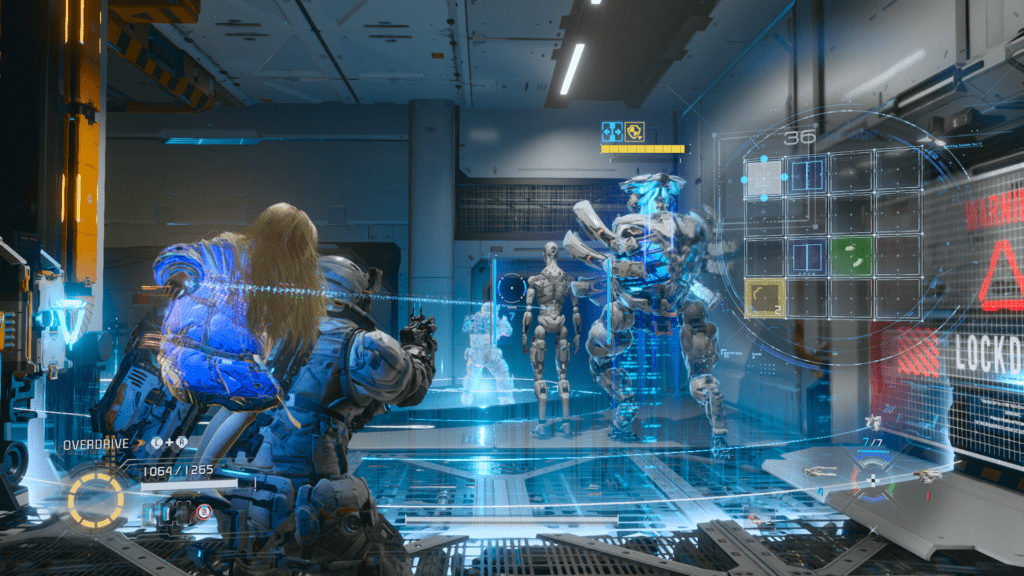
Hugh’s primary weapon has a limited ammo capacity and cannot be reloaded manually; instead, its ammunition regenerates over time. This makes continued hacking essential, not just to disable defenses, but to deal meaningful damage. Later in the game, hacking can even open up opportunities for what you might call a “fatal blow.” These brief moments, triggered by overheating or fully disrupting an enemy, allow you to unleash devastating damage. Sometimes this will destroy an android outright; other times, it will reduce its health enough to give you breathing room before the next encounter.
So hacking and shooting are actually dependent on one another, and later on, as you begin finding new nodes that you can carry into combat, every encounter with the Androids starts to gain that strategic, tactical edge. You have to plan when to use a specific hack on certain enemies, which nodes to save for tougher opponents, how to extend the duration of a hack, and so on. Because of that, the game constantly pushes you to think about how to approach the next fight and which of the tools you have on hand should be used against weaker enemies and which should be reserved for stronger ones.
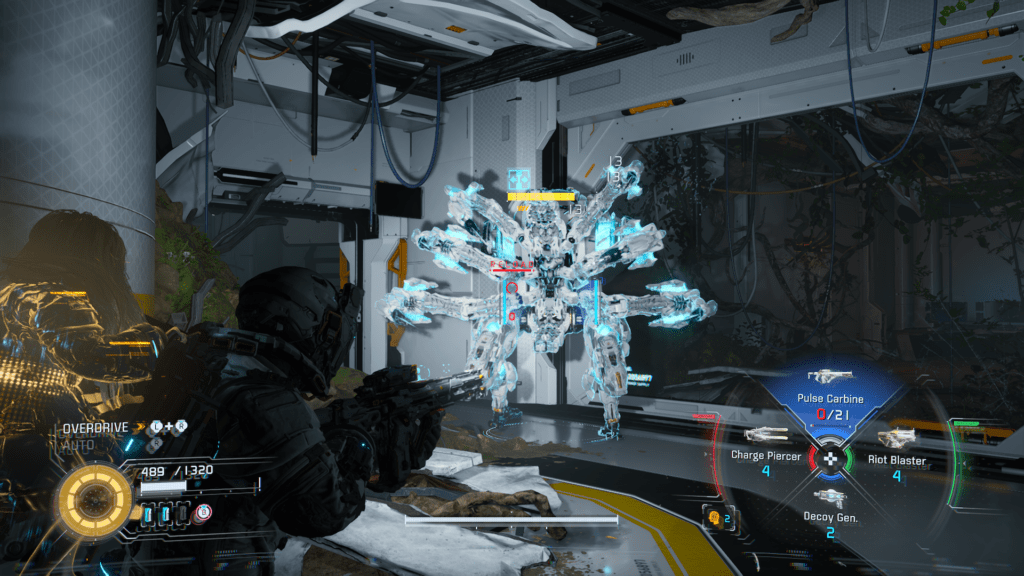
At the beginning, you’ll have a limited number of hacking modules at your disposal. For example, three nodes that allow you to deal increased damage to enemies, two that let you spread a single hack across several Androids standing next to each other, two or three that cause a robot to overheat, and so on. You’ll also find these nodes throughout the levels, and they’ll appear as drops when you defeat certain enemies. Another very useful mechanic is that every Hack you perform fills Diana’s hacking gauge. Once it’s full, you can unleash a powerful attack with a single click, dealing massive damage to all Androids around you while also “opening” them up for regular attacks, essentially functioning as a kind of special move.
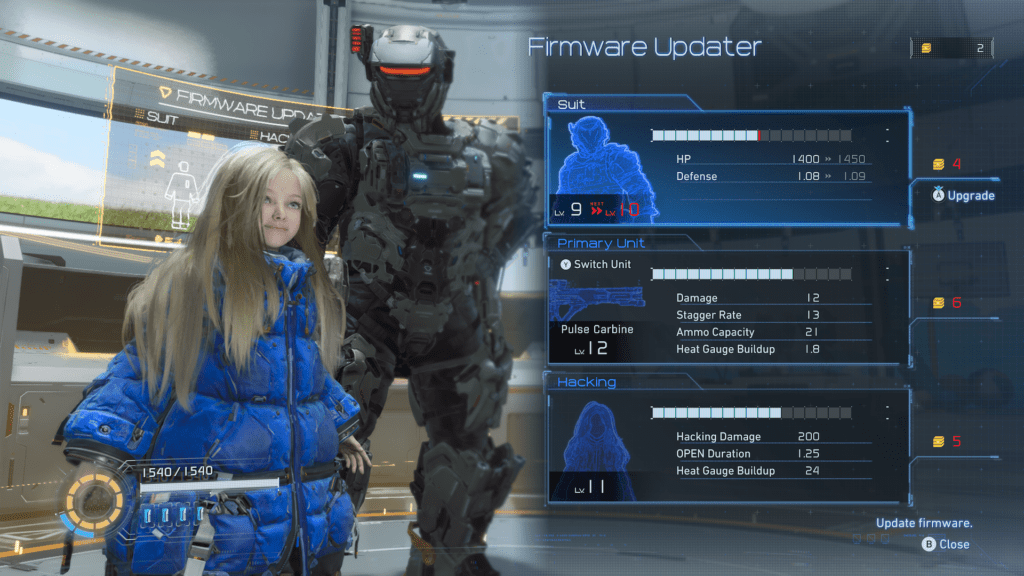
When you start the game, Hugh can carry only one hacking node at a time. Over time, however, as you gather materials to upgrade your suit, you’ll be able to expand your inventory and carry more nodes that you discover. In addition, there are suit modifications you can equip, which grant small, subtle, but very useful bonuses. For example, 10% increased damage to enemies within 10 meters, 30% increased hacking range with Diana, and so on. All of this shapes your playstyle, because every single mod and hacking node essentially functions like building your own class in another game. They provide specific bonuses and determine how you approach each fight.
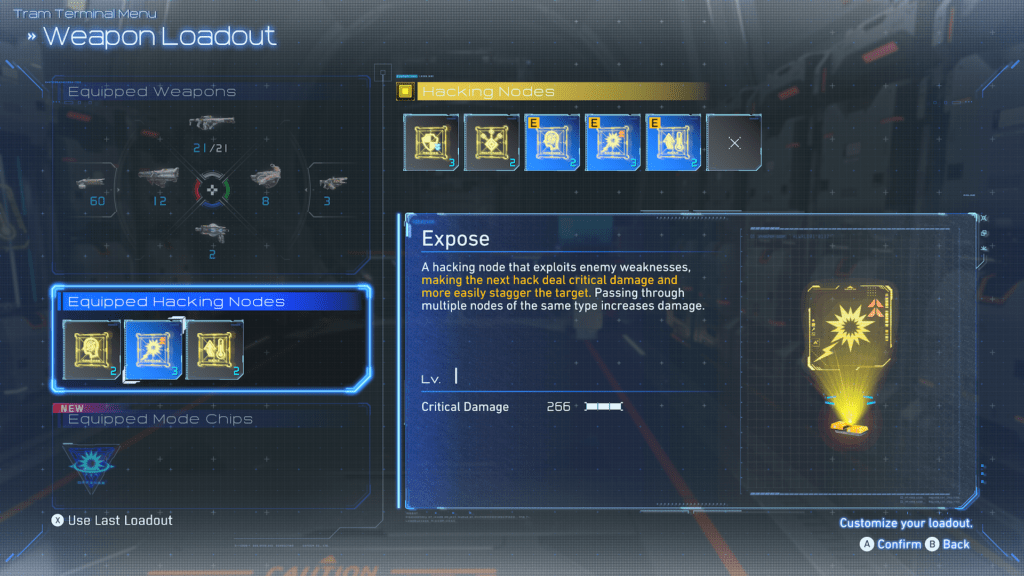
If you prefer close-quarters, more personal combat with Androids, you can create a build that allows you to be more aggressive. If you feel more comfortable keeping your distance from charging Androids, the mods will let you craft a build that supports that approach and resolve conflicts that way. It’s entirely up to you and what suits you best. That said, hacking and mods aren’t the only systems shaping your playstyle and combat approach in Pragmata.
The twist is that combat encounters are often designed to take place in fairly tight, confined spaces, forcing the player to be proactive with every action they take. This might be an issue for some players, as there are moments when it feels like you can barely turn away from the enemies surrounding you. However, when it comes to enemy variety, the good news is that with each new level, the game introduces new enemy types. Every type looks different and has distinct attacks and movement patterns compared to previous ones, so just when you get used to a certain enemy, the game throws something new at you to shake things up.
As you progress through the game, Hugh will find various weapons you can use. And just like with mods and nodes, weapon progression evolves over time. At first, you’ll have only one primary weapon and perhaps one special weapon. Later on, you’ll gain access to four, then six or more weapons that you can carry with you at any given moment. Weapons are divided into offensive, tactical, and defensive categories, in addition to your primary weapon, which is always available. Offensive weapons deal heavy damage to enemies, tactical weapons allow you to approach combat more strategically, while defensive weapons let you deploy shields, decoys, and similar tools. Each of these secondary weapons has limited ammo or charges. Once depleted, you’ll need to find more within the level or hope that an enemy drops exactly what you need and are accustomed to using. Every weapon is designed completely differently from the others, and when combined with everything else the game offers, it truly allows you to play however you want while constantly thinking about the best way to resolve each conflict.
You’ve probably already realized that there are a lot of variables at play here, and that the systems are designed to depend on one another, because they truly do. At first, I thought there wouldn’t be enough “toys” to use during gameplay, that hacking would feel limited to just one mechanic, that everything might become monotonous. But as time went on, I began to see just how deep the game actually is, how layered its systems are, and how everything is interconnected, with one mechanic relying on another. And I have to say, in a sea of games where you simply aim and shoot, this feels like a genuine, refreshing change. Precisely because the game forces you to think on multiple levels, far more than in a typical third-person shooter, it can also be more demanding and, honestly, more exhausting than you might be used to.
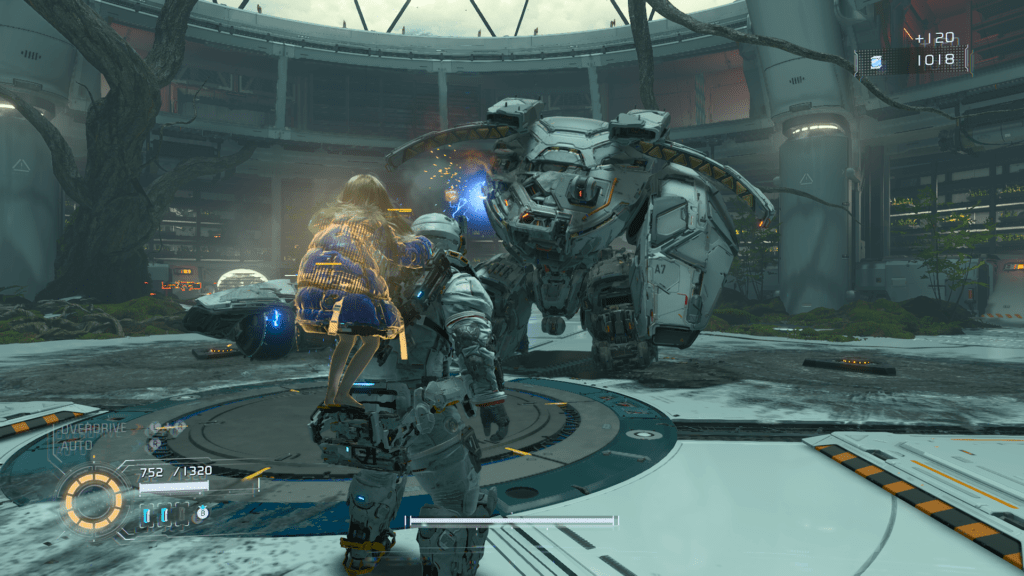
And that’s just when dealing with “regular” and slightly tougher enemies. The game also features boss fights that are spectacular in every sense. Boss encounters take place at the end of each level, serving as the perfect culmination of everything you’ve experienced up to that point, and each boss is fantastically designed. Every boss has its own weak points, and naturally, you’ll need to adapt to each fight, making use of absolutely everything you’ve learned, collected, or can gather in that section of the level in order to defeat them. If you ignore the systems the game has introduced to you throughout the level, each fight can drag on significantly. But if you enter with a clear plan, it will last exactly as long as it needs to.
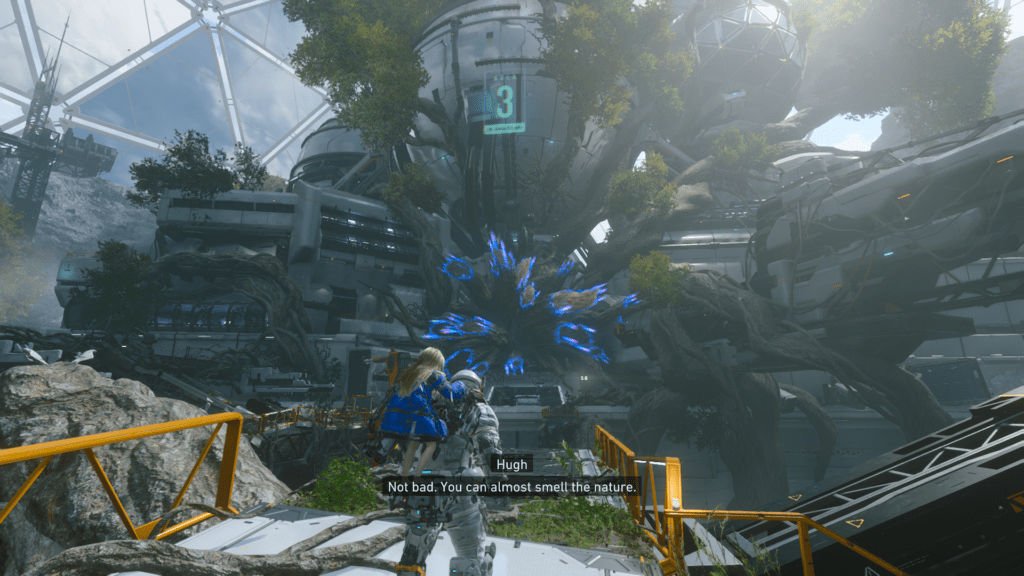
I think I’ve said enough about the mechanics, so I can move on to the next aspect that impressed me, the level design. I mentioned that this title incorporates metroidvania elements and ideas, and that’s absolutely true. The levels can be quite vertical, hiding various rooms locked behind barriers you can’t break immediately. These barriers can only be destroyed later once you’ve acquired additional abilities. Now, this isn’t strictly tied to the main progression, but it is connected to bonuses, upgrade materials, and other rewards. So if you want to fully upgrade Hugh and Diana, you’ll need to explore and fight inside special “red rooms” that grant even greater bonuses. However, to enter these forbidden red areas of the map, you’ll need to find red keycards. And sometimes, to find those, you’ll need abilities that allow you to reach parts of the map you couldn’t access before. So everything is connected, and on top of that, the game is filled with puzzles that also unlock various pathways.
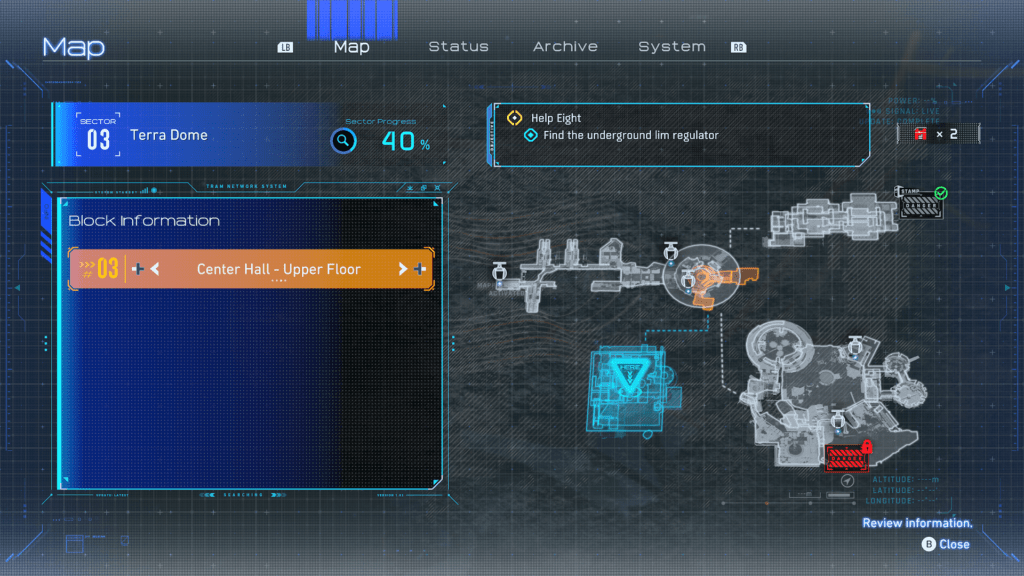
I should also point out that the levels themselves are not interconnected. At the start, you choose which level you want to play, and the game essentially takes you there. However, the places you can access within them depend on the tools and abilities you possess, as well as your own resourcefulness. Still, it’s worth emphasizing that the main story progression does not depend on whether you can reach every secret room in the game, which is a great design choice. The game doesn’t force you to explore everything, it’s entirely optional.
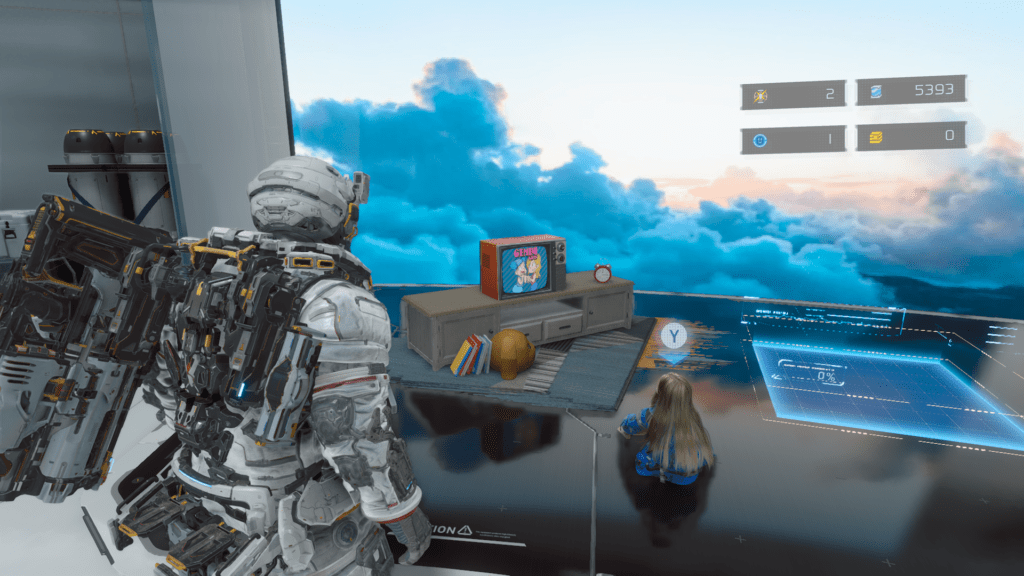
And yes, this brings us to that more relaxed, chill segment. As I mentioned, being able to choose which levels you want to play means there’s a central place from which you make that selection. Hugh and Diana have their own Hideout, where you can talk to Diana, upgrade your suit, “3D print” weapons and mods you’ve discovered in the field, read more about enemies, and train against Androids. All of this has its own progression system, because your Hideout can be upgraded over time. Gradually, you’ll unlock new modules that grant you new possibilities. This isn’t base-building in the traditional sense seen in other games, but rather an expansion of your base through fixed upgrades you discover while playing. For example, there’s a specific section where you can “print” nostalgic items and little pieces of life from planet Earth that Diana can play with. Things like an old CRT TV, swings, a basketball hoop, a tent where you can pretend to go camping. And with each of these upgrades, Diana becomes so delighted that she’ll sometimes even gift you a lovely drawing, sketched in the style of a seven-year-old, of course! And if you ever get tired of talking with her and explaining how the world works, you can even play hide-and-seek. As I said, the game can be incredibly wholesome and heartwarming in these moments, so much so that it makes you momentarily forget all the gruelling battles you’ve endured.
During the pre-release period, we had the chance to try the game on Xbox Series X, as well as on PlayStation 5 and PlayStation 5 Pro. I ultimately finished it on Xbox Series X, but to be completely honest, the game noticeably looks better on PlayStation 5 Pro. On Xbox Series X, I didn’t encounter any framerate issues, at least none that I noticed, no matter how demanding the scenes became. However, the lower resolution is noticeable, especially when looking at elements farther away. You can see jagged edges, and of course, FSR upscaling doesn’t exactly make things prettier or cleaner. Even so, despite that, the game still looks phenomenal on Xbox Series X. And to be clear, I’m referring to Performance Mode, which allows the game to run at 60 frames per second. On PlayStation 5 Pro, it’s a different story, the image is much cleaner, and it seems to me that certain effects and details are handled slightly better. I believe anyone who owns a PlayStation 5 Pro would probably choose to play that version, but because of Dolby Vision support on Xbox and my old habits, I decided to complete it there instead.
Beyond the visuals, the sound design is fantastic. The clashing of metal, Hugh’s heavy footsteps, and his voice echoing from inside the helmet he constantly wears are all excellently executed. However, amid all that, the actress’s voice performance as Diana is simply outstanding! I have to emphasize that it truly stands out above everything else in the game when it comes to audio.

We would like to thank Capcom & CD Media Greece for providing us with a copy of the game for review purposes.
Pragmata (PlayStation 5 & Xbox Series X)
In the end, Pragmata is a remarkably bold title when viewed as a whole. It introduces new elements not previously seen in third-person shooters, all supported by surprisingly deep progression systems that evolve from the very beginning to the very end of the game. Nothing here feels randomly inserted, and now I understand why the game was delayed multiple times. It simply needed time for all the systems it offers to be aligned, polished, and refined into the form you experience when you finally play Pragmata, and the best part is that they all function perfectly. Because of that, Pragmata is undoubtedly one of the most exciting new IPs to hit the market in recent years, and most importantly, a truly excellent game.
