
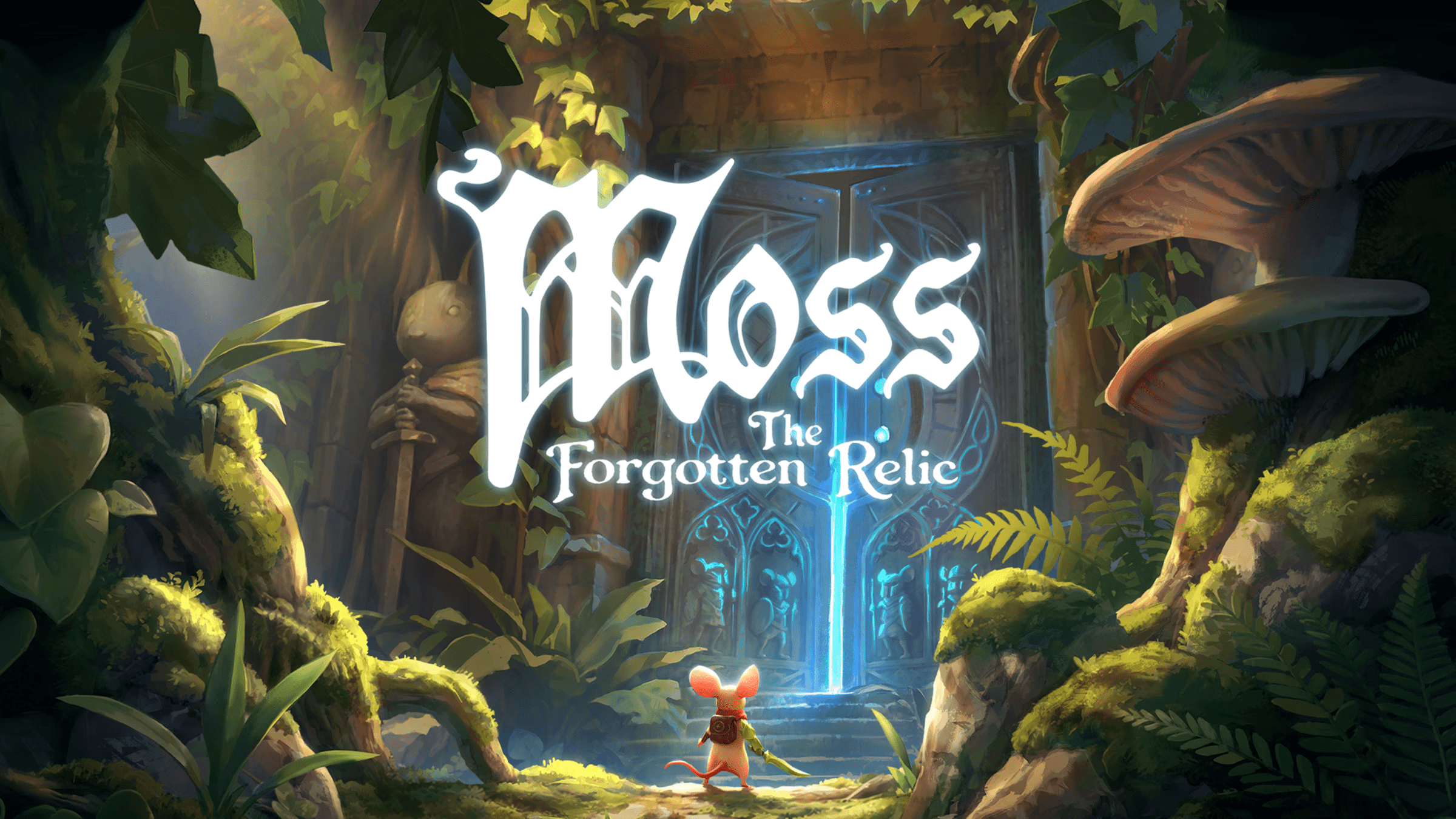

It’s been a long time since I played the first Moss game, and back then, I played it in VR, once upon a time on the PSVR1 and PlayStation 4. The entire experience was simply magical! In fact, “magical” might even be too weak a word to describe my experience with that game. When you say “VR,” everyone immediately thinks of highly intense experiences, but Moss provided something entirely different. It offered a beautiful story about a tiny mouse in a wondrous world where you act as her guide, the person helping her overcome a mountain of obstacles, all from a third-person perspective. It was a light, puzzle-platformer with a gorgeous narrative where you pulled the strings, holding Quill’s life and destiny in your hands. Then came the Meta Quest 3, where I replayed the first game and immediately followed it up with the second. Time passed, but the game simply wouldn’t leave my mind. And now, we’ve finally received the 2D version. As someone who played both games in VR, I was incredibly curious to see how the transition from virtual reality to a flat screen was handled. Over the past 10 days or so, we had the chance to test it out and evaluate whether this famous transition is actually worth your time.
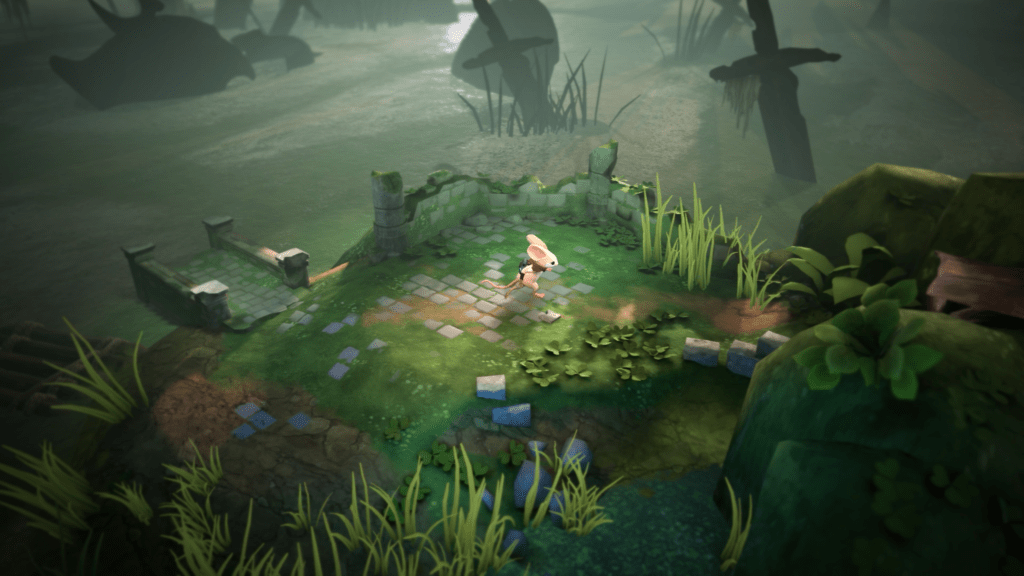
The story drops you into a world that looks as if someone cracked open a massive fairy tale book and decided to turn everything between its pages into a real, breathing adventure. Quill is a brave young mouse (who is female, by the way) facing problems far larger than her tiny stature would suggest. Her journey begins relatively modestly, but it quickly becomes apparent that hidden behind the ruins, forests, and ancient structures lies a much grander tale of a fallen kingdom, ancient magic, and dangers threatening this world. However, Quill is not alone. You are there as the Reader, a mysterious being existing outside her world, helping her overcome obstacles she could never conquer on her own. That relationship between Quill and the player is the heart of the entire game and one of the core ideas that made Moss so memorable right from the first installment. You aren’t just observing her adventure; you are her partner. Quill sees you, reacts to your presence, and behaves as if a genuine bond exists between the two of you, and as you play, you truly feel it too. It’s a wonderful sensation. In the VR version, this was particularly powerful because she could look directly at you, wave, or reach out her hand. Yet, even without the headset, that relationship still manages to work. It might not be as intimate as before, but Quill is still so well-animated and characterized that you very quickly begin to care about what happens to her.
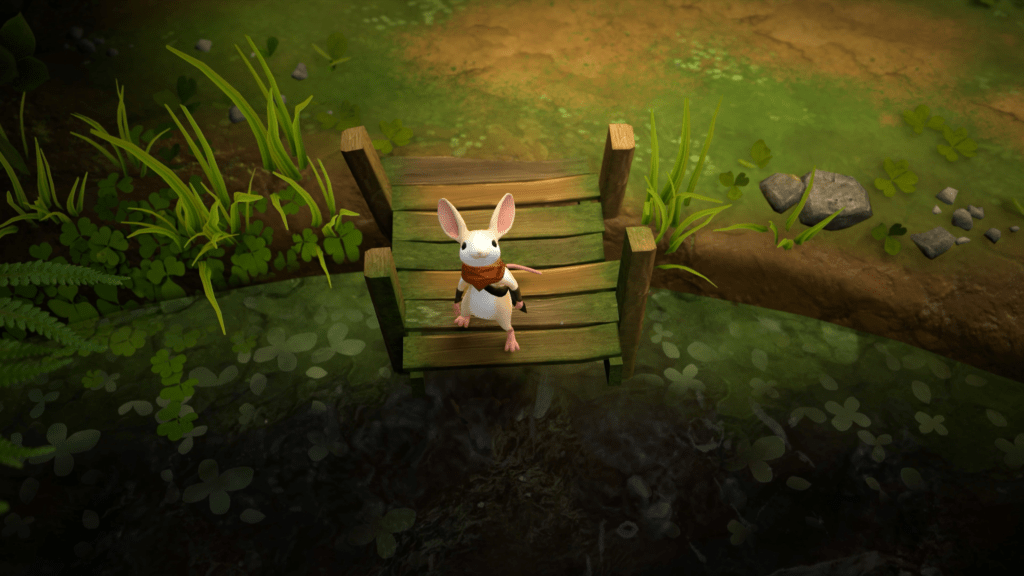
And Quill is precisely one of the main reasons why Moss works so brilliantly. She isn’t some complex character with a dozen layers of characterization and a massive biography you have to study through audio logs. Her personality is primarily conveyed through her behavior, animations, and tiny reactions to whatever is happening around her. When you do something good, she shows it. When she finds something interesting, you’ll see her react. When you help her clear an obstacle, you’ll often get a small gesture letting you know she is aware of your help. These are minor details, but they make all the difference. Quill isn’t just an avatar you control; she feels like a tiny partner braving the adventure alongside you, and that feeling is crucial because the entire game is built on the premise that the two of you must cooperate.
Because of this, the gameplay is rooted in an unusual blend of classic adventure, platforming, combat, and environmental puzzles. In VR, you controlled Quill while simultaneously acting as the Reader, essentially acting as a physical hand manipulating everything around her. With one hand, you guided Quill through the level to jump, climb, and fight, while with the other, you moved objects, triggered mechanisms, or otherwise altered the environment around her. That whole concept was super intuitive and felt entirely natural because you were physically reaching your hand into the tiny world in front of you. In this flat version, Polyarc has adapted that concept to a standard controller, so the Reader is no longer literally your hand, but a cursor you move across the screen. On paper, that sounds like a massive oversimplification, but in practice, the system works much better than I expected. Having said that, I do think the transition from VR to flat could have been, I don’t know, perhaps more natural? At least in the beginning, the controls simply didn’t feel intuitive to me. Perhaps I was just too accustomed to the VR execution in these games, making it jarring to adapt to a standard controller. It’s very possible that players who never tried the VR version simply won’t have this issue.
The best puzzles in the game actively leverage the fact that you have to think about both Quill and the Reader simultaneously. Quill might be able to jump to a specific platform, but she needs your help to move that platform into place. Perhaps you need to hold a mechanism in a certain position while Quill runs through an open door. In some scenarios, you can even manipulate enemies and use them as part of the solution. It doesn’t take long to grasp the game’s core philosophy and how its world operates. Quill can do things you can’t, and the Reader can do things she can’t. Only when you combine their abilities and get comfortable with the mechanics will the world truly open up. The puzzles aren’t particularly difficult, don’t expect brain-busters that will have you staring at a wall for half an hour trying to figure out what you missed, but they are creative enough to constantly force you to look at the environment from a different perspective. This is a light puzzle-adventure that places a heavier focus on storytelling and its magical world.
Exploration, therefore, is quite relaxing. The levels are relatively linear, but I feel like almost every space has something you can find and explore. There are hidden collectibles, secret passages, and items you might only notice if you take a closer look at your surroundings. This isn’t a game that suffocates you with a map covered in icons and dozens of different activities. Everything is much simpler and feels more like a classic adventure where the level design naturally guides you forward. You will often see an obstacle first, then spot an object you can move, and then naturally connect the two and realize what the game expects of you. That kind of design feels almost refreshing today, especially after so many massive games that constantly try to hold your hand and show you exactly where every single item is located.
Platforming is also a major part of these games, and this is where one of the differences between the original VR version and this adaptation becomes apparent. Quill’s movement is fairly straightforward, but jumping, climbing, and precise positioning require a bit more attention than you might expect from such a cute, laid-back game. Most of the time, there are no issues, but the camera and the layout of certain level segments can occasionally make it hard to judge distances. This is exactly what some reviewers have pointed out, transitioning to a flat screen means you lose a chunk of the spatial perception that VR naturally provided, making certain jumps or platforms feel less precise than in the original. Combat, on the other hand, is arguably the simplest element in the game. Quill wields her sword and, as the adventure progresses, gains additional abilities that alter how she deals with enemies. The fights are short, straightforward, and serve more as a change of pace between puzzles than as a robust action system. You won’t spend hours optimizing a build, learning dozens of combos, or studying enemy stats. The point is to think on your feet, dodge attacks, and use the Reader’s abilities to create openings for Quill to strike. In later sections, combining your spatial control with Quill’s attacks becomes more engaging, but the game never attempts to turn into a complex action RPG.
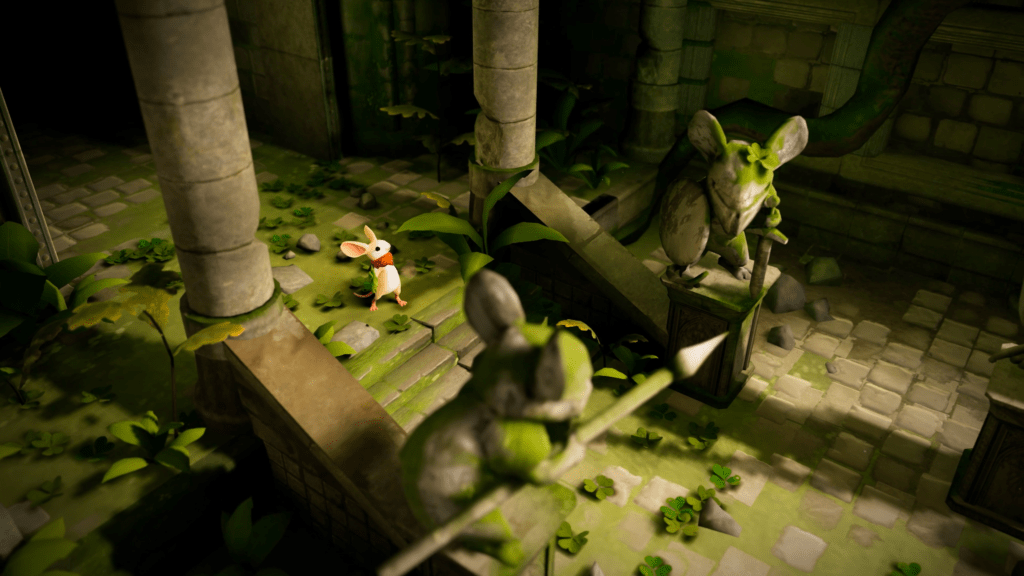
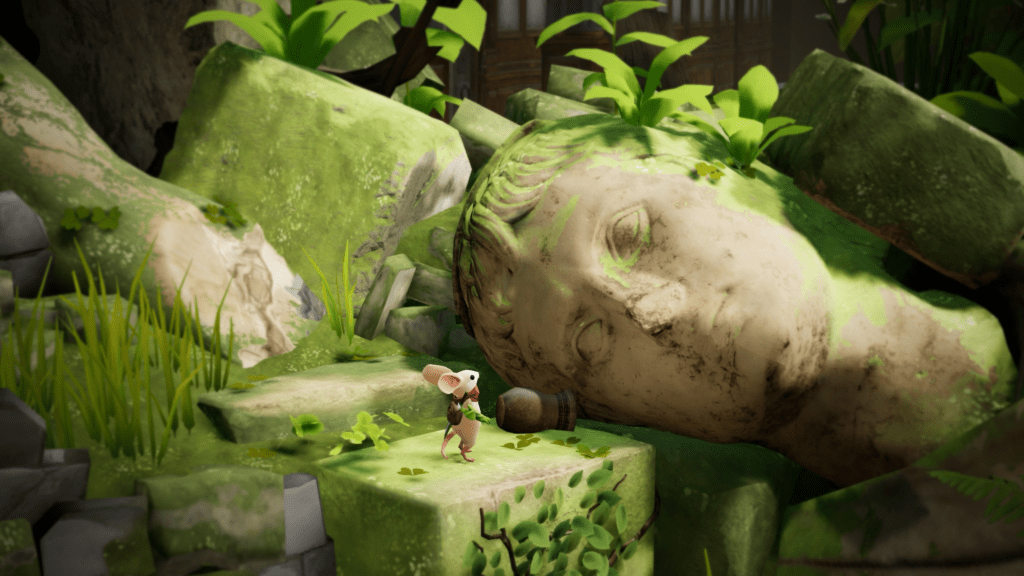
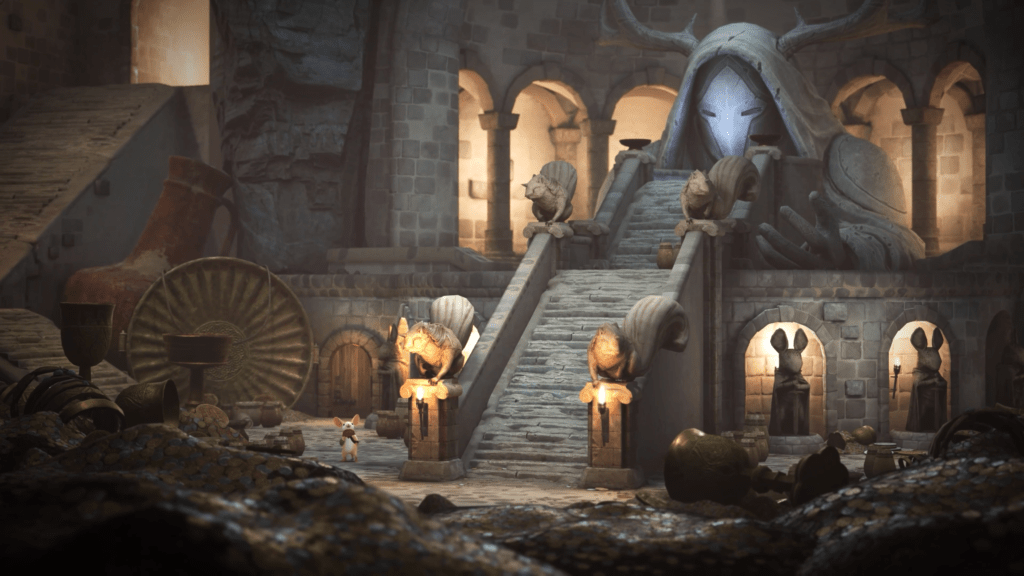
However, the game’s greatest quality is undoubtedly its world design. Polyarc managed to create something that looks like a physical diorama of a fantasy world, only this diorama is constantly moving and living right in front of you. Ruins are blanketed in moss, plants sprout between cobblestones, water cascades through ancient temples, and massive structures make Quill feel even smaller than she actually is. Everything is crafted to constantly give you the feeling that you are viewing the world from a completely different perspective. It’s one of those games where you’ll frequently pause for a few seconds just to admire the details around you. And this is exactly why the loss of VR is simultaneously the biggest flaw and the most fascinating aspect of The Forgotten Relic. The original Moss was built around the idea of you literally peering into a tiny world right in front of your face. You could lean in, look behind objects, bring your face close to Quill, or simply observe a scene from a different angle. When you move that to a television screen, a piece of the magic naturally fades. You no longer have the same sense of presence, nor can you “tuck yourself” into that tiny world in the same way. Most reviewers comparing the versions cite this exact loss as the biggest price paid for this adaptation.
But what matters most is that Polyarc didn’t try to hide the fact that this was once a VR game. Instead of completely overhauling the design, the studio preserved the core structure and tried to find a way to make it work on a traditional screen. The camera still frequently evokes the feeling of peering into a miniature diorama, and the Reader still directly manipulates objects in the world. Because of this, The Forgotten Relic might occasionally feel a bit unusual on a TV, but it also retains a character it likely would have lost had everything been completely rebuilt for flat gaming. GamesRadar highlighted this exact approach as the reason why the adaptation works better than one might expect, the game doesn’t run away from its VR roots; it merely adapts them as much as necessary.
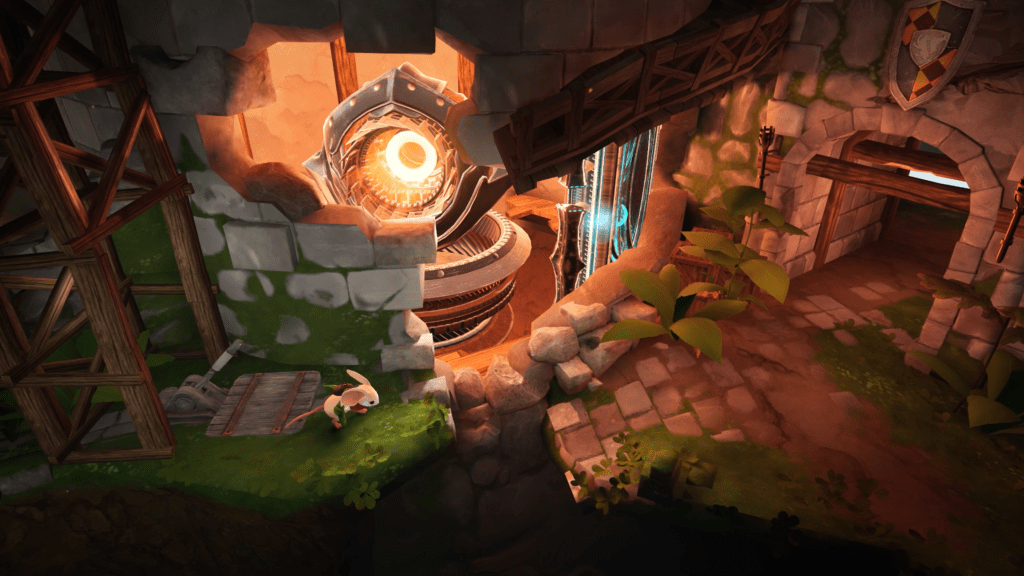
Visually, the game is still gorgeous. It doesn’t try to be photorealistic, nor does it need to be. Its aesthetic is much closer to an animated fairy tale, with vibrant yet natural colors, detailed textures, and a massive contrast between the tiny Quill and the gargantuan world around her. When you watch her trudge through grass that reaches her head, or stand before a towering statue, you immediately realize how crucial perspective is to the game’s visual identity. This is a world designed to be endearing. Even when you encounter something dark or dangerous, that overarching fairy-tale vibe keeps the entire adventure feeling relatively warm. Could the game look better on current-gen consoles? Yes, definitely. But the Moss games already had such a distinct design and well-established world that drastically changing it might have extinguished that spark and the feeling of living inside a fairy tale. The soundtrack is subtle, tracking the plot and on-screen events beautifully. The melodies generally blend into the atmosphere, evoking the sensation of flipping through a fantastical storybook. When danger arises, the music swells in intensity, only to return to softer, gentler themes during quieter moments. It all works together exceptionally well, further enhancing the feeling that you are part of a grand fairy tale, even when the gameplay remains relatively simple.
But definitely, the biggest advantage of this release is that it’s actually a combination of two games: Moss and Moss: Book II. And I have to say, this was a fantastic move, because the original Moss isn’t a massive game that demands dozens of hours to beat. But when you bundle it with the sequel and the Twilight Garden content, you get a package that makes far more sense as one complete, robust adventure. Today, more and more games try to justify their worth strictly through the sheer volume of content. Moss does the exact opposite. It shows up, tells its story, invites you into its world, gives you a few engaging puzzles and fights, introduces you to Quill, and then lets you go. There aren’t ten different endgame systems, there are no endless fetch quests, and you never feel pressured to clear a map for another twenty hours.
We would like to thank Polyarc for providing us with a copy of the game for review purposes.
Moss: The Forgotten Relic (Xbox Series X)
Because of all this, Moss: The Forgotten Relic leaves a very specific impression. If you’ve never played the original Moss games, you are getting an incredibly sweet, lighthearted adventure that is simple enough to play casually, yet creative enough to keep you constantly engaged with its world. If you have already played the VR versions, the situation is a bit more complicated. You will see everything that made Quill special—the same puzzles, the same world, and the same charm—but you will simultaneously know that something is missing. There is no longer that moment when Quill turns to you and you genuinely feel like she’s looking right at you from a world that exists just beyond your eyes. There’s no physical leaning over the tiny landscape. There is no sense of presence that made the original game one of the most important VR adventures out there. But considering this release was made for players who likely never touch VR, Moss: The Forgotten Relic stands as a light, sweet, wonderful platformer with clever but simple puzzles that will absolutely melt your heart as you play it.
