


Over the last few years, Owlcat Games has established itself as a powerhouse in the CRPG genre. Following their critically acclaimed Pathfinder adaptations, they made the massive and opulent leap into Games Workshop’s grimdark sci-fi universe with Warhammer 40,000: Rogue Trader. And after hundreds of hours of fun for the Emperor and more DLC yet to come, instead of resting on its laurels, the studio is already throwing in its next ambitious Warhammer 40,000 game into the ring. Warhammer 40,000: Dark Heresy acts both as a spiritual successor and a spin-off.
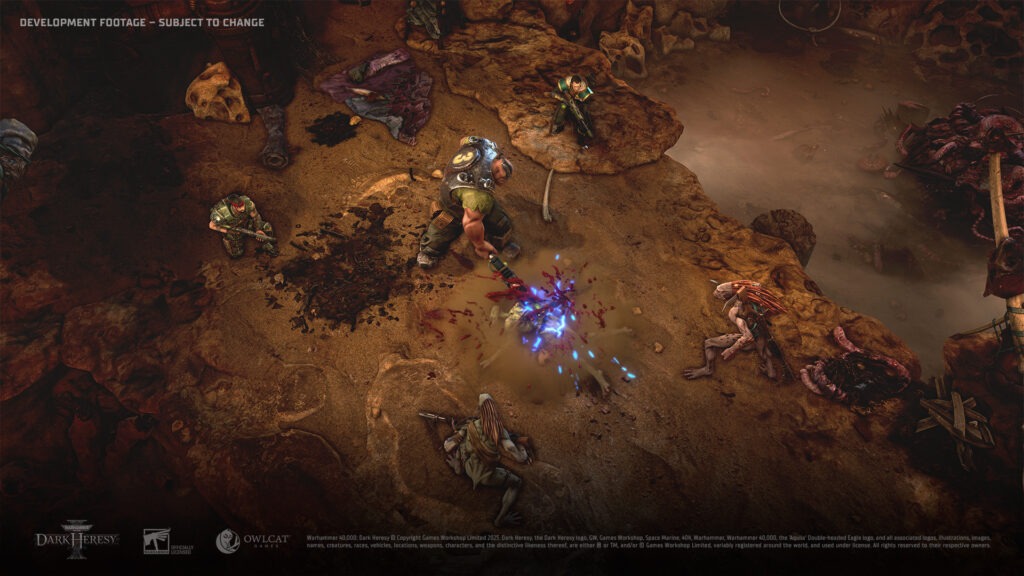
After the alpha phase, which kicked off in December 20025 for buyers of the Digital Developers Edition and Founders Packs, which offered a cross-section of what to expect from Dark Heresy and what changes compared to Rogue Trader, we finally get access to the closed beta of the game now, which introduces proper character creation, the start of the game and many more hours to play.
The Setting: In the Merciless Service of the Inquisition
While Rogue Trader put players in the boots of an unfathomably wealthy Rogue Trader commanding private armies and entire fleets, the scale of Dark Heresy shrinks down to a much more intimate, but definitely not less dangerous level. This time, you step into the role of an Acolyte of the Inquisition. Right at the start, you stand trial for murdering your Inquisitor and messing up your last objective. The only thing keeping you alive is that you recovered a powerful artefact just as commanded, but most of the Inquisitors are against you. Out of nowhere, one of the Inquisitors is taking you under their protection, which saves your life, but also means more and new trouble in the Warhammer 40,000 universe. Nothing comes for free, and especially not in the Inquisition. Political intrigues and messy crises are daily business in the Tyrant Star and the struggling Hive City. It is up to you to solve the disappearance of several Inquisition agents and find out about traitorous factions in the system and what the Chaos has to do with it. Your job is to investigate these cases and make bold decisions that never feel right and have full-on consequences. The game feels darker and slower than Rogue Trader, much more like a true detective story at the heart of an Empire crawling with heresy.
The New Investigation System: Detective Work in the 41st Millennium
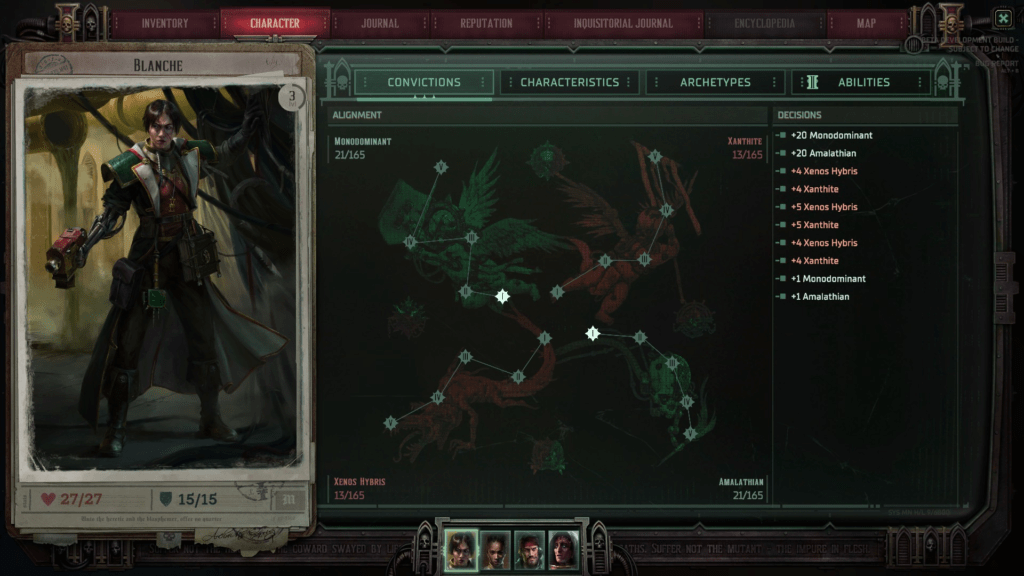
The core gameplay of Dark Heresy shifts hard away from the pure military muscle toward meticulous detective work. Instead of being combat-heavy like Rogue Trader, in Dark Heresy, you often have the chance to avoid combat altogether by taking your way out of it and facing other consequences. A much-appreciated change as combat encounters in Rogue Trader were too frequent and stretched out the game a lot. The centrepiece here is the newly introduced Investigation System. As you explore and interrogate witnesses, you gradually build a mental mind-map where clues are collected, analysed and linked together.
The cool part about this system is the moral gray area. The Devs made sure that there is rarely an absolute right or wrong answer. Most answers feel like a heavy burden to the player, with the consequences already lurking on the horizon. Instead, it’s all about who you decide to blame. As the long arm of the Inquisition, you are the investigator, judge, jury and executioner all at the same time. Companions can actively chime in, too. For example, even your bulky Ogryn companion, Cog, will occasionally drop simple but invaluable observations from his everyday perspective that open up entirely new contexts.
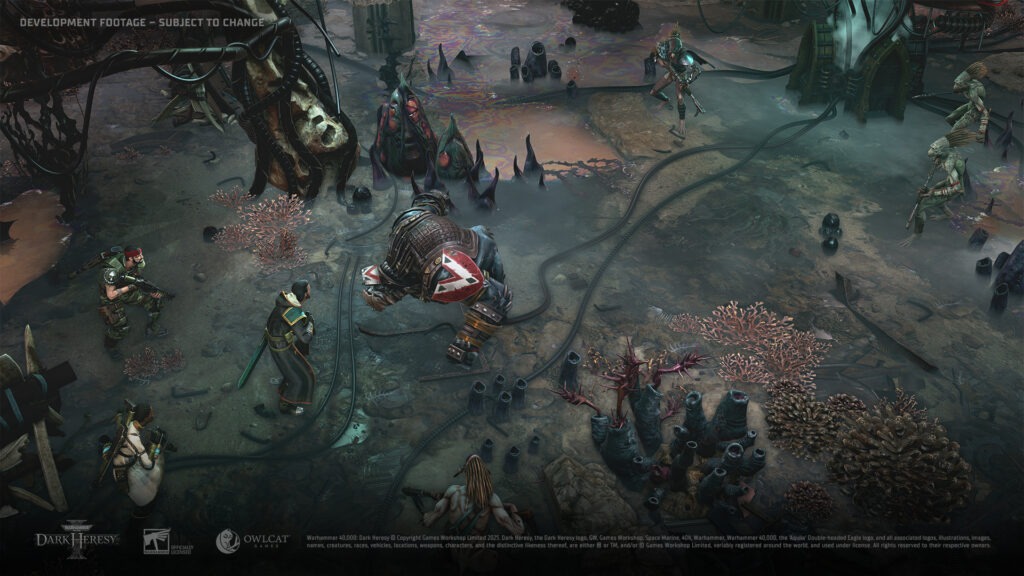
This system asks a lot from the player. Because of the nature of the clue hunt, you’ll scour interconnected maps way more intensely and backtrack to old locations far more often than in the hub-based worlds of Rogue Trader. On top of that, the system is brutally tied to skill checks. Even though the game is much clearer on skills and abilities in general and simplifies some of the system of Rogue Trader, if you botch a test for a clue, you are locked out of the line of inquiry. Since certain paths mutually exclude each other, like choosing to go undercover or pretend to join a heretical cult, or solving complex puzzles to break into an area, players face a real dilemma. The puzzle route might reward you with excellent loot, but it completely robs you of the chance to unmask the cult’s true mastermind. It is these bold choice and consequences that invites the players to replay the game again and again. And if it is anything like Rogue Trader in terms of length, you will spend hundreds of hours again on Dark Heresy.
Economy, Finances and the Two-Sided Reputation System
As mentioned before, since you are an Inquisition Acolyte, you do not have the Rogue Trader’s bottomless vault. Owlcat has ditched the abstract Profit Factor system. Dark Heresy introduces a more classical, traditional currency system. However, resources are scarce in the Hive. The economy is tight. Every time you fail a skill check, you have to deal with the penalty, be it buying expensive consumables or something else, which can wreck your party’s finances.
Trading with the Imperium’s powerful factions has also received a massive overhaul. Instead of just dumping cargo for blanket favour, the party now tracks two distinct reputation metrics with each of the faction vendors. Presence and Rapport. If you want to buy a faction’s best gear and items, you need to push one or both of these values to a certain level through specific dialogue chcoies and actions. This forces you to play strategically. Sometimes you will have to intentionally bully a vendor or act overly friendly, even if it goes totally against your own moral compass to min max the game. Or you stay true to your roleplaying self and screw the faction.
Character Progression: Streamlined Level-Ups and Modifications
Visually, the game takes a leap forward from Rogue Trader. Character models, environments and menus look way more detailed and polished. The level-up menu has been completely redesigned and borrows the clean and structured look of Pathfinder: Wrath of the Righteous. To curb the overwhelming and notorious menu fatigue of Rogue Trader, recommended talents are now neatly grouped into collapsible easy-to-read categories and streamlined. Character progression feels much clearer this way, and the returning archetypes from Rogue Trader, such as Soldier, Officer or Psyker, feel condensed, but also enhanced thanks to a lot of new specialisations.
Reworking Combat: Say Goodbye to Stat Bloat
The combat of Dark Heresy is delivering a much more deliberate and slower-paced, yet simpler experience so far. Instead of relying on too many stats at once, the game reworked the armour system and vital damage. Armour no longer gives you a flat percentage-based damage reduction. Instead, it acts as a second and independent health bar. As long as the armour bar is up, it blocks incoming critical hits and protects you from vital damage. Lightly armoured characters don’t get an armour bar, while heavy armour adds a flat layer of damage reduction on top of the bar. Once an enemy’s armour is completely stripped away, they become vulnerable to devastating vital damage. Certain weapons then allow you to pinpoint target sensitive body parts like the head or eyes. These precision attacks come with a baseline accuracy penalty. But here is the kicker, if you stun or immobilise enemies first, using your team’s abilities, that penalty vanishes, and your headshot accuracy jumps to a guaranteed and often timesdeadly 100%.
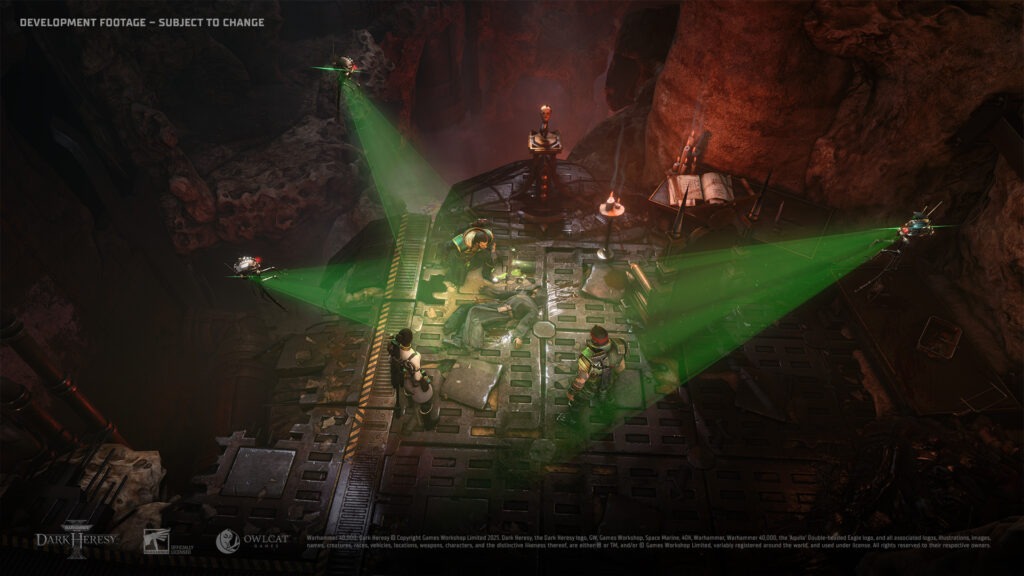
Another huge factor in combat is verticality. The Hive City battlefields feature way more verticality than before. A handy feature (the tab key) instantly highlights climbable ledges and ladders, letting you grab the high ground for distinct line-of-sight advantages before big shootouts.
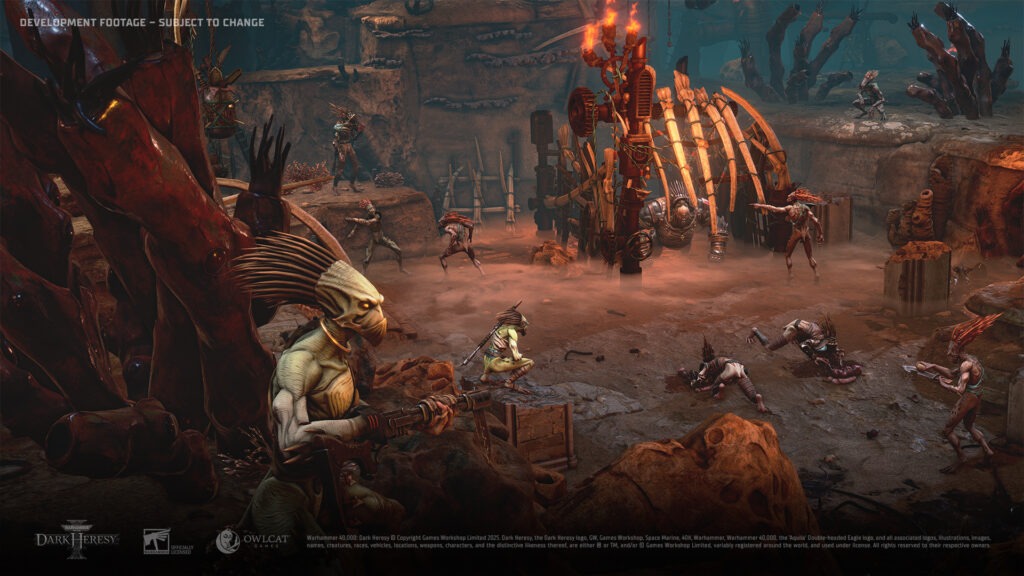
Furthermore, weapon identity got improved as well, so now weapons like lasguns melt through armor or flamers act as your primary control and debuff tools to keep enemy groups in check.
You are not alone: A RagTag Crew with Messed Up Views like Yourself
Assembling a colorful squad of weird and interesting characters has halways been one of Owlcat’s biggest strength. And yet again they make the new cast of companions not just some random NPCs who tag along, but fully visualized people with their own views and opinions, which they will tell you a lot, if you go against their views and actions.
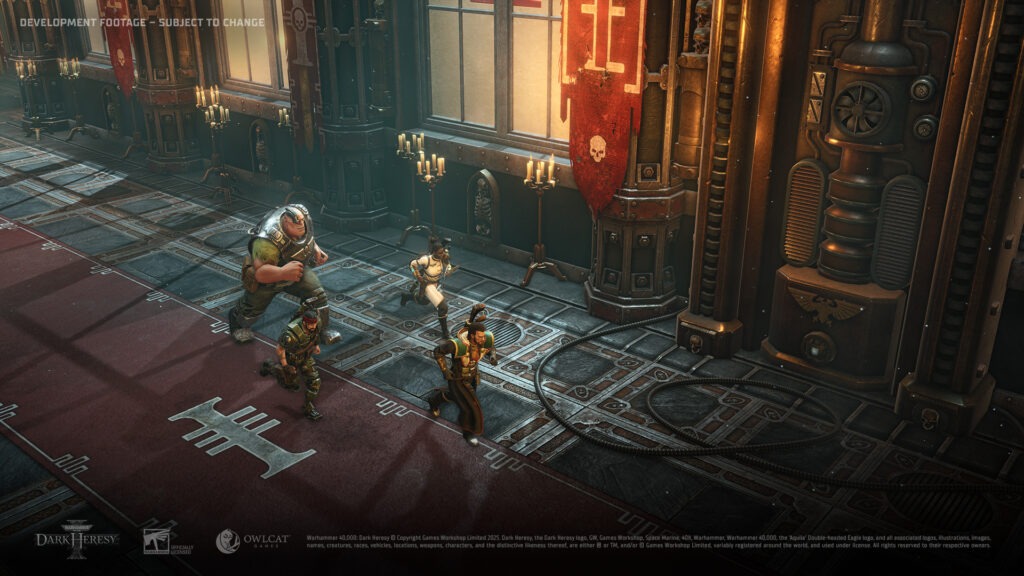
Right in the beginning you get Haymar, Epion and Sero, who get assigned to you by the Inquisitor. They have their own assignments, which align to you. Haymar being your stoic fighter and filling the Heavy Gunner role, while Epion being your combat medic, morale-debuffer and flamer user. Seros is a sanctioned telepathic psyker which characteristically is not only dealing damage with pyromancy but is also using mythic abilities. It doesn’t take much time to get to know your squad better and soon into the adventure you meet even more interesting and alien companions.
Verdict
The closed beta shows a much more complete version of Dark Heresy already. The way the narrative is presented by your choices and consequences is incredibly promising. Shifting away from the messy stat-bloat and buff-stacking of its predecessor towards a more streamlined subclass and modification system doesn’t hurt the game’s depth at all. Instead, it lets you focus on the narrative and the new Investigation System, which lies at the core of this even more narrative heavy approach to Warhammer 40,000. The overhauled tactical combat and less combat encounters make the gameplay loop and variety much better.
What makes me the most excited about Dark Heresy, outside of the streamlined systems and quality of life improvements, is the way choices and actions influence the games narrative.The closed beta was already full of tough and fundamental choices and if the full game gives us even more of these, the replay value will be massive.
