

The tabletop strategy game Warhammer 40,000: Mechanicus universe received its first video game adaptations back in the mid-1990s, and since then this unique sci-fi setting has spawned an almost endless number of games across virtually every genre imaginable, from simple 2D puzzle and sports titles all the way to massive action games with blockbuster AAA production values. Among the hundreds of titles released over the past few decades, strategy-focused games have consistently found the greatest success, and alongside the popular Warhammer 40,000: Dawn of War series from Relic Entertainment, a title arrived a few years ago that genuinely surprised everyone who gave it a chance.
That game was Warhammer 40,000: Mechanicus from French developer Bulwark Studios, a turn-based strategy game that successfully delivered the kind of tactical gameplay popularised by the XCOM franchise, while also embracing the dense atmosphere and lore that fans of the Warhammer 40,000 universe love so much. In fact, despite fierce competition, many players still consider this 2018 strategy title to be one of the best Warhammer 40K games ever made, which naturally made us very curious to see how its full-fledged sequel would hold up today, especially now that the strategy genre is far more crowded and competitive than before.
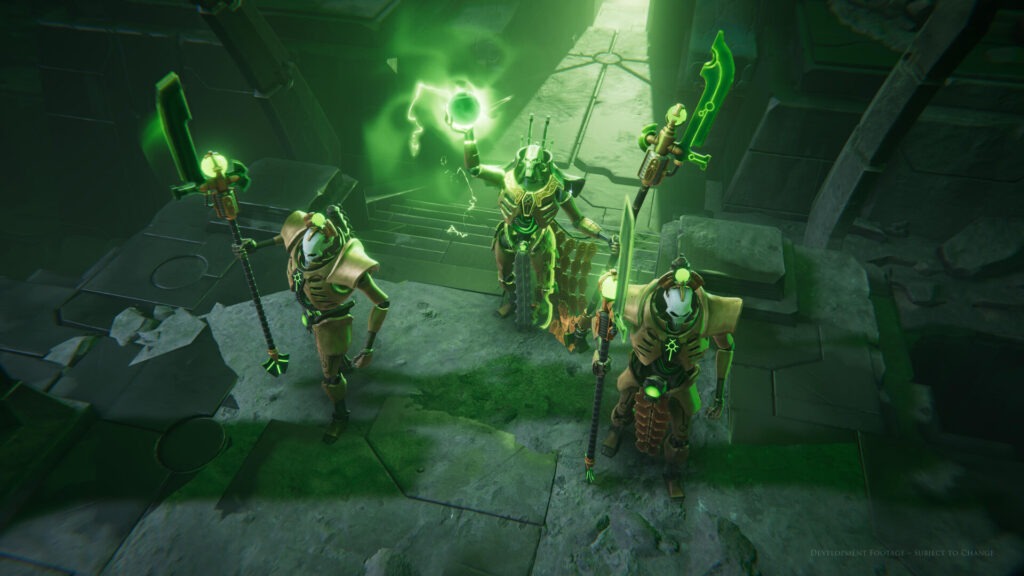
Warhammer 40,000: Mechanicus II follows a new adventure centered around Tech-Priest Dominus Faustinius, the main leader of the armies from the original Mechanicus, who is once again called upon to deal with the awakening of another buried Necron army on a new world that the Adeptus Mechanicus intends to transform into a massive Forge World. His mission is to purge the planet Hekateus IV without resorting to an “Exterminatus” order that would completely destroy the surface of the planet and wipe out all life upon it.
Faustinius brings with him the original cast of leaders who assisted him during the events on Silva Tenebris in the first game, including Priest Videx, Commander Khepra, the logistician Rho, the assassin Captrix, and the archaeologist Scaevola, personally leading them in the mission to reinforce the defenses of the Hive City Exveritas while exploring the surrounding regions where the Necrons are slowly awakening.
But that is not all. In addition to the full campaign focused on the Adeptus Mechanicus attempting to establish complete control over Hekateus IV, the game also features a separate Necron campaign where players take control of Necron Lords themselves. In this portion of the game, players directly command five different Lords who spend their resources to upgrade and summon additional units and assets within their “Court” factions.
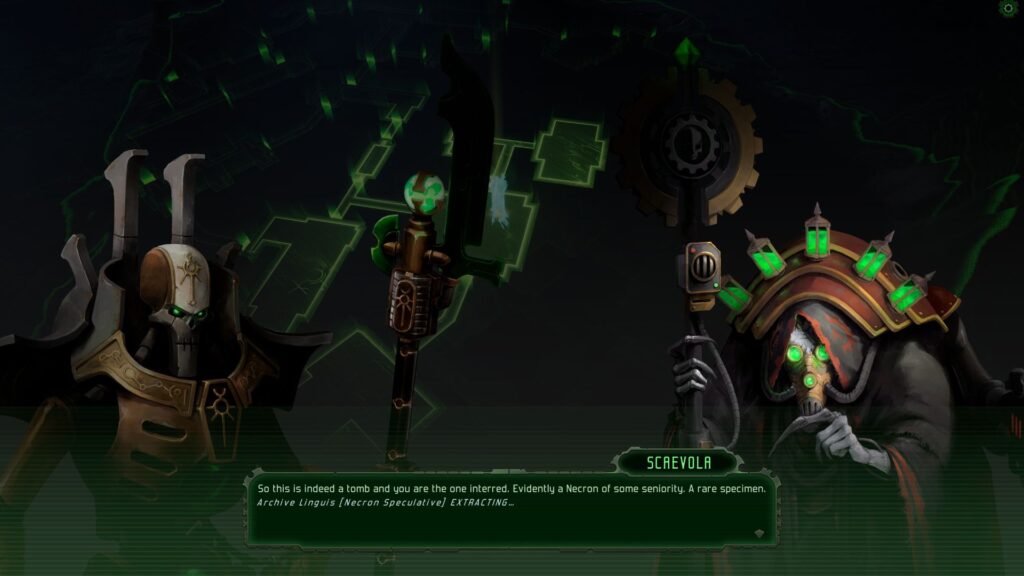
This means that Mechanicus II is not simply twice the size of the original game, but also significantly deeper in terms of tactical variety and unexpected moments throughout its two interconnected campaigns. Events first witnessed from the perspective of the Mechanicus leaders can later be replayed from the point of view of the Necron Lords, giving players a fascinating look at both of these iconic Warhammer 40K factions. As an additional treat, the game also offers brief glimpses at several other factions and forces from the wider universe, something longtime fans deeply familiar with the history and lore of Warhammer 40K will especially appreciate.
The game itself begins with a well-constructed prologue mini-campaign that introduces players to the core gameplay mechanics of both available factions. The battlefield unit management system differs significantly from what was present in the first Mechanicus, making it extremely important to properly learn and understand the many new mechanics this sequel introduces.
Both factions now deploy Leaders directly onto the battlefield, fighting alongside regular units, although the way they function is drastically different from one another.
The Adeptus Mechanicus leaders, five of them in total, alongside the occasional direct battlefield appearance of the powerful Magos Faustinius, possess a wide range of special abilities powered by Cognition Points gathered by standard units. Each leader collects these points differently: some generate them by attacking enemies, others when taking damage, while some accumulate them automatically at the end of every turn.
Movement across the battlefield is now much faster and more fluid, abandoning the traditional “action point” system used in the previous game. Units can move, activate their own special abilities, trigger the unique skills of their assigned leader, and attack, although attacking usually consumes the unit’s remaining movement potential unless otherwise modified by specific effects.
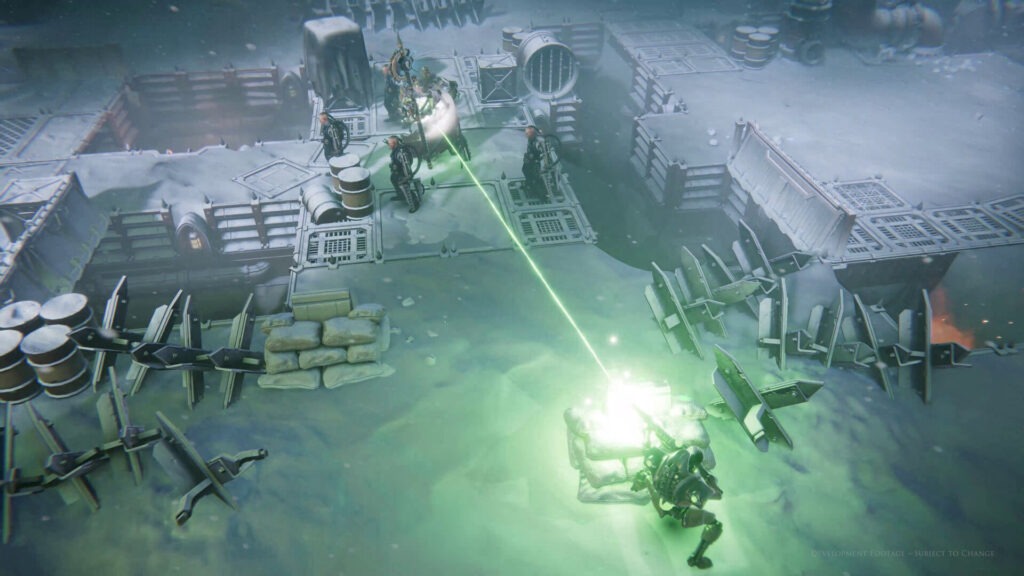
Because of its heavy focus on tactical positioning and the many synergies between leaders and units, Adeptus Mechanicus combat encounters often revolve around intelligent use of terrain and carefully positioning powerful sniper units in locations where they benefit from valuable cover bonuses.
The Necrons, on the other hand, rely on far simpler but far more aggressive battlefield tactics. They care little about using cover and instead field units that are significantly more relentless in direct combat. True to their lore, fallen Necron units are not immediately destroyed permanently, allowing their Lords opportunities to tactically resurrect them during battle.
This side of the campaign completely removes the Cognition Point system and instead introduces the brand-new Dominion mechanic, which can be charged to higher levels simply by dealing damage to enemy units. Higher Dominion levels unlock additional skills not only for the Necron leaders themselves, but also for regular units, allowing them to become considerably more powerful and dangerous on the battlefield.
Throughout both campaigns, players will gather additional points during missions that can be used not only to expand the abilities of their Leaders, each of whom comes with several skill trees and can unlock additional equipment and artifacts offering new offensive, defensive, and support abilities through both main and side missions, but also to upgrade entire armies.
Adeptus Mechanicus players will primarily want to expand the number of available Forges as quickly as possible, since these unlock additional army upgrade tiers, while Necron players will invest their resources into improving their dynasties, fortresses, and armies.
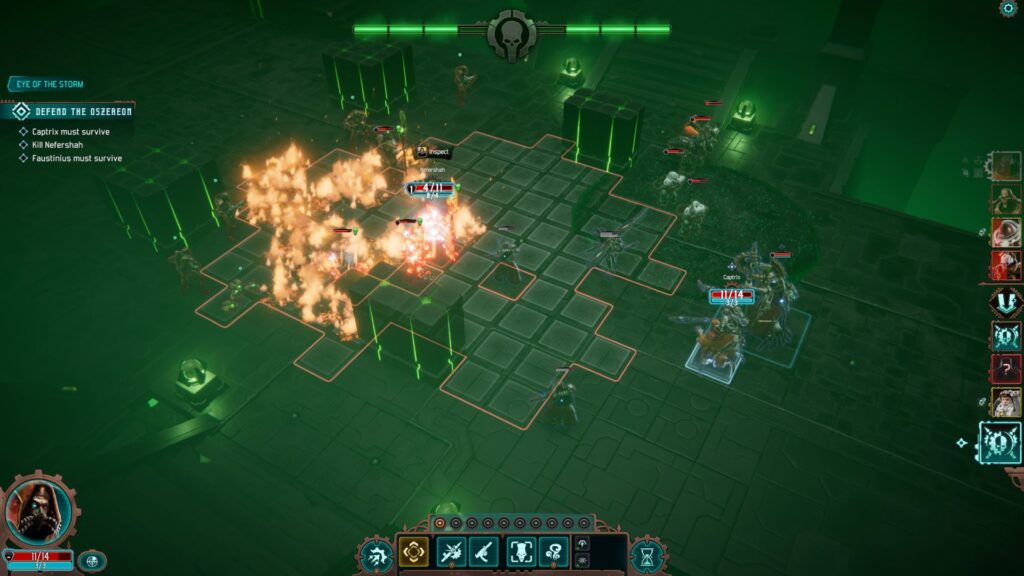
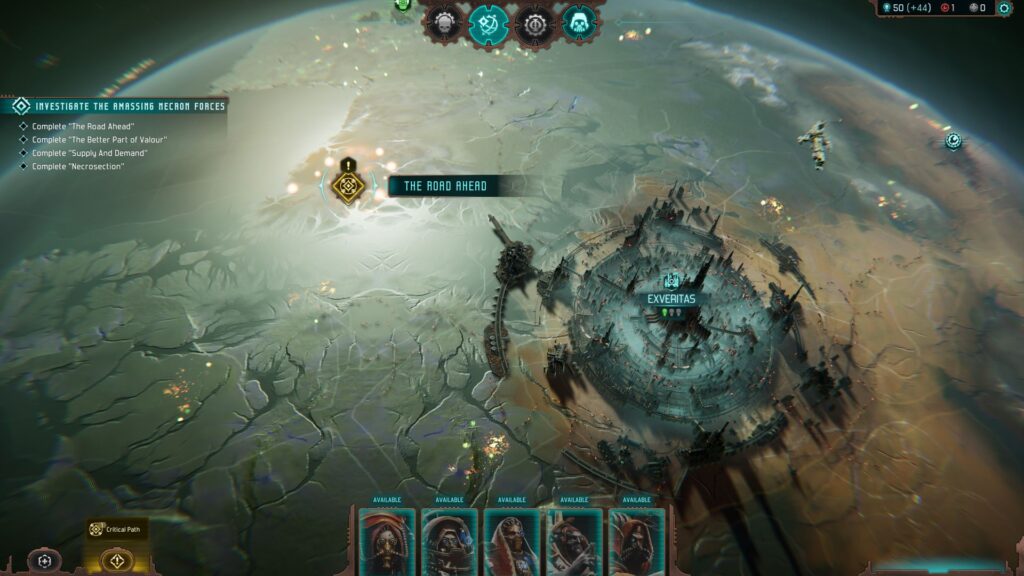
The world map gradually expands the number of missions available to players, splitting them into two categories: side missions, where you simply send Leaders away to resolve them automatically, temporarily losing access to them for a set number of turns, and main missions, where you directly command one hero and their selected units on the battlefield.
Each mission begins with selecting an active Strategem, which not only grants various bonuses but also increases the mission’s difficulty level through the Vigilance system, determining the number of enemies you will face during combat encounters. Missions themselves can range from simple one-off battles, though these are relatively rare, to chains of interconnected events where players are occasionally given the opportunity to make decisions that can either ease or complicate the upcoming objectives.
Combat encounters generally revolve around a handful of core objectives: eliminating all enemies, assassinating a specific target, surviving a set number of rounds, or escorting a key character to a designated extraction zone. Toward the later stages of both campaigns, these tactical challenges become significantly more demanding.
Thankfully, for players who are not especially comfortable with punishing tactical gameplay, the game includes a very detailed customization system that allows players to either simplify or further intensify the difficulty depending on their preferences. On top of that, both campaigns feature three predefined difficulty settings, alongside the option to individually tweak difficulty modifiers at any point while navigating the World Map.
The audio and visual presentation has been elevated to a much higher level compared to what was seen in the original Warhammer 40,000: Mechanicus.
The sequel now features significantly more narrative content before, during, and after missions, while voice acting has been greatly improved with fully voiced performances for all major Mechanicus characters. In the original game, most communication was delivered through heavily scrambled techno-filtered dialogue, an optional feature that is still available here for players who prefer that classic presentation style. The Necrons are also represented exceptionally well, with a much larger cast of characters compared to the first game.
As mentioned earlier in this review, the campaigns also introduce characters from several other factions within the wider Warhammer 40K universe, although we will avoid mentioning them specifically here in order to preserve the surprises for players.
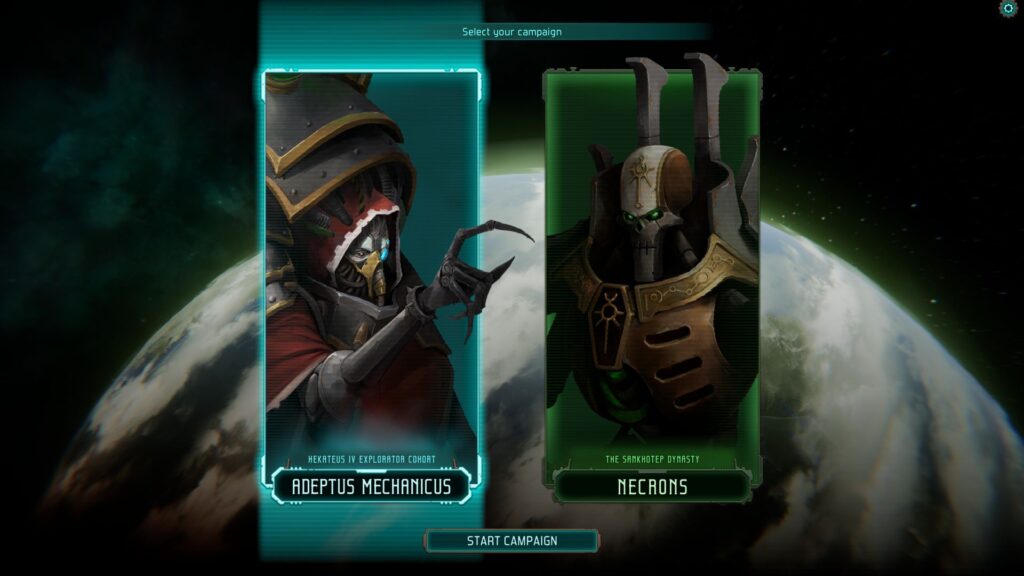
In addition to standard dialogue exchanges, certain narrative moments are now presented through simple but effective 2D and 3D cinematic sequences, significantly improving the game’s atmosphere compared to the original.
Music was one of the strongest aspects of the first Mechanicus, so we are happy to report that the sequel performs equally well in that department. Composer Guillaume David has returned to create additional compositions for this title, once again delivering the dark industrial sci-fi soundscape fans were hoping for.
Visually, the game is far more ambitious than its predecessor, but also considerably more demanding when it comes to hardware requirements.
Missions are no longer set exclusively inside buried Necron tomb labyrinths, but now also take place across the open landscapes of Hekateus IV, including forests, swamps, mountains, and large Adeptus Mechanicus industrial facilities. All of this makes the game significantly more visually detailed than the original.
When we first launched the PC version on a powerful RTX 4080 graphics card at maximum 4K settings, we were greeted by gameplay running at a rough 15 frames per second. This immediately forced us to enable the built-in DLSS upscaling technology, along with lowering the extremely demanding fog and smoke rendering settings. After making those adjustments, performance instantly jumped to well over 100 frames per second, providing a much smoother gameplay experience.
Unfortunately, this noticeable increase in hardware demands within the increasingly outdated Unity Engine meant that we were unable to properly enjoy the game on the ageing Steam Deck hardware. The game simply cannot maintain a satisfactory framerate on Valve’s handheld device, which also explains why the developers have not announced any plans to release it on the even weaker Nintendo Switch 2 hardware.
Warhammer 40,000: Mechanicus II is ultimately an excellent strategy game that offers a tremendous amount of enjoyment for fans of the Warhammer 40K universe.
Each campaign provides well over twenty hours of tactical gameplay, while the built-in accessibility and difficulty customisation systems make the game approachable not only for longtime fans of Mechanicus and XCOM-style strategy titles, but also for completely new players interested in seeing the Adeptus Mechanicus and Necron factions represented in such a memorable and compelling way.
We would like to thank Kasedo Games for providing us with a copy of the game for review purposes.
Warhammer 40,000: Mechanicus II
Mechanicus 2 is an excellent sequel to one of the best Warhammer 40K strategy games ever made. Expanded with a full Necron campaign, impressive army and hero progression systems, and highly effective new tactical combat mechanics, the game delivers a rich strategy experience that will satisfy both longtime fans of the universe and newcomers eager to explore the fanatical Adeptus Mechanicus and the arrogant Necron factions.
