

It was 2am on a Saturday night. And after a couple of bad decisions that cost me some of my most experienced combat ships, I arrived in a sector with a Cylon boss just waiting for me. My fleet was damaged, my tylium fuel was nearly empty, and morale was down. And then a window popped up, the military wanted more rations, or they would shut down some of my most important systems for good. Everything was on fire. The feeling of despair and the realisation that this run was over, was creeping into my tired brain.

Long have fans of the 2004 science fiction show Battlestar Galactica been waiting to experience the dread and paranoia of the show in a video game. While Black Lab Games made a solid real time strategy game with Deadlock nearly a decade ago, Battlestar Galactica: Scattered Hopes by DotEmu and Alt Shift, take the FTL roguelite formula and put it into Battlestar Galactica.
Alt Shift is not unknown to these kinds of games, as they used the FTL formula before with Crying Suns and added more narrative and ground combat to it. With Scattered Hopes they streamline this experience and focus even more on the crisis and narrative.
Battlestar who?
For people unfamiliar with the franchise, Battlestar Galactica is a science fiction franchise from 1978 with a reboot in 2004, in which humanity got nearly extinct, when the robotic cylons attacked. Barely anyone survived and in the TV shows, the last survivors join a fleet around the Battlestar Galactica and try to escape the Cylons and survive. The game itself doesn’t take place on the Battlestar, but a side stage of the war. You as the player command a smaller fleet escaping from Caprica, trying to escape from the Cylon fleets and ultimately joining the Battlestar Galactica.
A management nightmare
For people familiar to FTL now the fun begins. With your fleet you jump from galaxy to galaxy on a procedurally generated star map, trying to evade the cylon fleet. Every jump costs resources, which you always don’t have enough of. In each orbit, you must provide your ships with water, rations and tylium, try to repair your ships and look at the overall health of your fleet. Most of your ships are civilian ships, which give slight passive abilities, but you only have few fighters in your hangars to use and protect your fleet with. The core gameplay is to use your ten action points each sector to either collect resources from different sources, solve problems within your fleet from blackouts to rioting factions, please these factions or send your special units on missions. All of this is presented in beautifully pixel drawn backgrounds and little text adventures windows with solid art that fits the whole Battlestar Galactica vibe. Events feel close to the show. Which factions should I support? What will be the consequences? Should I help the SOS and repair the ship or is it a cylon trap in the making? Should I use my most experienced pilot for a mission to secure important resources or send the rookie? And what are the consequences of siding with certain factions more than others?
There are often no right decisions, and it is up to you to just manage the lesser evil. Managing these decisions to make every faction happy or rather less pissed, is a lot of fun. During my runs I often had that bad feeling, when I sided with one factions only to get screwed by another as a consequence two sectors later.
Traitors within our ranks
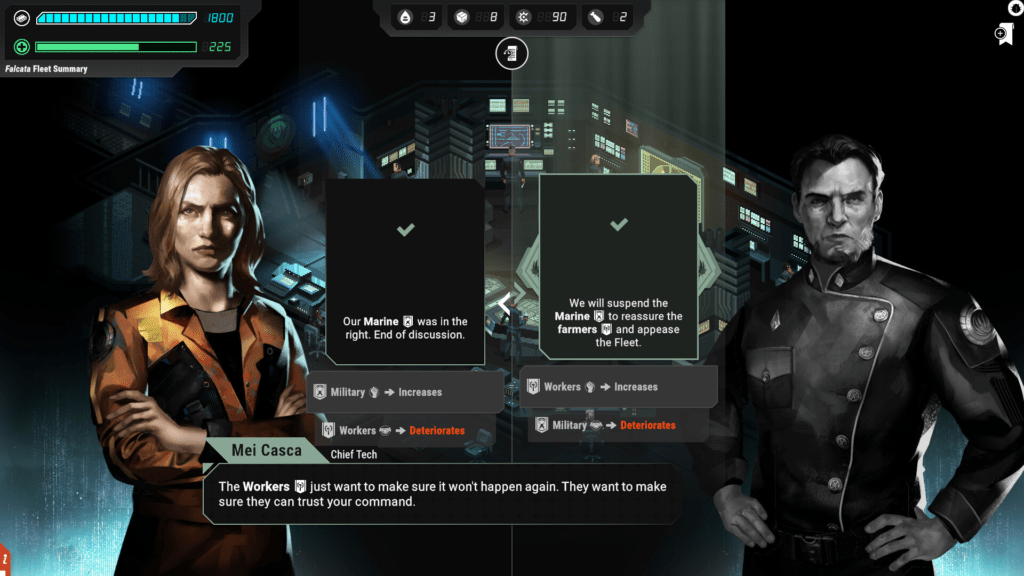
True to the show, at one point during your run the game declares that there are Cylon traitors among your crew. This moment starts a bigger quest chain, where it is up to you to discover who the traitor is and decide how to deal with them. What sounds like a cool idea, sadly ends up being mostly menu based. Each sector you open an investigation menu and decide from a role of hints what to reveal. You can even spend more resources to reveal more or talk to some people in the bar to get an extra information. Once you have done that enough times, you reveal the Cylon and you can decide to vent it, get informations out of it or give it a second chance.
While the idea is cool, some sort of proper detective work instead of the same menu would have done so much for this. The paranoia of the show really falls flat here. And as a big fan of the Battlestar Galactica board game, in which finding the Cylons and the people that turn into Cylons during the game, I know there is nothing cooler than figuring out who to trust and who not to. If the developers decide to enhance or expand the game, I really hope they expand the investigation system with proper events and more narrative instead of these bland menus.
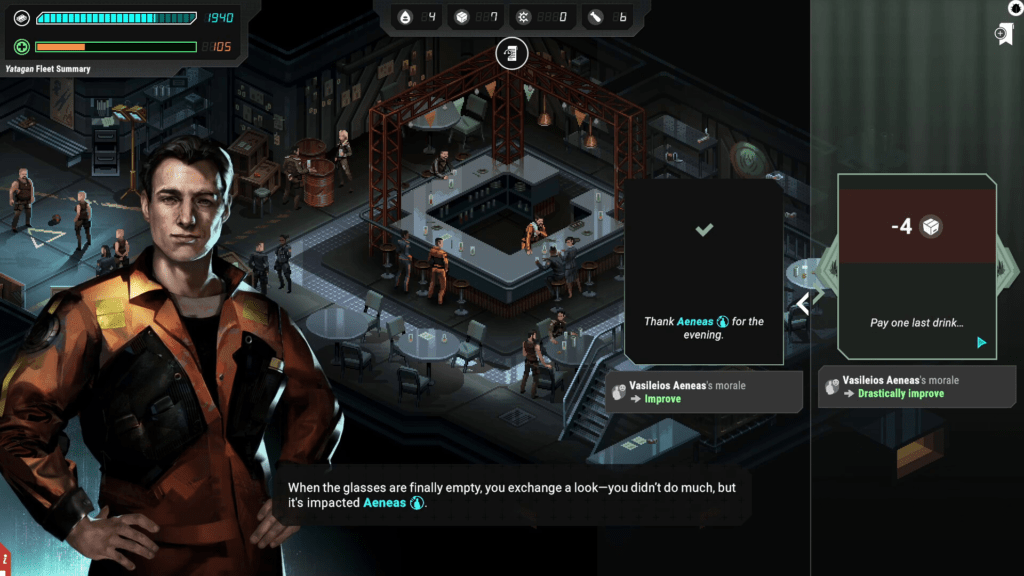
Something that is also kind of true to other events in the game. While the crisis solving while everything is getting worse, is fun overall. There are often only two choices to make, and these feel repetitive and samey quickly. More branched-out narrative or mechanical solutions would be welcome here.
Fighting or fleeing? DRADIS in action
Of course, not all issues can be just resolved with resources. After you have done your ten actions each sector, it is up to you to hold out against the Cylon fleet for a while before your fleet can jump into safety.
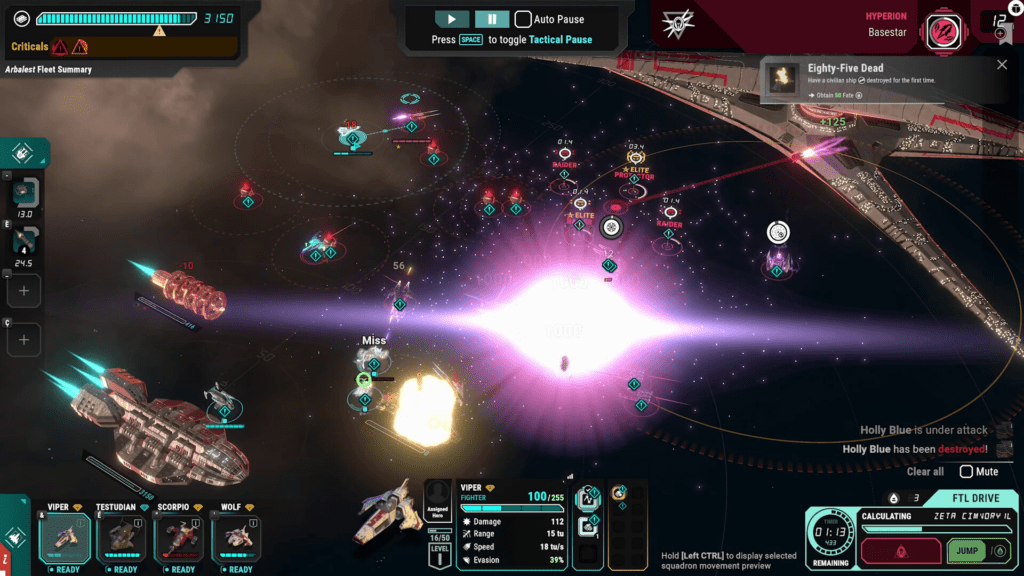
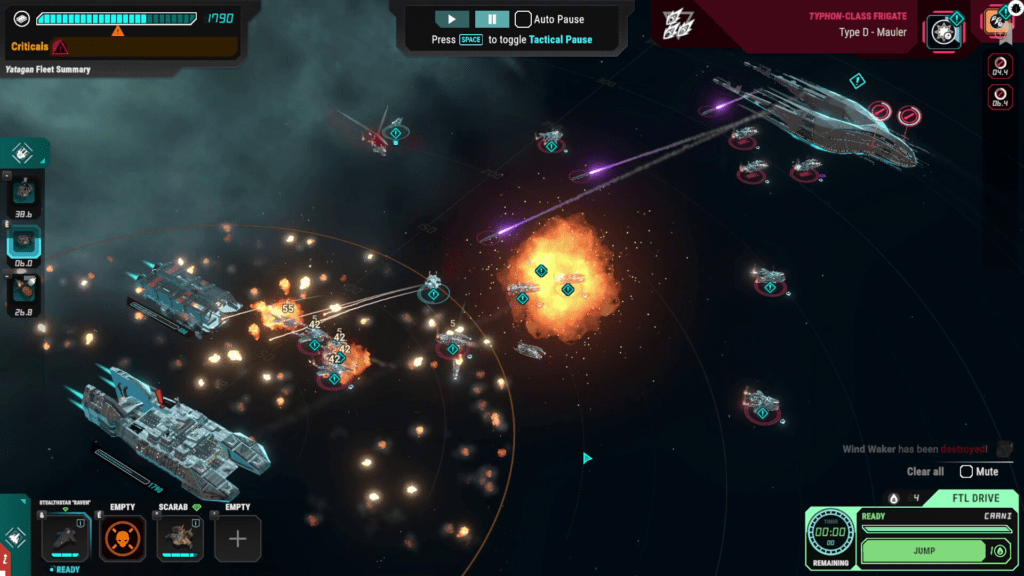
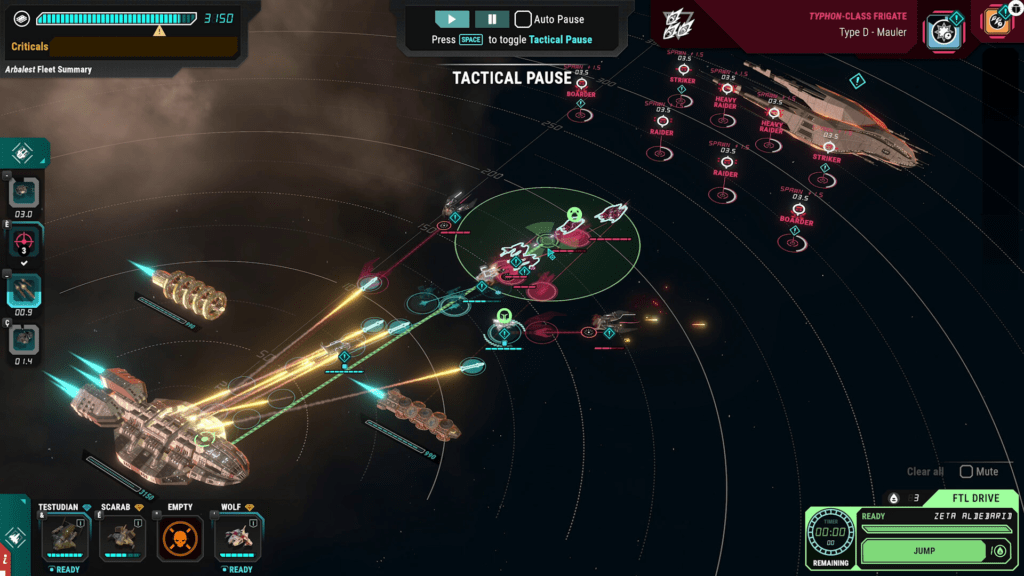
Combat is done in real time, which you can always pause. And thankfully so, as combat gets messy really quick, as the Cylon army will overwhelm you and your couple of ships at some point. But it is designed this way on purpose, as it is your goal to jump to the next sector after you hold out for a while.
What I really enjoyed about the combat is how it catches the look and feel of the DRADIS system, known from the TV show, which is the detection system and radar.
At the bottom left you can find your ships, weapons and fighters and at the top right the Cylon ship will join the combat. Each cylon ship has a different kind of fighter fleet and sometimes combat zones are also filled with mines or asteroids or other things.
As the player, you send out your fighter ships and pilots, which serve different kind of roles in combat. Some like vipers are agile and will follow enemies’ thanks through passive and active abilities ships can learn from levelling up or the pilots that command them, while others serve more like artillery to heavily hit enemy ships or intercept rockets and atom bombs. Additionally, your fleet has some weapons of its own to interrupt enemies or nuke down larger clusters of Cylon fighters.
When the jump timer runs out, a massive swarm of Cylons will join the fight, and you’d better time the return of your fighter ships right or they are gone for good, when you escape with a jump to the next sector.
While combat starts out pretty simple, the more you level your pilots and ships, the more passive and active abilities they will get to use in combat, which is essential to holding out against the Cylon fleets. Especially since the named boss Cylons, who always come with a gimmick in their fights.
Catching the show’s atmosphere
Graphically the game is nothing to talk home about, but a lot of little details do their job. Every run starts with a small intro that gives of major Battlestar Galactica 2004 vibes and the pixelart and artworks manage to catch the shows atmosphere as well. In each area of the game, you can find a lot of little details, such as in the bar or in the hangar and uniforms and documents, fit the shows as well.
What brings you back all the way to 2004 the most however, is the sound design. The studio absolutely understood how important the soundtrack is. The soundtrack is heavily inspired by the original score and especially elevates the combat sequences.
Progress along the way
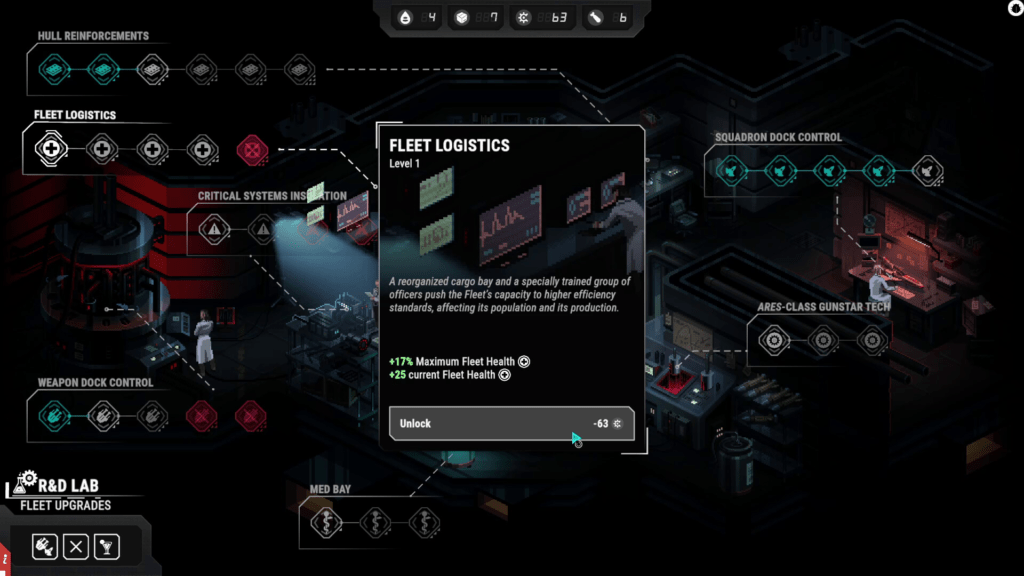
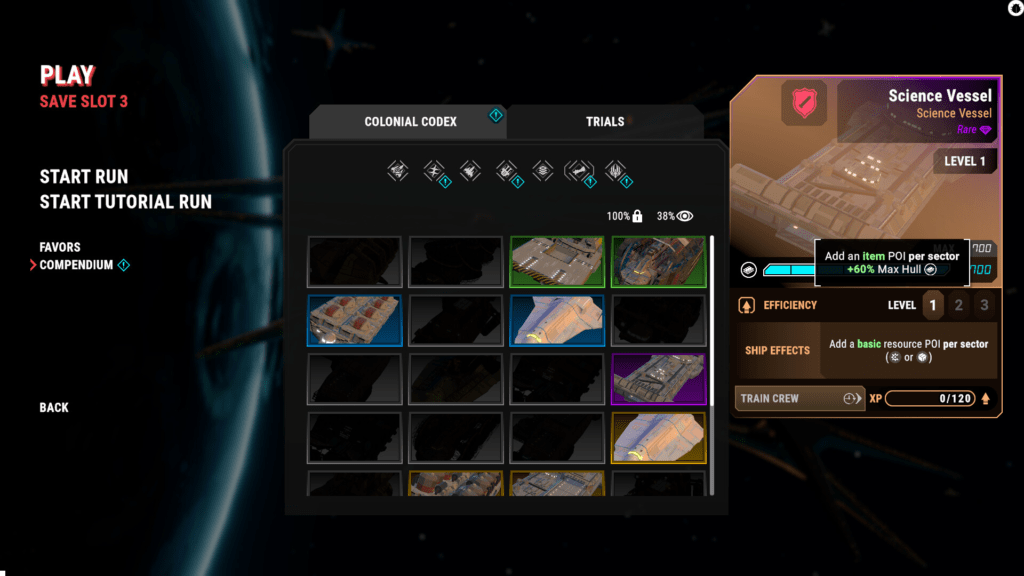
As often with roguelites, the game can get quite overwhelming, especially if you start on greater difficulties from the get-go. The game’s difficulty is loaded upfront, which means it gets easier over time thanks to it’s Hades’ like meta progression. The difference between starting fresh and even your second or third run is huge, thanks to all the quality-of-life options you can unlock after each run. And there is a lot to unlock over time, from simple starting resources which make a huge difference to rerolls and to much more.
And while the events are fun and engaging at first, the repetitiveness will set in at some point, not only events showing up again, but as said before, the issue is that it’s just option A and B. I really hope Alt Shift will enhance on the event system in some post-launch updates and DLCs.
We would like to thank Dotemu for providing us with a copy of the game for review purposes
Battlestar Galactica: Shattered Hopes (PC)
As a big fan of the Battlestar Galactica TV show, I had a good time with Alt Shift’s take on a roguelite version of it. Especially for the first ten to fifteen hours, the gameplay loop of constant crisis solving, advancing the meta progression, unlocking new ships and finding out what works in combat to beat the bosses, kept me motivating. With slight adjustments to the event system and a little bit more variety through post-game support or DLCs, the game can even get better. The FTL formula works great here, and they just nailed the Battlestar Galactica feeling.