



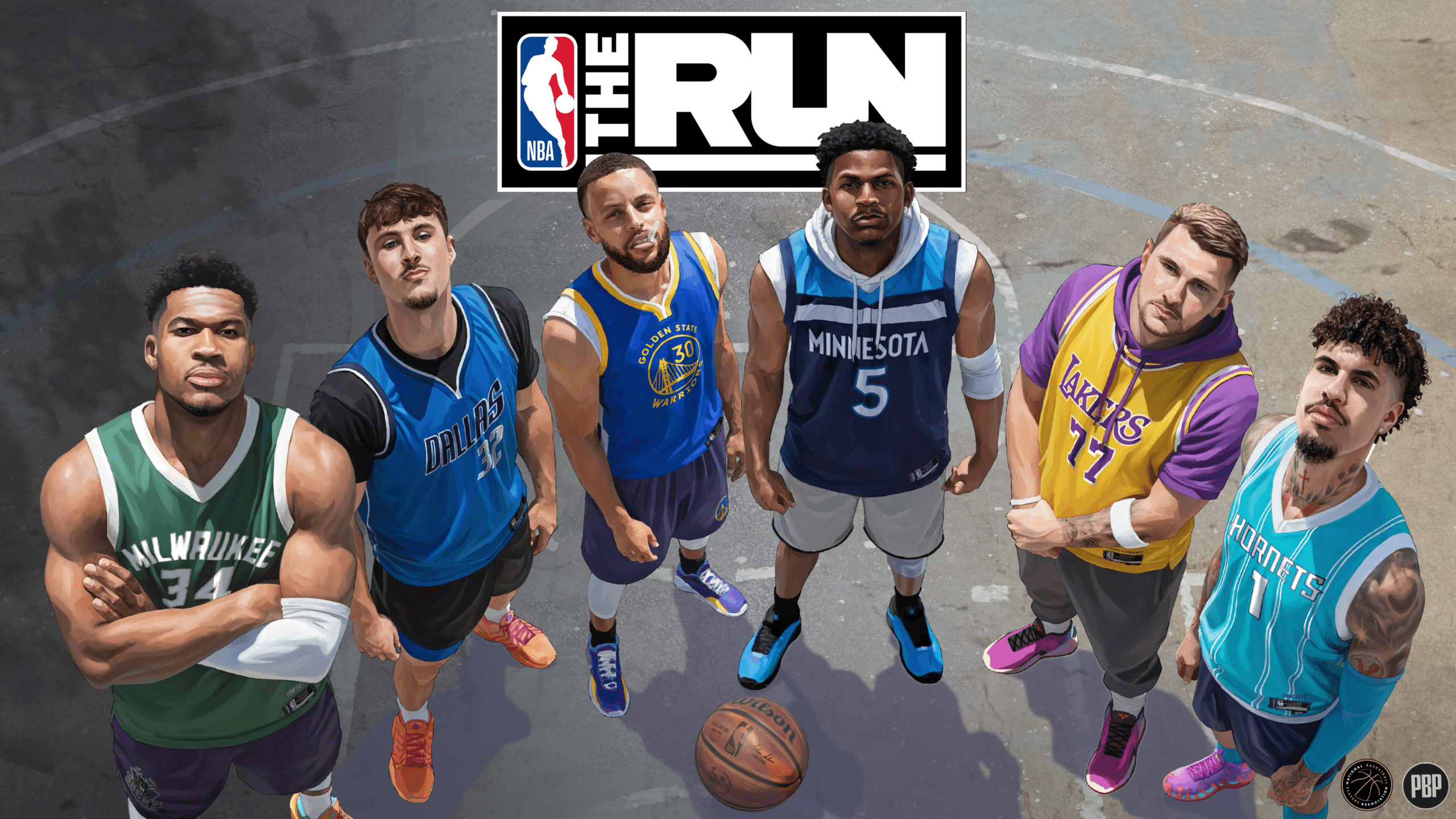


Whenever I think back to how many hours we spent playing NBA Jam as kids, and later NBA Street during high school, I can’t help but smile. It didn’t matter which game we were playing or who was holding the second controller, every single session was unforgettable. Even when we played solo, we’d spend the next day telling our friends about the insane dunks we pulled off or the ridiculous plays that somehow worked. Honestly, I miss those days of carefree arcade basketball, over-the-top action, outrageous slam dunks, and legendary commentators screaming every time someone caught fire. For years I’ve kept asking myself the same question: why don’t we get games like that anymore? Has the market really lost interest in arcade basketball? Then, completely out of nowhere, NBA THE RUN showed up. And the even better news? It’s being developed by industry veterans who previously worked on EA Sports titles, quite possibly even NBA Street itself.

After years in which basketball games have been divided almost exclusively between serious simulations and half-hearted attempts to recapture the spirit of arcade classics, NBA THE RUN tries something surprisingly simple, something hardly anyone else has been willing to do. It wants to bring fun back to street basketball. Fast-paced action, outrageous plays, and that addictive feeling that once kept us glued to NBA Street and NBA Jam for countless hours. Instead of simply copying old formulas, however, Play by Play Studios aims to create a modern interpretation of that experience, designed for today’s players who want short, intense, highly competitive matches. It’s a double-edged sword, though. At its best, the game delivers exactly what it promises: chaotic, lightning-fast basketball packed with ridiculous dunks, flashy tricks, and spectacular plays. But at the same time, it also proves that even the best ideas aren’t always enough to create a sports game with lasting appeal.
The very first thing you’ll notice when launching the game is the complete absence of a tutorial. You’re simply thrown straight into the action. Sure, there’s an option to shoot around by yourself, almost like showing up to your local court on the hottest day of summer before the older guys arrive and take over. It’s a nice touch if you think of it as simulating the real-life experience of learning basketball on your own, but it also makes the game considerably less welcoming for newcomers, or, more specifically, players with limited patience. Beyond that, there’s really only one thing to do: start a match and play. That’s pretty much it as far as game modes go. The core experience revolves around online 3v3 multiplayer, complete with over-the-top dunks, power-ups, and constantly changing rule sets inspired by different eras of basketball history. Looking at the bigger picture, NBA THE RUN clearly wants to be a fast-paced multiplayer sports game built around quick matches and nonstop adrenaline. And when everything clicks, it absolutely delivers. There are few things more satisfying than getting matched with two random teammates and completely demolishing another squad from the other side of the world 21–5 without breaking a sweat.
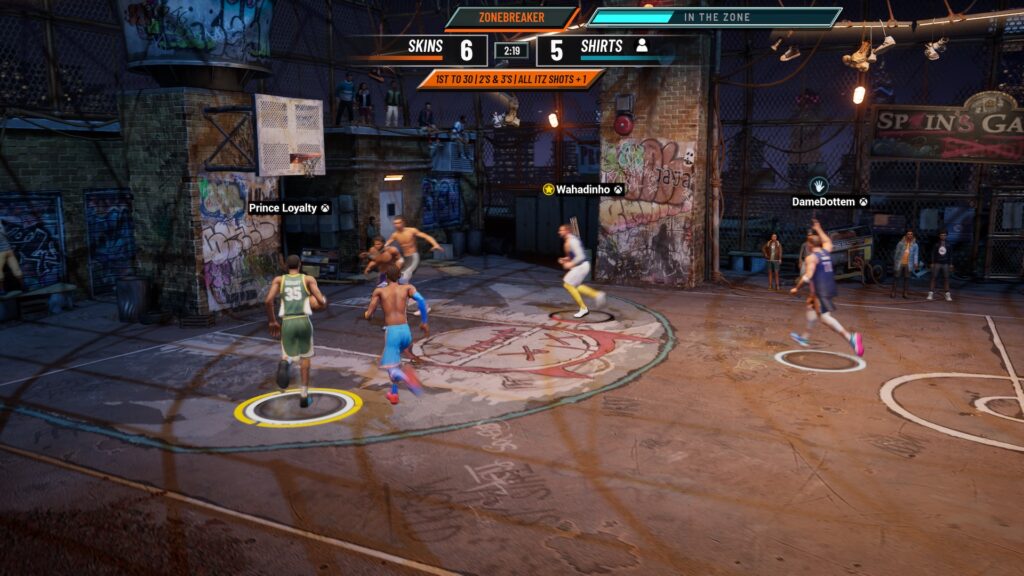
That feeling is exactly where NBA THE RUN shines the brightest. On the surface, the game appears incredibly simple, but once you settle into its rhythm, you begin to realize there’s more depth beneath all the flashy highlights than you’d initially expect. Running straight to the basket and mashing buttons isn’t enough. Opponents punish poor decisions surprisingly quickly, especially in online matches where you have to learn when it’s worth taking a risk, when to pass the ball, and when to save your special moves for the perfect moment. Every possession matters. There’s no time to overthink every play. Three players, often with completely different skill sets and playstyles, have to figure things out on the fly if they want to win, or at the very least, avoid getting completely blown out.
Gameplay is incredibly fast and aggressive. The ball constantly flies from one end of the court to the other, there’s virtually no downtime, and every match is designed to keep your attention at its absolute peak. Unlike traditional NBA simulations where a single game can take quite a while, everything here is built around short play sessions. It’s the kind of game you can launch, play a few matches, and move on without feeling like you need to invest hours into a season mode or career. That design philosophy fits today’s multiplayer landscape perfectly. At the same time, however, it also exposes one of the game’s biggest weaknesses. Once the initial excitement wears off, you begin to notice how quickly the core gameplay loop starts repeating itself.
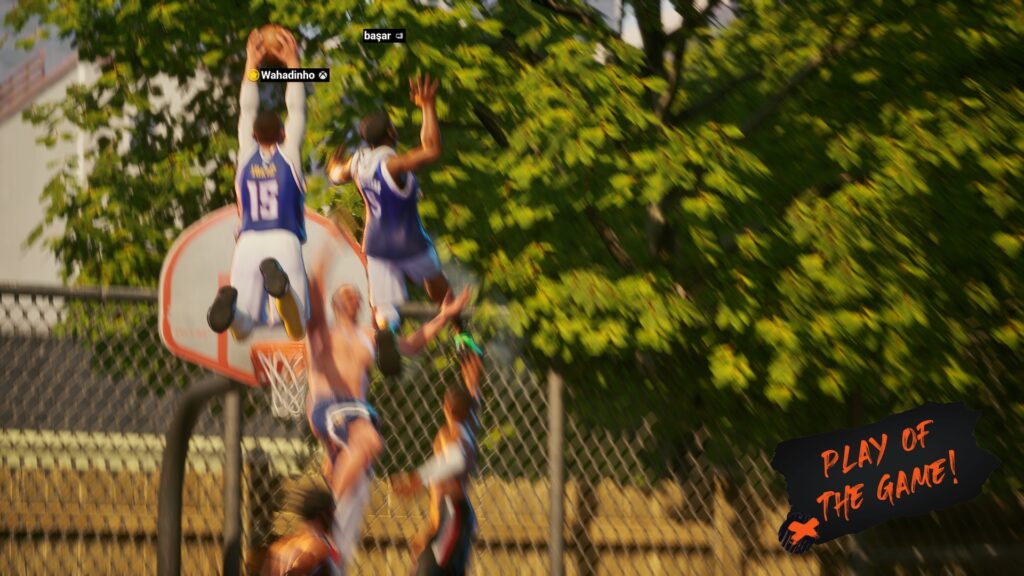
The main, and, realistically, only, game mode is Knockout Tournament, which serves as the foundation of the entire experience. The concept is simple: win matches, advance through the tournament, and fight your way to the top. Think of it as a roguelite, except it’s basketball. Lose, and you’re back at the beginning. Winning earns you more money and experience points, allowing you to improve your team as you progress. You can either play online with each player controlling a single athlete or tackle the tournament solo, managing the entire three-player lineup yourself. Surprisingly, the solo option often feels better because you have complete control over your team’s decisions instead of relying on random teammates who may not share your playstyle. On the other hand, when you’re having an awful shooting night, there’s nobody there to bail you out either. Both approaches have their advantages, but one of the coolest aspects of solo play is putting together your own dream team. You start identifying what your lineup is missing, what kind of basketball fits your style, and gradually build a squad around those strengths.
One of the more interesting ideas comes from the constantly changing victory conditions and rule variations that completely alter how matches unfold. Not every game is a simple race to 21 points. Every now and then, different challenges appear that force everyone to rethink their strategy. Alley-oops might be worth three points while every other basket counts as just one. Three-pointers might be disabled entirely. Stamina could remain permanently full. Small twists like these completely change the flow of each match. Personally, I think it’s a fantastic mechanic because it prevents games from becoming repetitive. If your opponent insists on attacking the paint while three-pointers are worth significantly more, you can catch up almost instantly with a few well-timed shots from deep. Likewise, if someone completely ignores the match rules and keeps scoring regular baskets while alley-oops are the real objective, you can absolutely dominate them, as long as you’re paying attention.

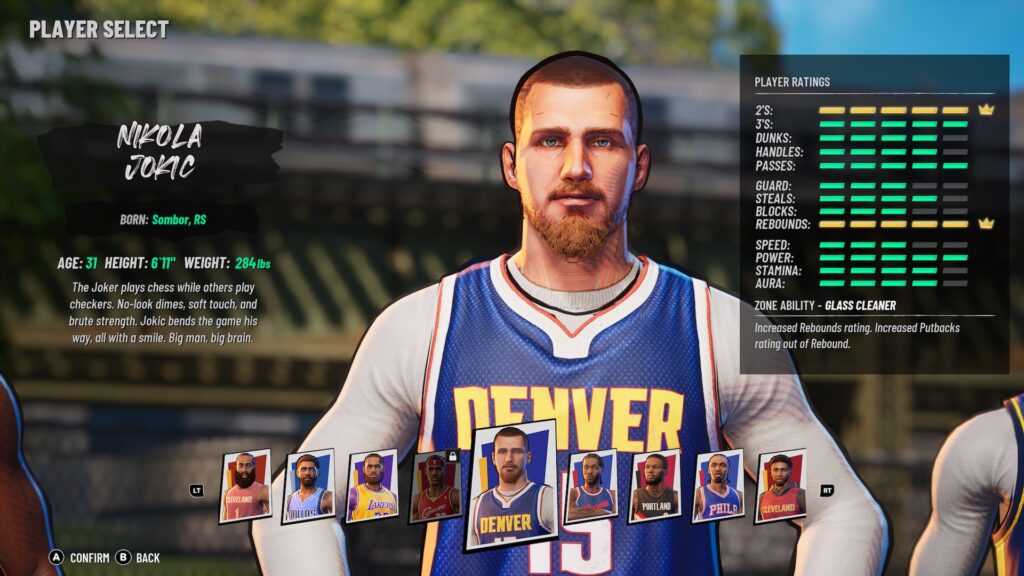
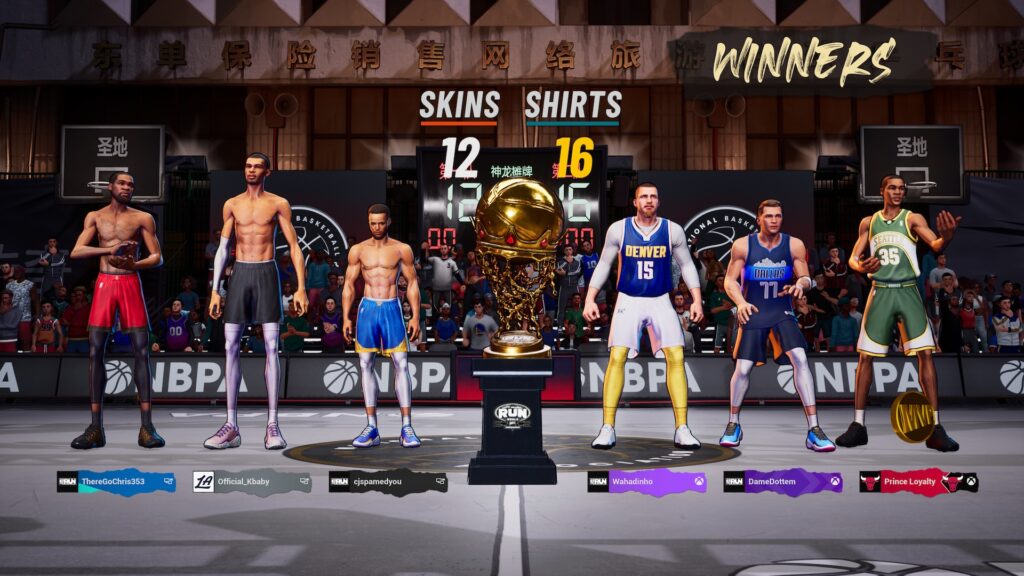
A huge part of the game’s charm comes from its roster. NBA THE RUN features plenty of recognisable NBA superstars alongside alternate player versions and legendary street basketball icons that reinforce its arcade identity. Unfortunately, aside from Nikola Jokić, none of the legendary Serbian 3-on-3 players made the cut, which honestly feels like a missed opportunity. But hey, at least there was room for a bunch of random influencers… Still, there’s something undeniably fun about controlling players like Stephen Curry, Kevin Durant, or Luka Dončić in this kind of exaggerated arcade environment. It creates a completely different feeling compared to traditional NBA simulations. Here, realistic player ratings aren’t what matters most. It’s all about playstyle and the unique abilities each player brings to the court.
Here, too, there is a progression system, and everything revolves around earning credits and unlocking additional content. As you play and win, you earn money that can be spent on various cosmetic items, new moves, and alternate player variants. It is not the kind of deep progression system you would find in a major RPG or a sports career mode, but it works well within the game’s overall concept. Most importantly, it never undermines the fact that skill and adaptability determine the winner here, not who has the flashiest jersey or the largest collection of dunk animations. The constant stream of unlocks gives you a good reason to jump into one more tournament or a few more matches; as I said before, it has a very roguelite-like hook.

This is also where it becomes clear that NBA THE RUN is designed primarily as an online experience. If you are looking for a traditional single-player mode, a career campaign, or something similar to older sports games, you will probably be disappointed. The game lacks the kind of solo content that can keep you engaged for dozens of hours on your own. Its entire structure is built around replaying matches, improving your personal skill, and competing against other players.
That is not necessarily a bad thing, but it does feel a little strange for a title that aims to revive the spirit of classic arcade basketball games. One of the greatest strengths of the old NBA Street titles was precisely the fact that you could enjoy them alone, unlock new characters, complete challenges, and feel a constant sense of progression. NBA THE RUN instead places a much heavier emphasis on the competitive side of the experience. For some players, that will be perfect; for others, the lack of substantial content outside online matches will be noticeable. Personally, I do miss the option to play solo from time to time, to boot up the game and simply have fun dominating the AI. I am competitive when it comes to games, especially sports titles, but sometimes I just want to relax and enjoy the ridiculous dunks and chaotic matches without worrying about ranked opponents.
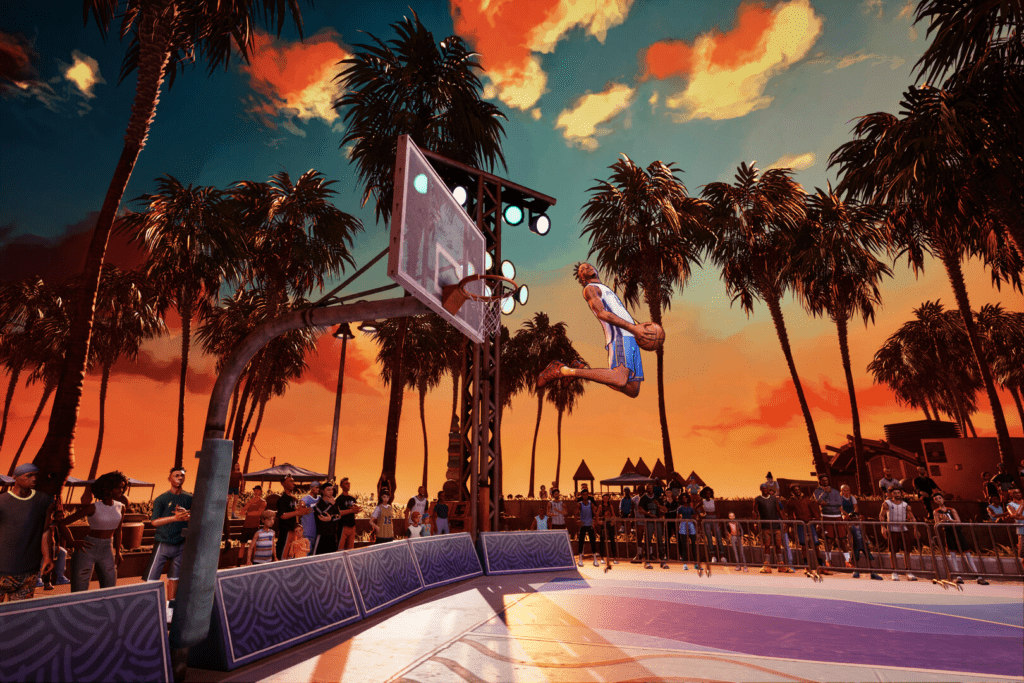
Visually, the game goes in the exact opposite direction of the NBA 2K series. Rather than chasing realism, it embraces a stylised look with exaggerated effects, vibrant colours, and a comic-book-inspired presentation. That approach fits the game’s identity extremely well. Dunks are accompanied by flashy visual effects, players remain instantly recognisable, a perfectly timed shot sends the ball streaking toward the hoop in flames, and the courts have enough personality to make each match feel distinct. It may not be the most technically impressive sports game on the market, but its visual style gives it a clear identity of its own.
Best of all, NBA THE RUN genuinely tries to capture what made street basketball special in the first place: the feeling that you are participating in an event, not just a game. Locations such as Venice Beach and other famous streetball courts add a great deal of charm, while the commentary and the energy during matches help make everything feel more alive. That said, for a country that proudly calls itself a “basketball nation,” it is disappointing that none of our iconic courts made the cut, Kalemegdan would have been a perfect fit. Aside from Jokić, Serbia is essentially absent from the game, and that is genuinely a shame.
The music, crowd effects, and commentary all contribute to the game’s rapid-fire pace, and during close finishes they do a surprisingly good job of raising the tension. The presentation is not on the same level as the biggest sports franchises, but it is obvious that every element was designed to support the core idea of fun, exaggerated, highly entertaining basketball. If I am being honest, though, some of the commentators’ one-liners made me cringe a little. Maybe that style of humor is popular with younger players right now, but it did not always land for me.
The biggest issue with NBA THE RUN is that you understand exactly what it is offering relatively quickly. The first few hours are a blast. Pulling off your first perfect play, winning a tournament against a coordinated team of skilled opponents, or chaining together an absurd highlight sequence feels fantastic. But as time goes on, you begin to notice that there are not enough new mechanics or modes to keep refreshing the experience. For me, the sweet spot was playing for an entire evening, taking a day off, then coming back for another long session a couple of days later. Spacing it out helped prevent burnout because, unfortunately, the amount of content is fairly limited. The important thing is that what is there works extremely well. And to the developers’ credit, the multiplayer foundation is excellent, especially thanks to the implementation of rollback netcode, which makes online matches feel remarkably smooth with virtually no noticeable lag or sense that the game is cheating you.
We would like to thank Play by Play Studios for providing us with a copy of the game for review purposes.
NBA THE RUN (Xbox Series X)
In the end, I am not entirely sure how to summarize NBA THE RUN in a single sentence. It is a genuinely interesting project, a successful attempt to bring the spirit of arcade basketball into a modern package. No, it is not a full-fledged successor to NBA Street, but it absolutely feels like a spiritual successor. The vibe is there, the energy is there. The fast-paced action, spectacular moves, and the sense that any possession can turn into a highlight-reel moment make it enormously fun whenever you are in the mood for a few quick matches. More than anything, it is refreshing to see a game that once again treats basketball as pure entertainment, where the things that matter most are the same ones that made us fall in love with the sport in the first place: spectacular plays, fierce rivalries, and that unforgettable feeling when the final shot decides the winner.


