



It’s always difficult to be original when working with themes that have been explored and re-explored so many times in games. Titles inspired by the works of H. P. Lovecraft can easily be placed in that category. And I don’t mean only Cthulhu games, but all titles that deal with similar phenomena and rely on somewhat familiar mechanics. It’s a theme that allows you to build vastly different worlds, yet the core idea often remains the same, and the gameplay rarely changes in meaningful ways. Still, Big Bad Wolf Studio wanted a challenge. Like many studios before them, they chose Cthulhu as their inspiration and built something that may feel familiar at first glance. But once you dive deeper into the mechanics of Cthulhu: The Cosmic Abyss, you begin to realise that the originality and systems present here are ideas that simply should have existed long ago. Big Bad Wolf Studio took advantage of the lack of bold inspiration in other titles and bravely immersed itself in crafting its own world, its own interpretation of this ancient evil. And did they succeed? I can freely say that they did, even more than that.

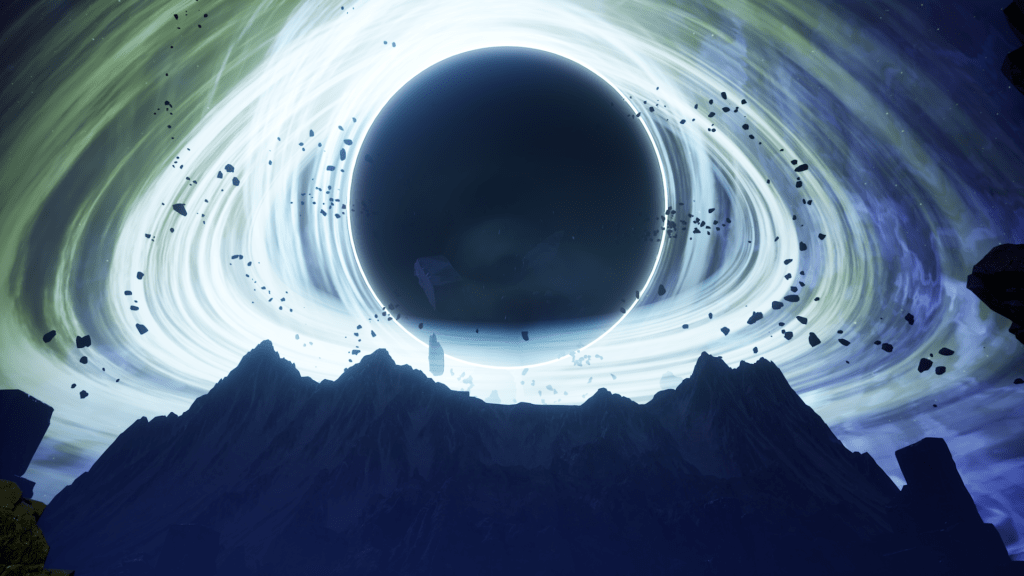
Unlike most Lovecraft-inspired games, which often take place in 1923, or perhaps 1953, Cthulhu: The Cosmic Abyss throws you into the future, specifically the year 2053, which is quite a bold move for a game of this type. Most of these stories are set in earlier periods for a reason. However, from a narrative standpoint, 2053 fits perfectly here. The world is slowly running out of natural resources, so corporations are turning to alternative ways of obtaining them. And no, I’m not talking about space or the Moon, but the depths of the ocean. As desperation grows on the Earth’s surface and climate change brings massive devastation, humanity finds yet another way to terrorize itself, through the occult. As a result, the world sees more and more practitioners of dark rituals.
You step into the role of Noah Williams, an anti-occult agent whose initial task is to uncover what happened to his colleague Mei, who has cut off all communication with the new occult bureau Noah works for, Ancile. Noah already has personal experience with the occult, as his parents were kidnapped and sacrificed by a cult leader. So it’s safe to say he doesn’t exactly have warm feelings toward such forces and carries a personal vendetta when it comes to investigating and preventing occult activity. However, having experience with the occult does not mean he is immune to it; quite the opposite. Everything he sees and goes through will affect his psyche, and that becomes one of the central mechanics of this title.

Cthulhu: The Cosmic Abyss is fundamentally a first-person horror detective adventure. Noah has no weapons to defend himself with, nor will there be opportunities to fight back. Instead, he is equipped with other tools that allow him to progress. One of the key elements at his disposal is an AI implanted in his brain called Key. All Ancile agents have it, but Noah shares a special connection with this AI. It doesn’t just provide additional information or help solve the problems in front of him, it is also there in critical moments to reason on his behalf when he can no longer distinguish what is real and what is not. Over time, Noah will be pushed to his limits, under immense pressure to maintain his sanity throughout this journey because of everything he sees, feels, and remembers from his childhood. His path is far from easy, it is filled with internal battles of the mind, alongside the external horrors he must confront. Travelling through the world of Cthulhu: The Cosmic Abyss will not be simple, not for Noah, and honestly, not for you as the player either.
And I don’t mean only in terms of puzzles and exploration. The game masterfully conveys a sense of isolation and a growing claustrophobia that gradually overpowers any initial feeling of freedom. Whether you are in a tight, confined space searching for an exit or in a wider open area, there is always a lingering sensation that the world is closing in around you. At first, that feeling isn’t overwhelming, but as time passes, the discomfort slowly intensifies, both for the protagonist and for you. The grotesque locations, the haunting landscapes of suffering and death, the vividly written documents you uncover, and the brutality inflicted upon others all contribute to this atmosphere. The game never relies on cheap jump scares. Instead, it allows unease to grow within you gradually, so that after half an hour, or sometimes several hours, you suddenly feel a chill running down your spine because of everything you’ve seen, done, and experienced. The last game that conveyed this feeling so effectively was SOMA, but I must admit that Cthulhu: The Cosmic Abyss operates on a completely different level. Here, there are far more elements you can see, touch, and interact with. It’s more complex, larger in scope, and pulls the player in on multiple levels beyond what even the excellent SOMA achieved.

On top of that, Noah’s reactions translate remarkably well to the player. Although he is an occult agent, as I mentioned, he is not immune to what he sees, hears, and does. His responses feel human and natural because he isn’t a typical video game hero, just a man forced to face something extraordinary. The moments when he encounters the surreal are often the same moments when you will find yourself reacting similarly, sharing his short comments, confusion, or even disgust. That connection between Noah and the player works beautifully from the very beginning.
Cthulhu: The Cosmic Abyss features very interesting puzzle-solving systems. At its core, everything revolves around exploration and understanding your surroundings, how things function and what purpose they serve. In other words, knowledge is your primary tool for progressing through the game. But knowledge is also your greatest enemy. By manipulating objects and interacting with the world, you learn more and more about what is happening around you, yet every piece of knowledge carries the risk of corrupting your mind. Mental corruption plays a major role in the game. Perhaps not immediately, but as you invest more hours into the experience, its influence grows stronger. Knowledge is essential, yes, but it also makes your mind more susceptible to everything you see, feel, and read, which may eventually lead to madness. Well, not you exactly, but Noah, thankfully.

That doesn’t mean you are doomed to let your mind be corrupted by occult forces simply by uncovering the truth. Cthulhu: The Cosmic Abyss always gives you choices in how you approach a problem or solve a puzzle. Through investigation, by asking the right questions, both to yourself and to the AI, by finding clues and deducing how this world truly functions. It’s a beautifully designed system that works brilliantly from the beginning all the way to the very end of the game.
The game starts slowly, but for good reason. Your investigation into what your colleague was planning and where she disappeared begins above the surface, inside her house. This is where the game introduces its core systems and shows you how everything functions. You’ll also get your first glimpse at how puzzles work, though on a much smaller scale than what awaits once you dive deeper into Cthulhu: The Cosmic Abyss. Not long after the introduction, you descend into the depths of the ocean, standing at the threshold of a sunken city that hides something unspeakable. That’s when the game truly reveals what it is.
At first, you’ll be dealing with a single problem, a single puzzle that needs solving. Later on, however, several will unfold at once, and you’ll be given complete freedom in how and in what order you approach them, as long as you eventually reach the key objective. That freedom is one of the game’s greatest strengths, but for some players it may also feel overwhelming, especially if they struggle to mentally organize and prioritize what needs to be tackled first.

Puzzle-solving can be demanding, because the game relies heavily on learning and understanding everything happening within its world. That means a lot of reading, paying attention to small details, and logically connecting information. Examining items is particularly interesting, strongly reminiscent of Resident Evil. Beyond basic descriptions, certain objects may hide secrets, clues that require closer inspection. The game subtly hints at this, but it’s up to you to discover and connect those threads yourself.
All the clues you uncover, documents, puzzle fragments, item descriptions, are stored in the so-called Mind Palace, which essentially functions like the one in Alan Wake 2. It’s a dedicated menu where you can review everything you’ve found and piece it together into a larger narrative. You can link clues that logically lead to similar conclusions or relate to the same problem. Over time, when you acquire specific items, questions will arise: how does this work, what is it used for? That’s when you’ll start assembling parts of the puzzle inside the Mind Palace. The solutions you reach often point you toward your next objective, making the manipulation and organization of information within the Mind Palace absolutely essential.
This system exists to prevent players from getting lost in the sea of information, but at first it can feel overwhelming. Eventually, you’ll grow accustomed to it, and you’ll have to. If you don’t adapt to the system, confusion will quickly take over. There were moments when I decided to gather every piece of information, trigger every puzzle, and only then step into the Mind Palace to sort everything out. When I did, I was greeted by chaos. Notes and clues scattered everywhere, making the entire process more exhausting than I expected. My honest advice is to enter the Mind Palace frequently, review your findings, analyze item descriptions and documents as you go, and keep a clear focus. Without a fixed sense of direction, both the game, and your own thoughts, can spiral into complete disarray.

It’s also important to understand that there isn’t a single fixed path to any conclusion. Everything depends on what you discover and how you approach the investigation. Sometimes you’ll reach a deduction with fewer clues; other times you’ll need far more. It all comes down to your logic and playstyle. If you’re naturally good at puzzles and deductive reasoning, you might require less information. But the clues in this game don’t only serve puzzle-solving, they shape your journey through Cthulhu: The Cosmic Abyss itself. Every deduction, every chosen solution, and every dialogue you have with Key influences how the story ends.
There isn’t just one definitive ending. There are six possible conclusions, and the path toward each one is determined by everything you do and every choice you make. It’s a beautifully designed system, and the game doesn’t constantly remind or explain it to you. Instead, it trusts you to figure it out. During your playthrough, you’ll inevitably have moments where you think, “Maybe I could have done this differently,” or “Perhaps I should have chosen another option.” Those moments are precisely what shape the outcome of your adventure.
As mentioned earlier, the game truly opens up after the introduction. You’ll gain access to far more information and far more objects to investigate. This brings us to the Sonar system. Similar mechanics exist in other titles, typically mapping out nearby points of interest. Here, however, there’s a clever twist. At first, the sonar won’t highlight anything useful unless you already have a clue about what you’re looking for. For example, if you find a gemstone, Key will analyze its frequency. In the Sonar menu, you must then select that specific frequency. Only after doing so will scanning the environment reveal other gemstones of the same type.
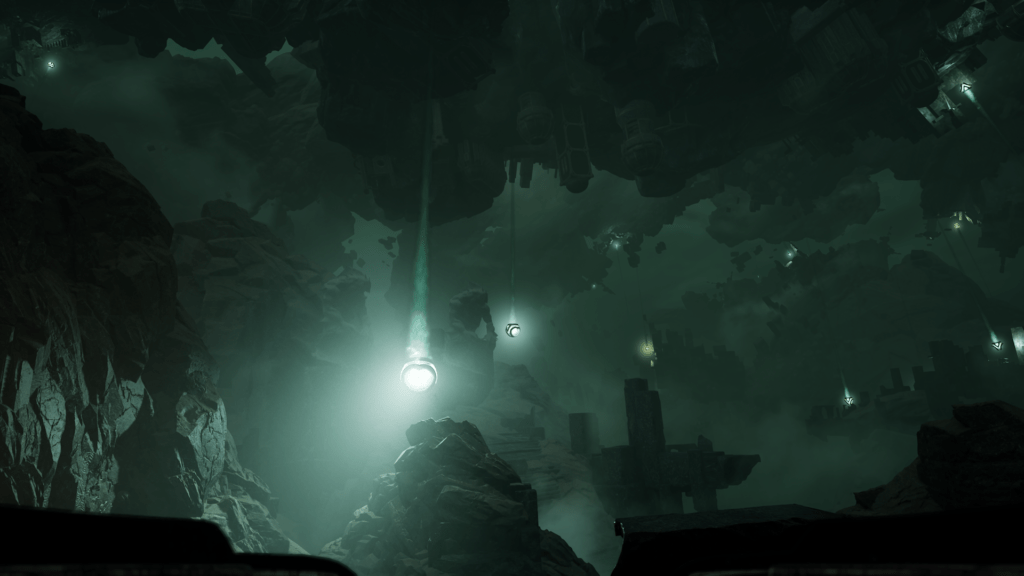
This is the core mechanic of investigation and exploration in Cthulhu: The Cosmic Abyss, and without a doubt the tool you’ll be using the most. Sometimes you’ll need the frequency of a specific object to locate puzzle components, while other times a particular frequency will act as a guide, almost like a compass, leading you toward a solution or deeper into the world itself. As you progress, you’ll discover more and more frequencies that become essential for advancement. Certain items, puzzle fragments, and even solutions can contain up to three unique combined frequencies, all of which you must recognize and track down to solve a riddle.
The great thing is that once you find a piece of a puzzle, you can immediately see which frequencies it contains. If you’re searching for the next fragment, you can simply select those frequencies and follow the trail toward the solution. Honestly, I’m surprised we’re only now seeing a mechanic like this in games, it’s genuinely fantastic, and I can easily imagine other titles in the genre adopting something similar in the future.
What fascinates me most is how Cthulhu: The Cosmic Abyss blends classic mechanics familiar to the subgenre with fresh ideas that make the experience even more compelling. At no point does any system feel unnecessary or included just for the sake of having more features. Everything serves a clear purpose and offers tangible value to the player, which is refreshing. There’s no mechanical bloat here, no filler systems added simply to increase complexity. At first, it may seem like there isn’t much to juggle, but over time you’ll realize it’s more than enough. In fact, for some players, even these tightly designed systems can feel overwhelming at times.
That confidence comes from the fact that Cthulhu: The Cosmic Abyss knows exactly what it wants to be from the very first minute. And as you continue playing, that confidence only grows stronger. From the outstanding soundtrack that builds tension and unease, to the vivid and disturbing written descriptions, to the brilliantly implemented investigation mechanics, everything feels carefully crafted and exactly as it should be.

That said, there is one complaint, at least in this pre-release period, and it concerns performance on Xbox Series X. The game offers two modes: Quality, which prioritizes higher resolution and enhanced detail, and Performance, which aims for 60 frames per second. Visually, both modes look excellent, but neither maintains a stable frame rate. During moments when the sonar highlights numerous objects sharing the same frequency, I experienced frame drops that felt like they dipped below 20 FPS, even in Performance mode. For a slow-paced, methodical horror adventure like this, it’s not a dealbreaker. Still, in certain sections, it does break immersion. And that’s perhaps one of the very few genuine flaws the game has. Other potential “issues” will largely depend on what players expect from a title like Cthulhu: The Cosmic Abyss.
Cthulhu: The Cosmic Abyss (Xbox Series X)
Anyone who knows what they want from a game of this type, especially those who enjoyed SOMA, or even the exploration-driven design of Outer Wilds, to which an interesting parallel can be drawn, will find Cthulhu: The Cosmic Abyss to be a truly exceptional and unconventional horror adventure. It’s rare for a game like this to pull me so deeply into its world, to make me want to touch everything, read everything, and investigate every corner the way this one does. Big Bad Wolf has done an outstanding job, taking a well-worn horror theme and transforming it into something fresh, original, and genuinely captivating. It offers hours upon hours of engagement, and I have to emphasize its excellent replay value. Even after your first playthrough, the game encourages you to approach things differently and discover alternative outcomes shaped by new choices. And that, ultimately, is the true magic of this title.


