






I remember when I first tried playing Returnal. I jumped into it knowing almost nothing about how it actually worked, but I was simply drawn in by all the hype surrounding it. It didn’t take long, though, to realize just how fast those colorful projectiles were flying toward me, how relentless the enemies were and don’t even get me started on the bosses. The biggest blow was having to restart from the very beginning of the biome every time I died. For a souls veteran, that shouldn’t feel like such a harsh punishment, but unlike the souls games, it took me longer here to truly understand and explore everything the game had to offer. Still, once everything clicked, I was rewarded with fantastic combat and a deeply emotional story.

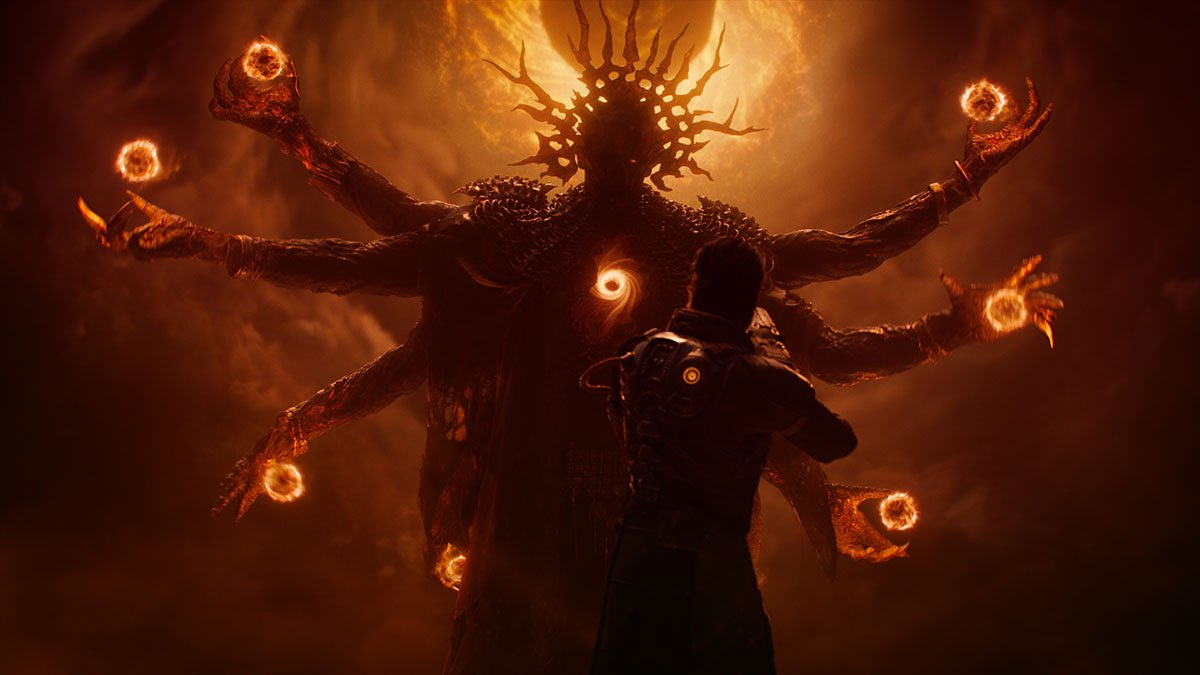
Five years later, Housemarque has finally delivered a new game. And while Saros is a successor to Returnal, it’s unique in its own way. The trailer caught me completely off guard last year, especially when I saw that the inspiration for this game was ,,The King In Yellow” by Robert W. Chambers. I watched it with my Twitch community, and I’m pretty sure they were all rolling their eyes as I started yelling at every single glimpse of “the king” on screen. These days, people keep asking me if Saros is just Returnal 2, so here I’ll try to explain how it differs, and what makes it such a unique and unforgettable experience.
In this game, you take on the role of a man named Arjun Devraj, who arrives on the planet Carcosa with his crew, Echelon IV, to investigate what happened to three previous expeditions. Those earlier teams had come to Carcosa after the Soltari corporation discovered a mysterious mineral called Lucenite, but under strange circumstances, the crew members vanished. Arjun awakens on Carcosa with no memory of what happened after landing, and once he reaches the base, he learns that one of his own crewmates has completely lost his mind and sabotaged their ship, which is the only way off the planet.
After this disaster, Arjun takes it upon himself to find the missing members of the previous crews, but he quickly realizes that Carcosa is anything but welcoming. The planet is teeming with hostile alien life, and every solar eclipse drastically reshapes the environment, making enemies stronger and more aggressive. On top of everything, Arjun is also searching for his wife, Nitya, who was a part of Echelon I. Throughout his journey, every time Arjun dies, he returns to the base, but once again with no memory of how it happened.
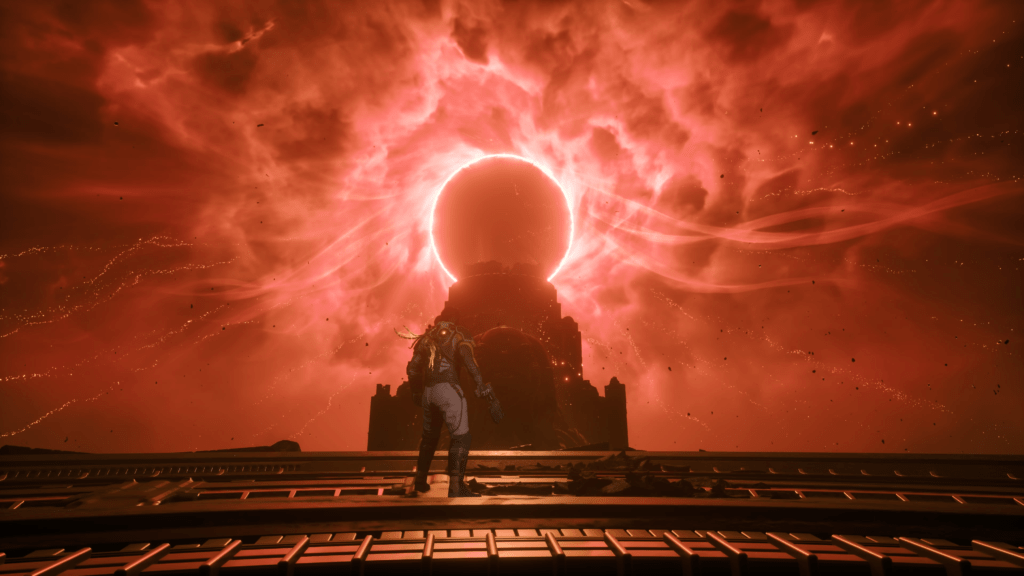
In the original story, Carcosa is described as a mysterious ,,lost city”. Its sky is filled with black stars, twin suns, a strange moon, and the gloomy Lake of Hali. The entire landscape is bathed in a yellowish light. The city itself feels like a ruin, adorned with monolithic towers rising behind the moon, and as a place of lost souls, it carries an aura of decay. At its center stands the king, described as wearing a mask, but beyond that mask is hidden a glimpse into madness and despair.
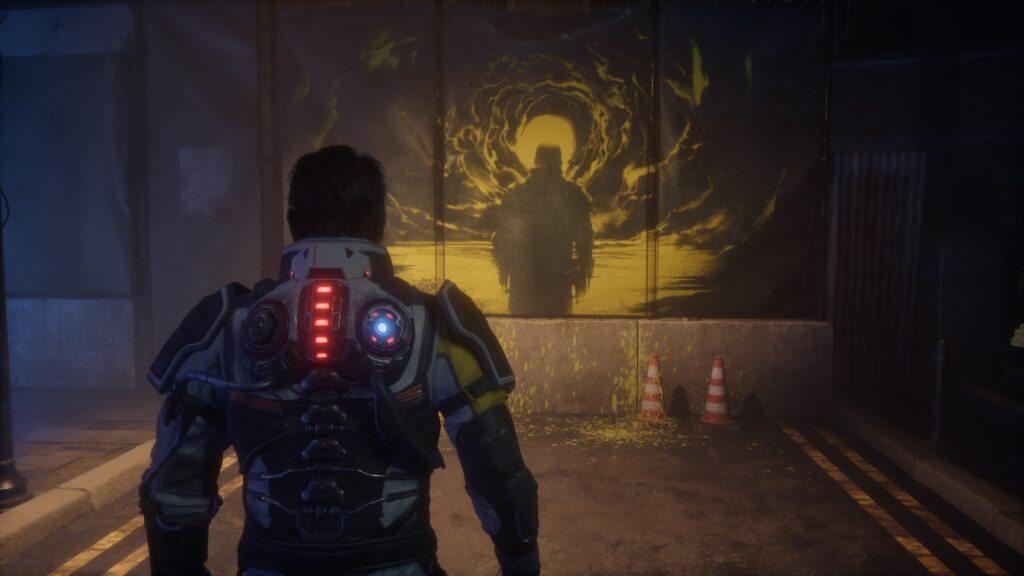
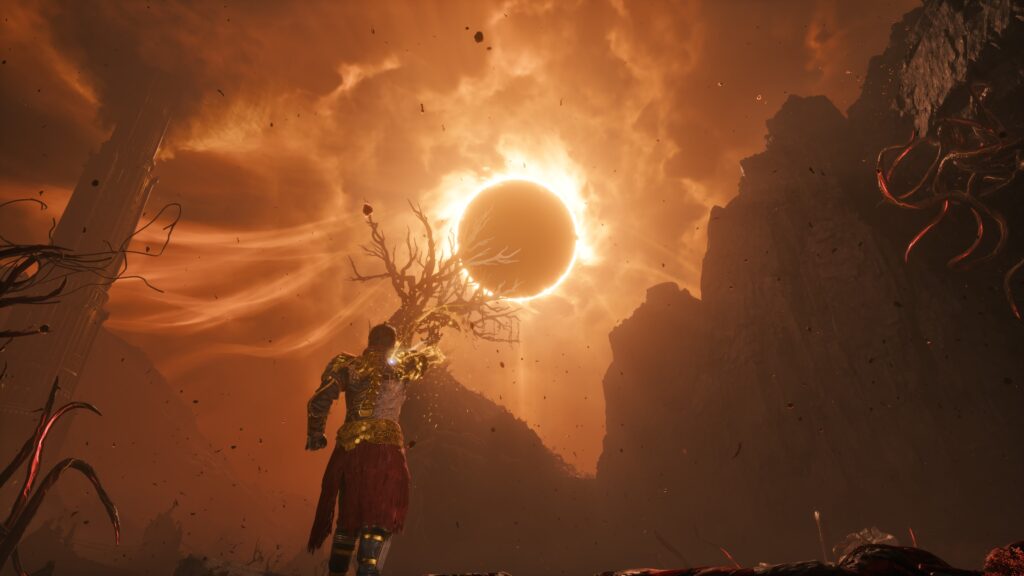
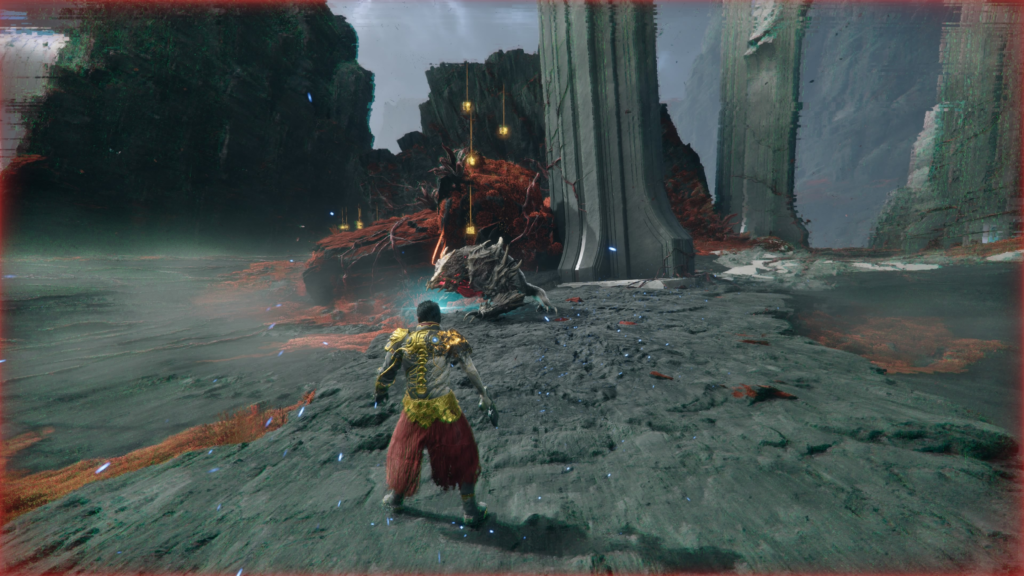
Carcosa in Saros is somewhat different. While surviving the first biome, you’ll notice a blend of beautiful yet strange white marble sculptures, pale red grass, and alien vines stretching everywhere, along with grey, decaying trees that almost seem to take on human shapes. The biome is filled with ominous projectiles you must dodge, as well as various enemies, some flying and shooting at you, others charging head-on until you reach strange hands emerging from what looks like blood – red water. If you come into contact with them, they will grab you, triggering a solar eclipse that transforms the entire environment into something far darker.
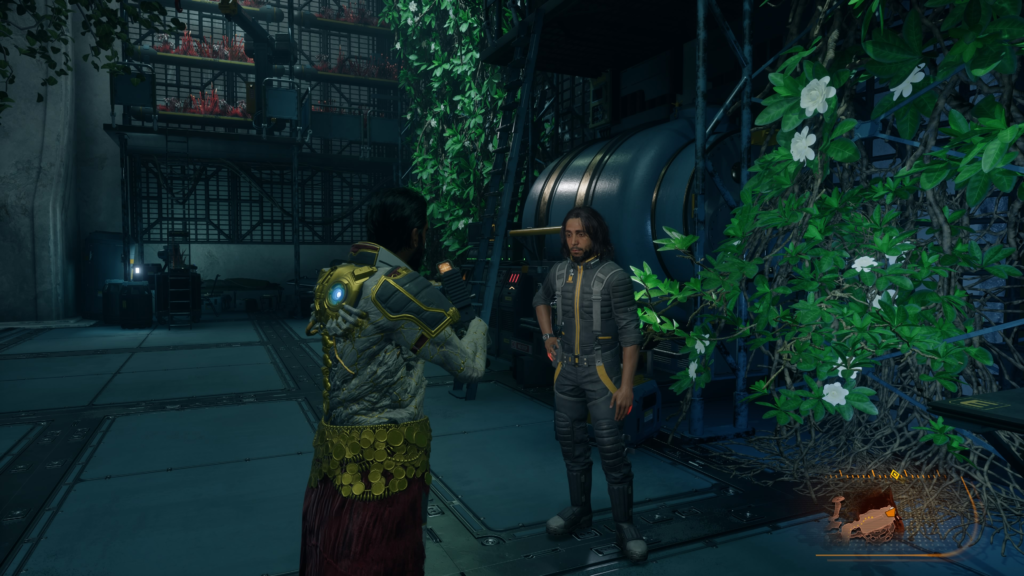
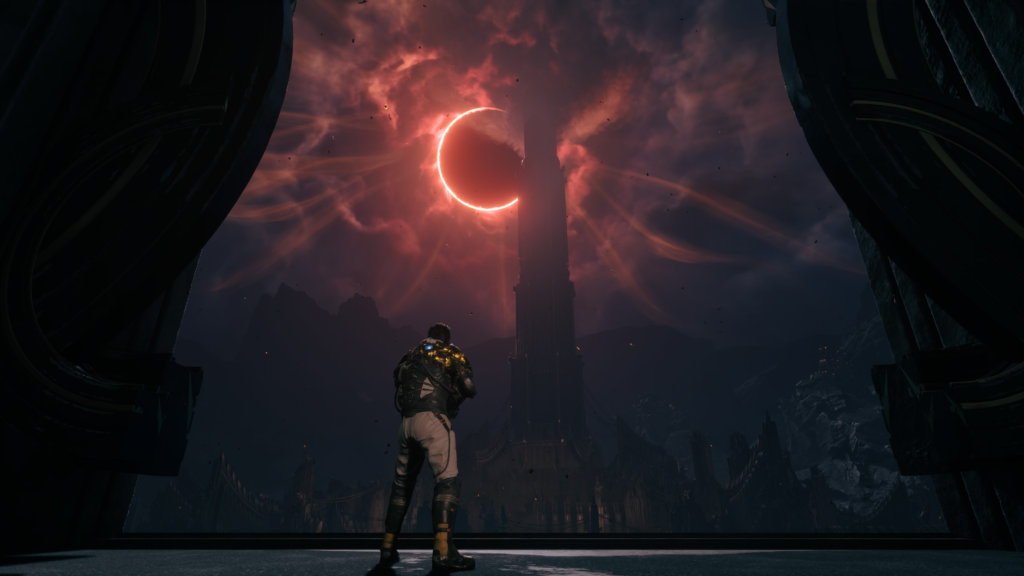
The sun appears to burn, vines turn into tendrils, and enemies become even more aggressive. Each biome has its own boss, and every time you die, you return to the base, where you can speak with members of your crew, including Sheridan Bouchard, commander of Echelon IV, Jerome Jackson, chief executor, pilot Stack, engineer Kayla, the mysterious Sebastian, Arjun’s friend, and Primary, the newest product of Soltari artificial intelligence. Throughout the game, you’ll also encounter numerous audio logs that reveal more about other characters and their fates. The story follows a similar structure to Returnal, where every detail matters in forming the bigger picture. Each eclipse, each death, each boss defeat, and each biome progression reveals new scenes. Some repeat, but as you progress, they subtly change. Where Returnal is cold, depressive, and reflective of its protagonist, Saros is explosive and fiery.
Gameplay is the crown jewel of this game. As a third – person action title, Saros combines a roguelike structure with bullet-hell shooting, filling the screen with enemy projectiles and demanding quick reflexes to survive. You’ll have access to a wide arsenal, including pistols, rifles, shotguns, crossbows, and the ripsaw rifle, which fires deadly projectiles that tear through enemies until they die.
The game features three types of attacks: a standard attack where you press or hold R2, an alternative attack where you half-press L2, and the most powerful attack where you fully press L2 while firing. The adaptive triggers truly shine here, and the controller’s vibrations let you feel not only every bullet but every movement. There are also special abilities that charge during combat, such as Prominence, which you unlock early on and which launches a massive explosive attack. Later, you can even switch this ability.
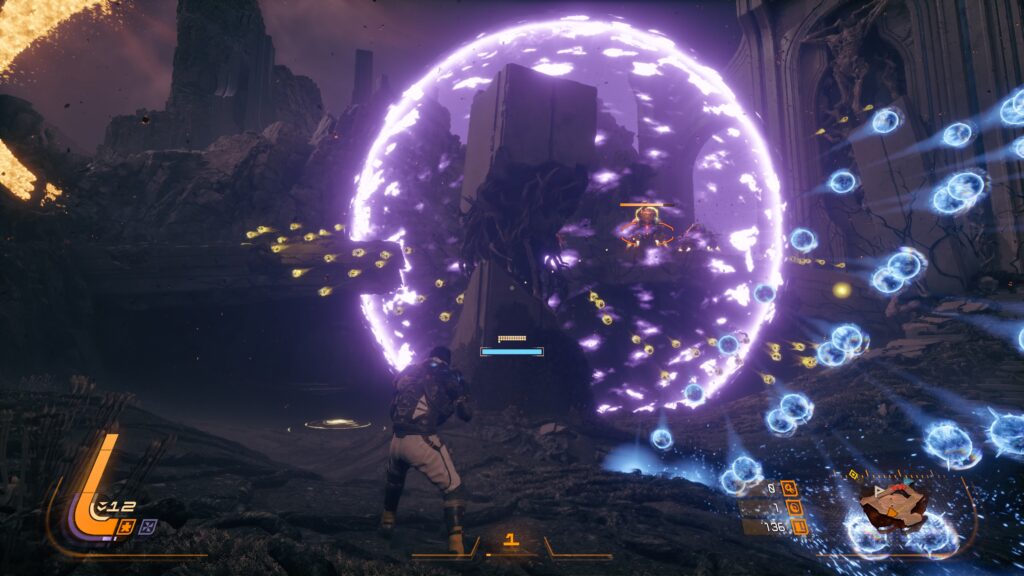
My go-to weapon was usually the Ricochet Handcannon, whose bullets bounce and deal damage, which is ideal for handling multiple enemies. If you focus on a single target (like a boss), you can switch to an alternate firing mode that allows continuous shooting as long as you time your reloads perfectly. You also have a shield with limited duration, as well as a melee attack used to break enemy shields or barriers, often revealing valuable items or text and audio logs.
Throughout the game, you’ll encounter orange, red, and blue pillars, each offering different rewards such as weapons, keys to unlock paths, abilities, or health. After some time, you unlock the Carcosan Modifier, which can make the game easier or harder depending on your choices. To truly understand Saros, you need to grasp its three colors – green is Resilience, increasing max health, blue is Command, enhancing your shield and allowing more frequent use of your strongest ability and yellow is Drive, increasing the rate at which you collect Lucenite and convert it into Proficiency. This is important to know, as various items can improve your stats or strengthen your weapons.
Saros also features a skill tree, allowing you to unlock abilities as you gather points. However, there’s something called, the death penalty, and that means each time you die, you lose some of those points. Despite this, with its skill tree, Carcosan Modifier, and the ability to skip directly to later biomes via Primary’s portals, Saros is far more accessible than Returnal.
Since we already explained your skills and attacks, let’s talk a little bit about enemies. Their attacks also have three colors – blue, red and yellow.
Blue attacks can be blocked and absorbed to charge your strongest ability. Yellow attacks can also be blocked but inflict corrosion, limiting your ability to heal. Red attacks cannot be blocked at all, though you’ll later gain a parry ability to counter them if you’re confident enough, if not, you can still avoid them by rushing or dodging. The most important lesson I learned is movement. Always stay in motion, circle around enemies instead of retreating, and prioritise moving over damage because that will keep you alive.
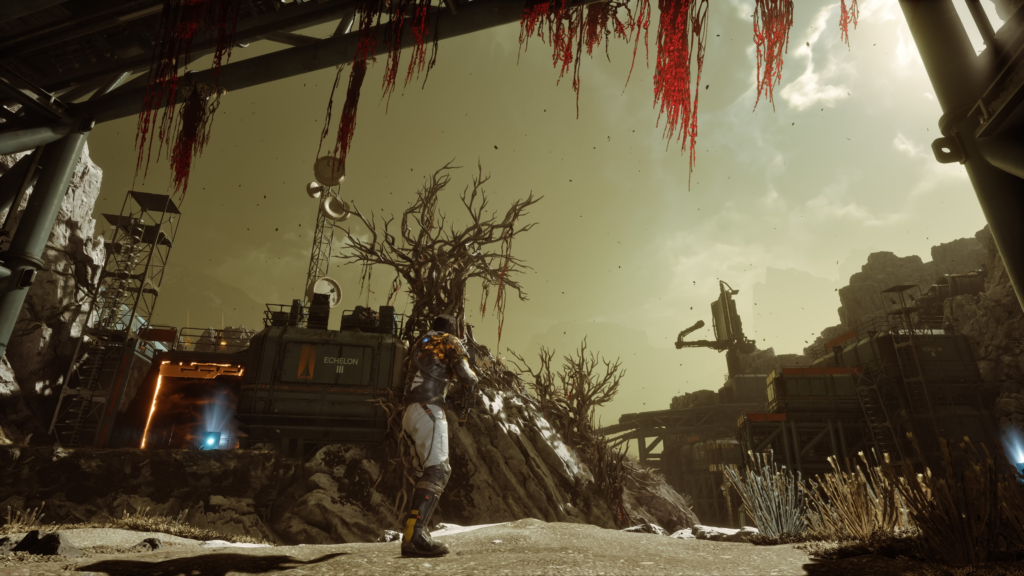
One more important thing. In this game, you have a map in the lower right corner. Blue flag tells you where you need to go, white flag tells you that there is a place you can explore. At first, you won’t be able to reach every place because some require certain abilities, but that’s why you can always come back later on and reach what you couldn’t before.
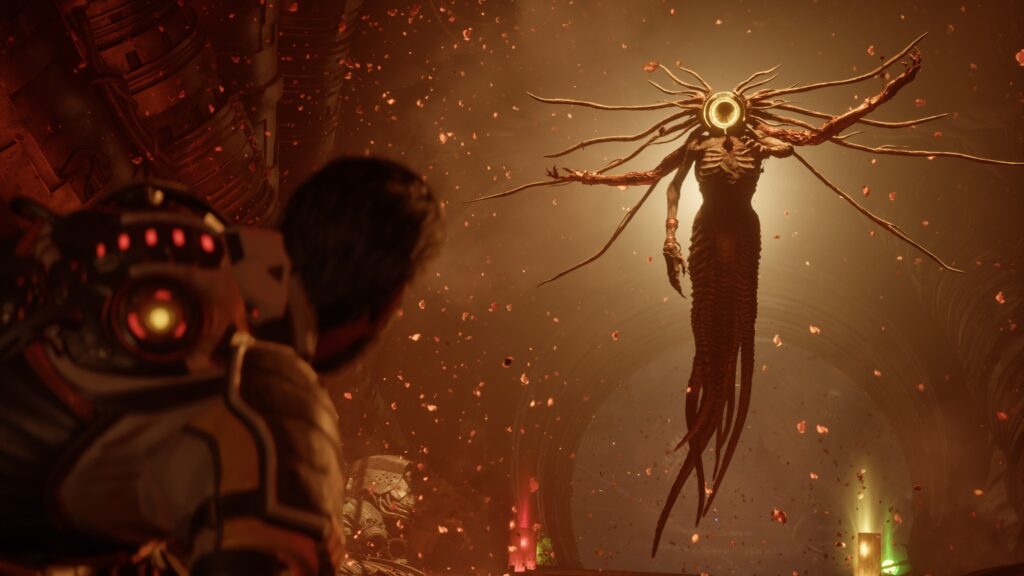
Visually, the game is stunning. The transition from calm to chaos during a solar eclipse is breathtaking. Some biomes change completely, like, for example, a swamp that initially allows free movement across blood – red water, but later transforms into a toxic hazard during the eclipse. Boss fights feel surreal, and there are sequences beyond the planet that add narrative depth. The vibrant colours contrast beautifully with the game’s somber tone.
The sound design is phenomenal, especially in how it builds tension, silence is never truly empty, and sudden audio distortions feel like warnings. Sound doesn’t just accompany the world, it shapes it. You might suddenly hear a scream out of nowhere or the subtle jingle of your medallion as you move.
Voice acting and performance capture are, as expected, excellent. I’ve known Rahul Kohli since The Haunting of Bly Manor, where he played the kindhearted chef Owen, and later from The Fall of the House of Usher, where he portrayed the arrogant Napoleon Usher (fun fact, his role in this show was a video game developer). As the protagonist, Kohli delivers a restrained performance, portraying a man who feels his sanity slowly eroding under Carcosa’s influence, quietly, controlled, and without ever needing to say it aloud. Thanks to performance capture, facial expressions and body language work seamlessly with the voice, making the characters feel grounded and believable.
Saros (PlayStation 5)
In the end, Saros is another major success for Housemarque. Once you start playing, it’s hard to put down because of its fantastic combat and constant sense of curiosity that push you forward, because no matter how many times you die, you always come back stronger. Saros may not be for everyone, but for those who embrace its rhythm and tone, it offers something rare and that is an experience that is thoughtful, unsettling, and true to its vision.


