



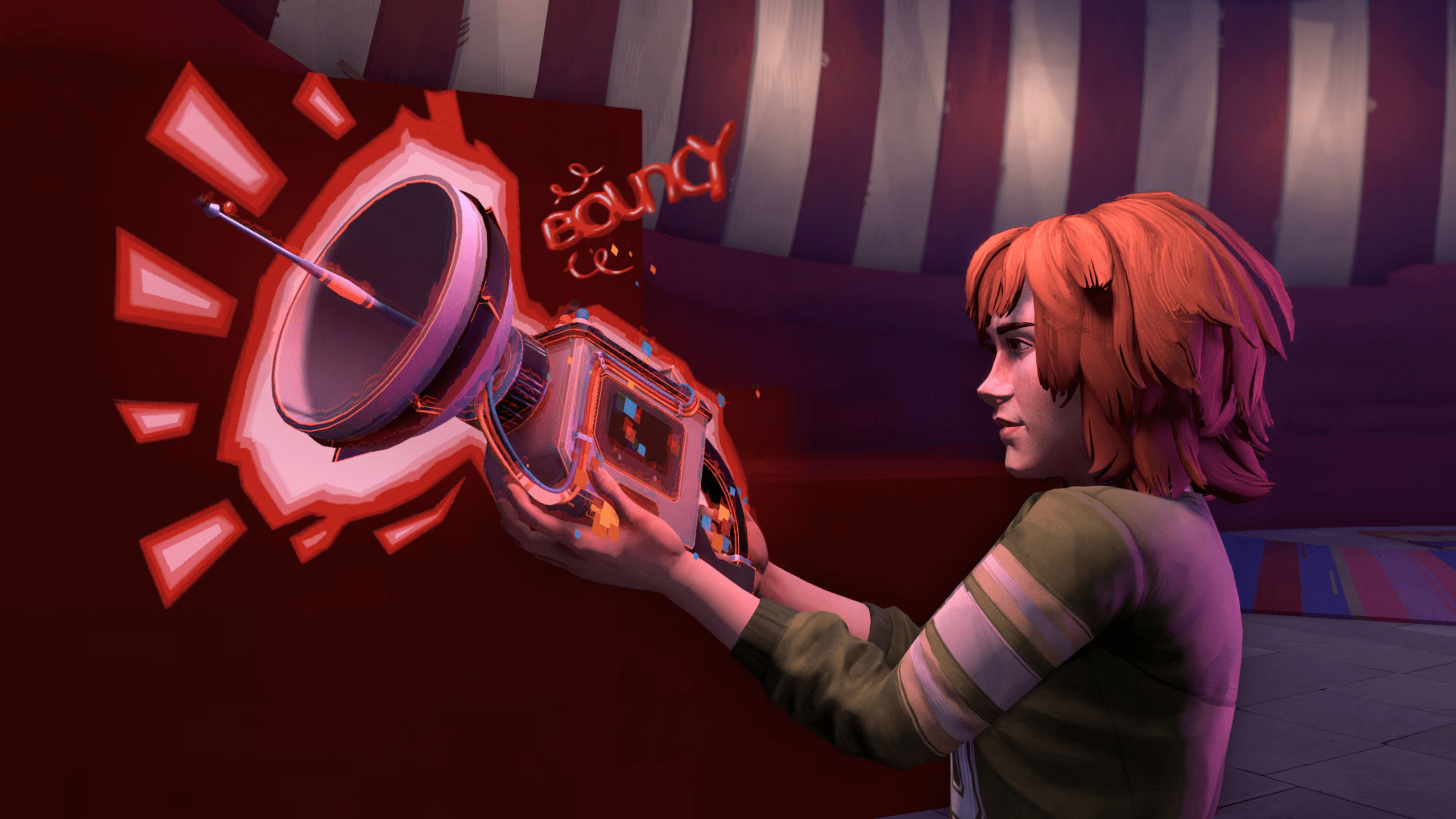


It’s been a long time since I last played a really good 3D puzzle game. Whenever I think about the genre, Portal 2 is the first title that comes to mind. Right after that, I think of The Talos Principle, Quantum Conundrum, and plenty of others. There are even a few whose names I can’t remember anymore, but I know they were fantastic. In general, I’ve always loved games that revolve around manipulating objects to solve puzzles. They’re engaging, sometimes demanding, but in the best possible way because, unlike many modern games, they force you to think. They get your brain working, pull you into their world, and make you forget about the one you actually live in. Good games do that. Bad ones simply frustrate you.
Then came Yerba Buena, an indie title developed by Mad About Panda and published by Focus Entertainment. It brings a fantastic core idea, a solid narrative setup, and, best of all, a mechanic centered around manipulating the world itself. On paper, it checks practically every box I look for in this type of game. Of course, having all the right ingredients is only half the battle, the important thing is whether they actually work together. So let’s take a closer look at what Yerba Buena has to offer.

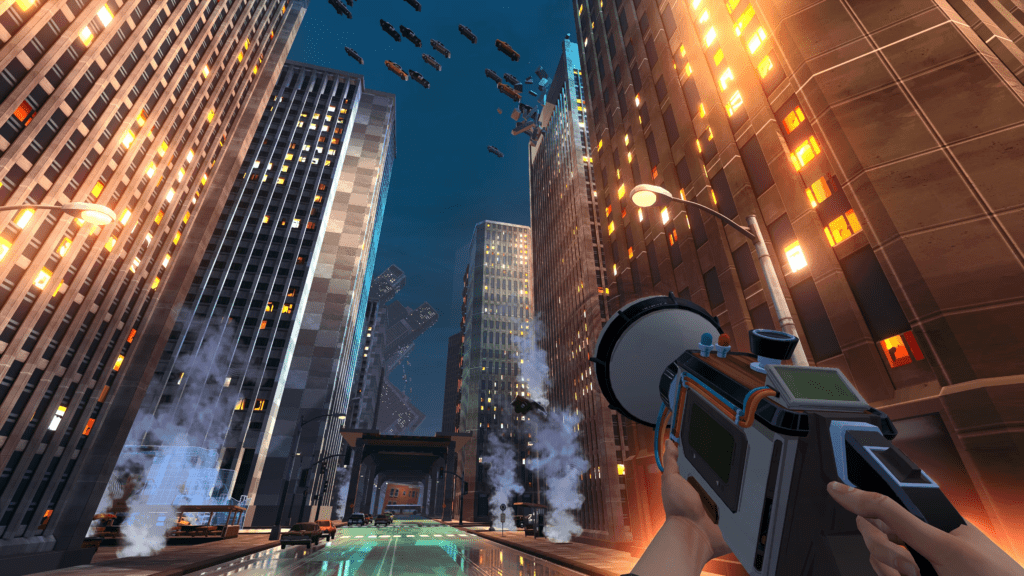
The game takes place in 1970s San Francisco. You play as Barbara, or simply Barb, a woman who can’t quite find her place in the world. She doesn’t know what she wants to do, can’t establish any sort of routine, and desperately wants to break free from the repetitive loop she’s trapped in. One day, Barb and her friend Russell are driving through the city in his taxi when something completely unexpected happens. A stranger forces Barb out of the vehicle, kidnaps Russell, and disappears. The only thing left behind is a mysterious bag wrapped in chains.
Naturally, Barb rushes to her friends looking for help in rescuing Russell, especially since the police seem unwilling to do anything. And that’s where your journey begins, a journey through a wonderfully crafted world drenched in the style and atmosphere of the 1970s, a setting that shines through every corner of the game. At first, your goal is simple: save Russell, or at least try to. And in the meantime, a much larger conflict emerges, one involving a massive corporation threatening to destroy a park known as Yerba Buena. And now, your task is not only to save your friend, but also preserve Yerba Buena.
A little bit of real-world history makes this setting even more interesting. Yerba Buena Park actually exists in San Francisco and is one of the city’s protected landmarks. The name itself is a tribute to the region’s original identity. Before the city became known as San Francisco, the area was called Yerba Buena, meaning “good herb,” named after a fragrant medicinal plant that grew there. Understanding that context makes Barb’s determination to protect the park feel entirely justified. She isn’t just fighting for a patch of land, she’s fighting against corporate greed and the destruction of a place with genuine historical significance.
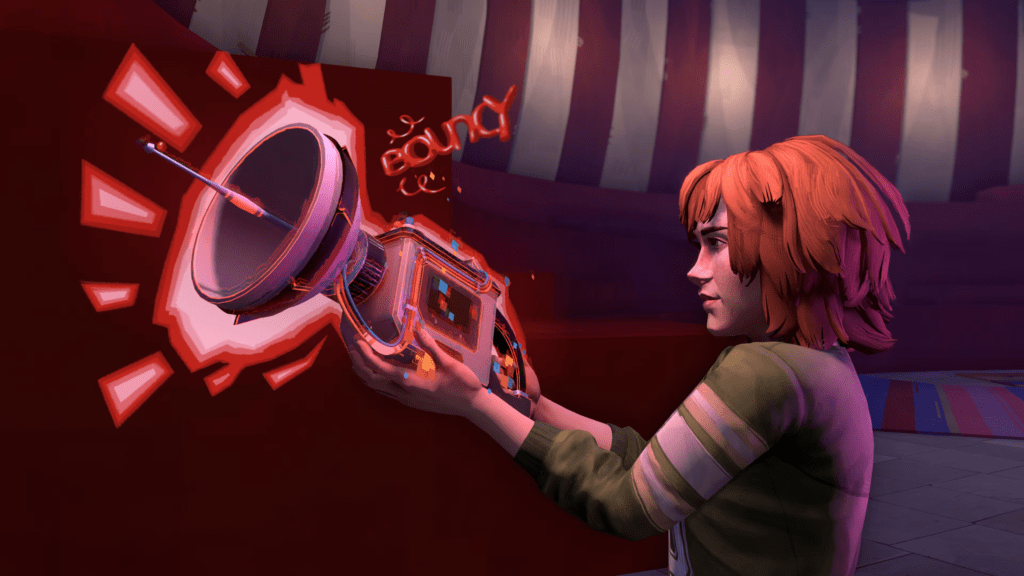
After a brief introduction, Barb opens the chained bag and discovers The Oscillator, a unique device shaped like a weapon that allows her to manipulate the world around her. More specifically, it lets her move, rotate, and reposition certain objects, objects affected by a strange phenomenon known as glitches. In this world, some things simply stop functioning correctly and become glitched. Ordinary people can’t interact with them, but Barb can manipulate them using the Oscillator. And that’s where the game’s core mechanic reveals itself.By manipulating these glitched objects, you solve the problems and puzzles scattered throughout the world.
The first clever thing about this system is that you can only interact with glitched objects. If you could manipulate everything, the entire puzzle structure would collapse. There has to be a set of rules, and the game sticks to them consistently. The second interesting twist is that you can’t simply pick up and move objects freely like you would in Portal or similar games. Instead, you can only move them according to specific movement patterns.
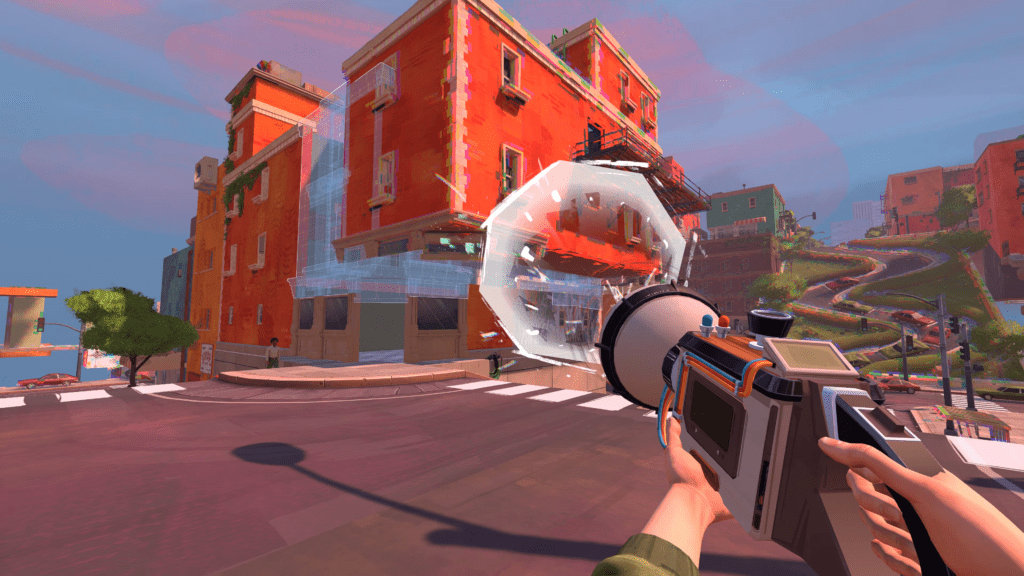
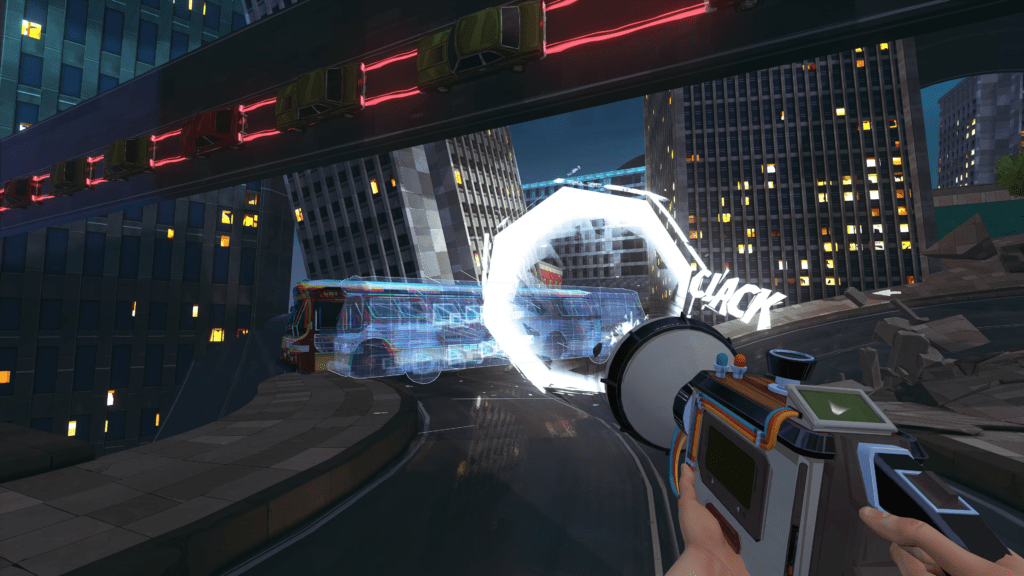
And this is where the Oscillator becomes particularly clever. Rather than generating movement on its own, it copies movement patterns from objects in the world. Cars, traffic signs, moving machinery—anything that follows a predictable motion path can become a source of movement. If a car moves from left to right, for example, you can capture that motion and apply it to a glitched object elsewhere.
Imagine the entire game as a giant puzzle. The difference is that instead of looking at it from above, you’re standing inside it from a first-person perspective. Your objective is to rearrange all the movable pieces in a way that creates a path toward your goal. And naturally, it’s never as simple as moving one object and then another. Most puzzles require combining several glitched objects together to reach specific areas.
And those objects aren’t always small props, either. Sometimes entire sections of buildings or massive environmental structures become part of the puzzle. You might need to reposition multiple pieces of a building just to create a route leading to a rooftop. Early on, these challenges can feel surprisingly demanding, and the game leans heavily into the classic puzzle-game philosophy of experimentation. Try something. If it doesn’t work, try a different approach. There are always enough movement sources available, you simply need to find them.
You do this by pressing the Left Trigger, or L2 on a PlayStation controller. This activates a scan mode that highlights objects whose movement patterns can be copied. The only minor issue is that these objects are usually in motion, which is the entire point. On a controller, following those movements precisely and capturing them isn’t always the easiest task, especially when the object is located far away. As a result, you often need to figure out how to position yourself at a reasonable distance before you can successfully copy the movement you need. Before diving deeper into the mechanics, it’s worth circling back to the story for a moment.
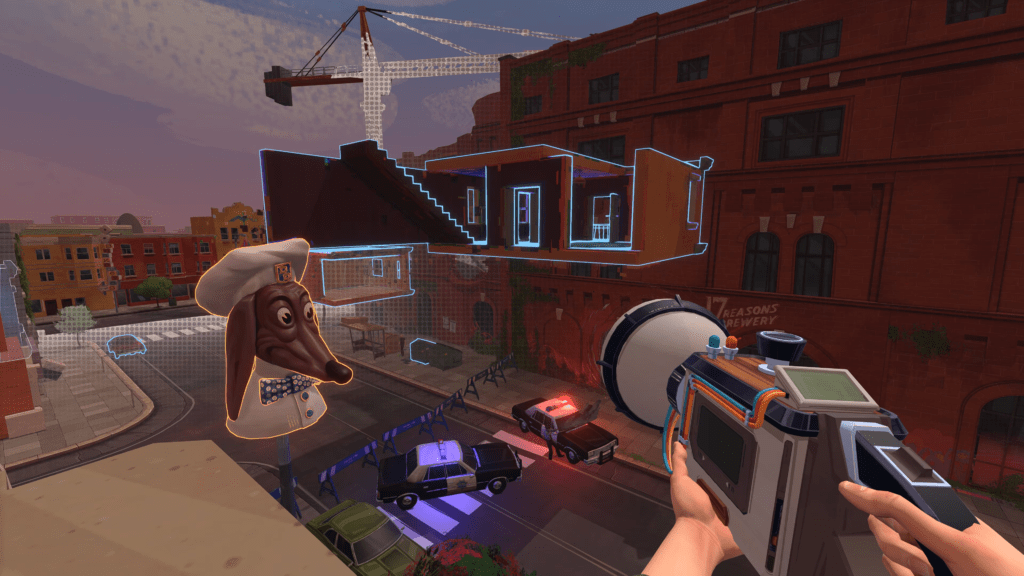
Very shortly after obtaining the Oscillator, Barb discovers something unexpected: she is actually an NPC inside a video game. Not only that, but she’s an NPC who wants to change the way the game itself is structured. The glitches aren’t merely bugs, they’re anomalies that allow her to bend and rewrite the rules governing her reality.
I’ve already seen some criticism directed at the NPCs in this game. Some players argue that they feel stiff, that they move awkwardly, or that their behavior lacks purpose. But honestly, I think all of that fits perfectly within the narrative. These characters are, quite literally, scripted NPCs trapped inside a game world. They’re designed to follow predetermined routines and limited behaviors. As you progress through the story, their mannerisms start making more and more sense, and it became one of the aspects I appreciated most about the game. But enough about the story for now, let’s get back to the mechanics.
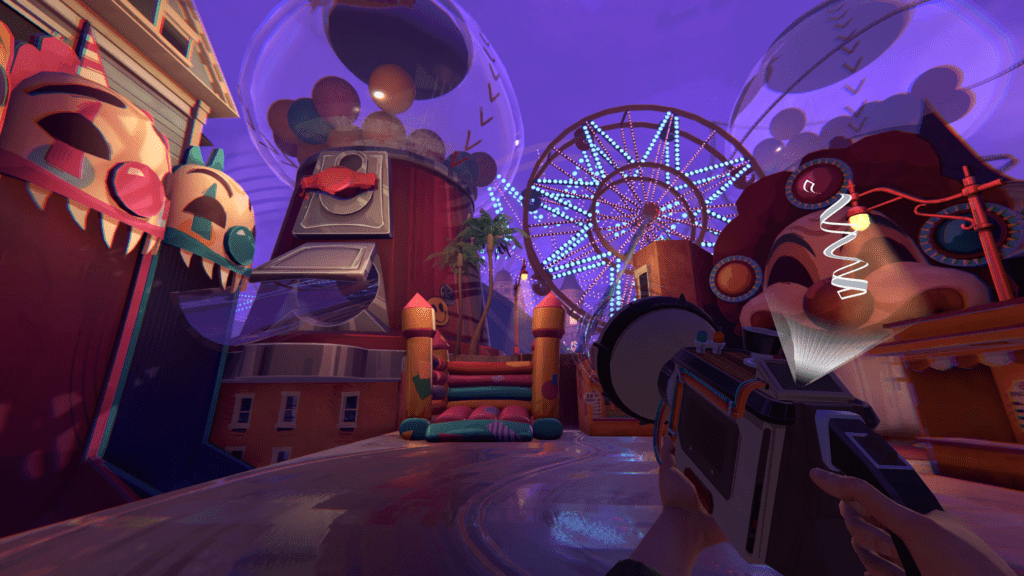
At its core, the entire gameplay loop revolves around what I already mentioned: manipulating objects. As time goes on, however, the puzzles become increasingly complex and demanding. And the world itself is absolutely wild. The things that happen in it, the levels you explore, and the characters you encounter are often completely unexpected. The game constantly finds new ways to surprise you, throwing twists and ideas your way when you least expect them. This isn’t one of those games where you move from one level to another following a predictable theme or progression. Instead, the transitions between areas are often bizarre and unpredictable, making every new level feel like a genuine surprise.

Because of that, the level design in Yerba Buena is genuinely impressive and easily one of the game’s greatest strengths. But more importantly, the way the puzzles gradually evolve throughout the adventure is handled exceptionally well.
As I mentioned earlier, things start relatively simple. You copy basic movement behaviors, a trampoline bounce, a rotating sign, a moving car, and use them to reach the next objective. As you progress, the developers begin combining these mechanics in increasingly creative ways. Soon you’ll encounter levels where multiple properties need to be combined simultaneously. You might need to create an object that jumps, rotates, and moves forward at the same time in order to cross a section of the level and help you reach the exit. Later puzzles force you to think several steps ahead. First, you alter one object, then use that change to affect something else, and only then can you solve the main challenge. Sometimes you’ll apply multiple Oscillator effects to a single object or swap properties on the fly while navigating through a level.
The best part is that the game rarely locks you into a single solution. You can get incredibly creative, and you’ll often discover absurd approaches that the developers probably never anticipated themselves. That freedom creates an incredible sense of satisfaction when you finally crack a difficult puzzle.
Even in the very first level, I thought I had figured out a specific way to reach the roof of a building. But later, after experimenting with moving objects around, I ended up reaching the roof through a completely different route. And honestly, that’s the true beauty, and arguably the biggest selling point, of the game. Even when revisiting an old level, you’ll constantly wonder: Could I solve this differently? What if I tried this instead? Before you know it, you’re completely absorbed in experimentation.
I’ve already mentioned how complex some of the puzzles can become, and there were definitely moments where my brain genuinely hurt. Partly because you yourself are part of the puzzle, and partly because almost everything around you becomes part of the puzzle as well. You have to train your mind to think differently, to approach problems from unusual angles until you eventually settle into the game’s unique way of thinking. There are moments where it can feel a little overwhelming.
But once you truly understand the mechanics and learn how this world operates, that overwhelming feeling transforms into something entirely different. Suddenly, you find yourself wanting more puzzles, more challenges, and more opportunities to put your brain to work.
Since this game comes from a relatively small development team, there are a few minor issues that stood out to me. The first is targeting moving objects with the Oscillator. As I mentioned before, some of these objects can be very far away or extremely small, making it tricky to accurately capture their movement patterns. The second issue is performance, or more specifically, the frame rate. The game runs at 30 FPS on PlayStation 5 and on other console versions as well. Considering how lightweight the game is on PC hardware, I honestly don’t understand why the developers chose to target 30 frames per second. This feels like a game that would greatly benefit from running at 60 FPS.
The third issue is one that I personally don’t consider a flaw, but I know some players will. The game does very little hand-holding. It doesn’t explain every mechanic in detail, it doesn’t provide constant hints, and it rarely steps in to help. Instead, you’re expected to figure things out entirely on your own. For some players, that may become frustrating. For me, however, it’s one of the game’s biggest strengths.
We would like to thank Focu Entertainment for providing us with a copy of the game for review purposes.
Yerba Buena (PlayStation 5)
In a sea of games that constantly recycle the same ideas and formulas, it's refreshing to see a title willing to do something different—something that genuinely tries to stand apart from the crowd. And honestly, I don't know how nobody came up with this particular style of first-person puzzle design before, because it's brilliant. I'm genuinely happy that a small team like Mad About Pandas managed to find an idea that feels fresh and largely unexplored, and then execute it so successfully. If you're a fan of puzzle games, this is absolutely a title you should try. There's already a demo available on Steam, and I believe it's available on consoles as well.


