





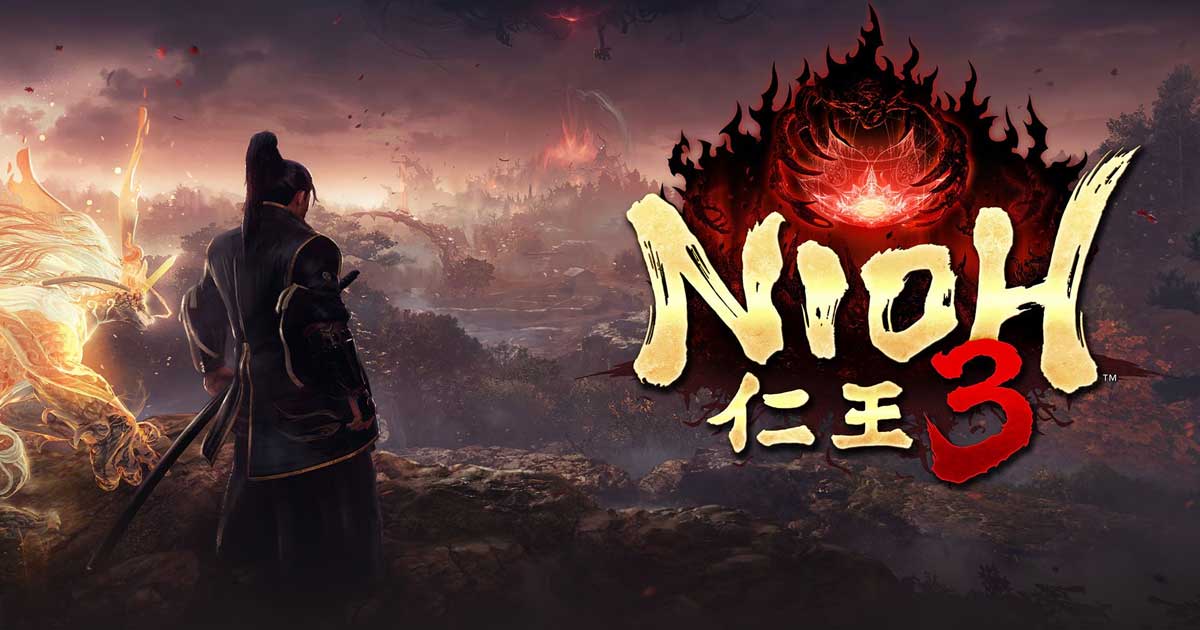


I can’t say I don’t absolutely love Team Ninja games. Ever since the days of the original Xbox and Ninja Gaiden, I’ve genuinely adored every action title that’s come out of their kitchen. Some more, some less. Some impressed me in absolutely every aspect, while others I loved purely for their incredible gameplay. Ah yes, Team Ninja and their near-perfect gameplay in almost every release. What’s interesting is that every one of their games has clicked with me, especially Wo Long: Fallen Dynasty, Rise of the Ronin, and of course the Nioh titles. And when it comes to Nioh specifically, those games have always felt like something special from Team Ninja and Koei Tecmo, brilliant interpretations of Japanese history infused with rich mythology. An excellent combination. The first two entries were fantastic, each in their own way. Different, yet equally strong. And now the time has come for the third installment, the one that was supposed to change everything. And I have to admit… it does. So let’s start from the beginning.

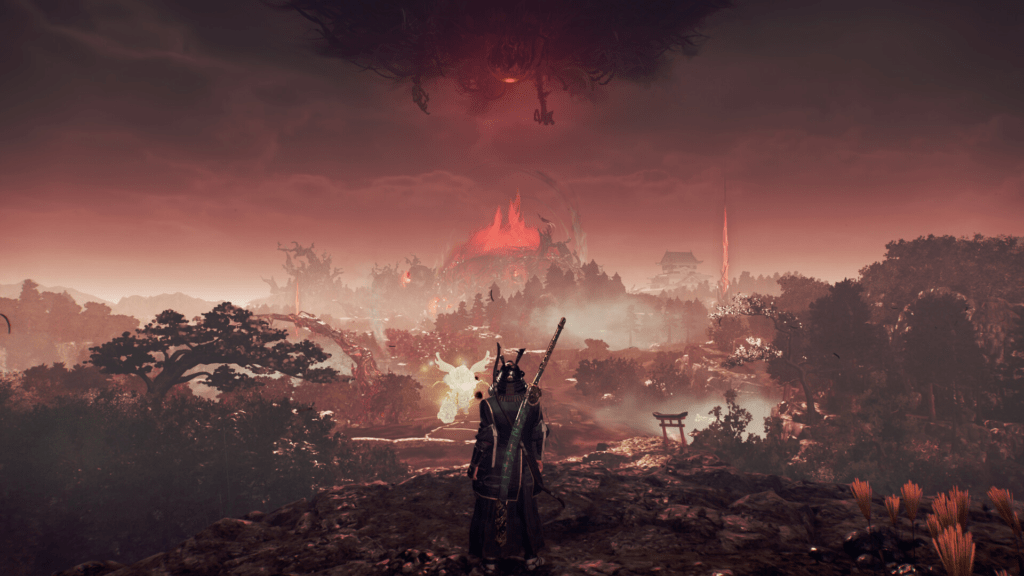
Let’s begin with the story. But before that, I need to briefly touch on how it evolved in the first two games. In Nioh, we had a fixed protagonist — no character creation — which didn’t sit well with everyone. In Nioh 2, we could create our own character, but there wasn’t a particularly strong personal background tying that character deeply to the overarching events. It didn’t feel all that “personal,” if I can put it that way.
In Nioh 3, however, the story is far bigger and more ambitious. You step into the role of Tokugawa Takechiyo, heir to the shogunate, preparing to become Japan’s next shogun — only to be betrayed and cast into chaos when his younger brother Kunimatsu, completely lost and blinded by jealousy and hatred, summons dark forces to rise against him. That central drama, brother versus brother (or sister, depending on your character), war versus peace, doesn’t remain trapped in a single era. It stretches across time itself, forcing you to travel through different historical periods such as Sengoku, Heian, and Bakumatsu, all while trying to change the fate of the country and defeat the corruption of yokai forces threatening not just Japan, but the entire world.Even with all those fantastical and surreal elements, yokai creatures, guardian spirits, time travel, the core narrative remains simple and universal: the fight for peace, the struggle against betrayal, and confronting your own demons, both literal and metaphorical.
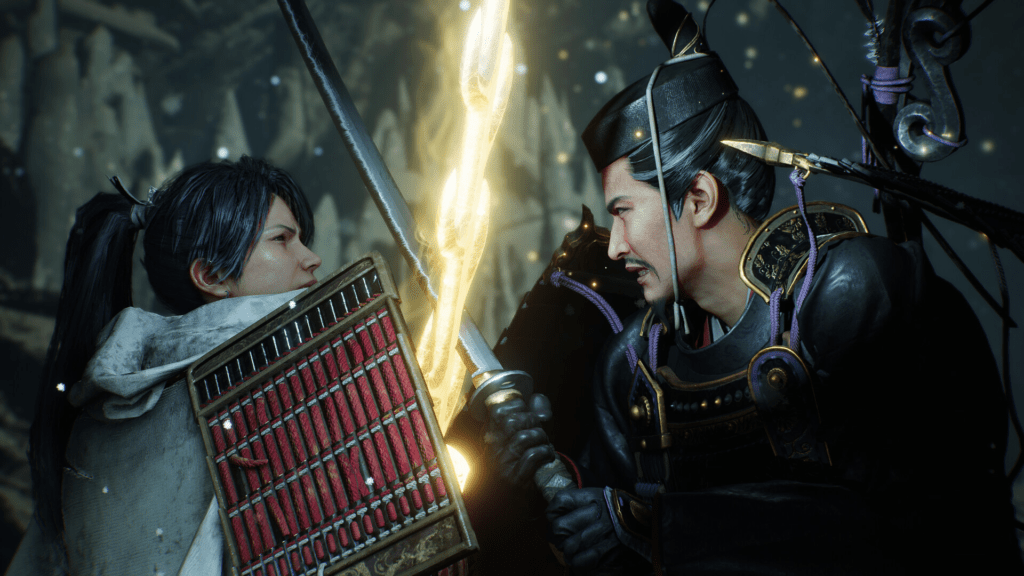
Oh, and I almost forgot, in Nioh 3, you actually create the appearance of your heir. So once again, we get a combination of the first and second games: a historically grounded story, but with that crucial element that allows players to connect with a character they’ve created themselves.
What truly makes this story stand out compared to previous entries is that fusion of historical figures and mystical elements. Encounters with figures such as Hattori Hanzo (I genuinely smiled when I saw him), Honda Tadakatsu, or the mysterious Queen Himiko, combined with traveling across multiple eras of Japanese history, create the feeling that you are part of a much larger narrative. One that doesn’t depend solely on your skill in combat, but also on your ability to understand and influence the destiny of a nation.
At the end of the day, Nioh 3 forces you to think about what it means to be a leader, and what you are willing to sacrifice to keep the world stable. That theme isn’t present only in the story; it’s reflected in every step you take, every fight you endure, and every decision you make. So unlike the previous two entries, Nioh 3 attempts to do something far more ambitious narratively. And yes, I know what most players will say, you don’t play Nioh for the story, you play it for the gameplay mechanics. Fair enough. But for the first time since the original game, the story genuinely pulled me in, to the point where I was truly invested in everything I saw, heard, and, well, slaughtered.
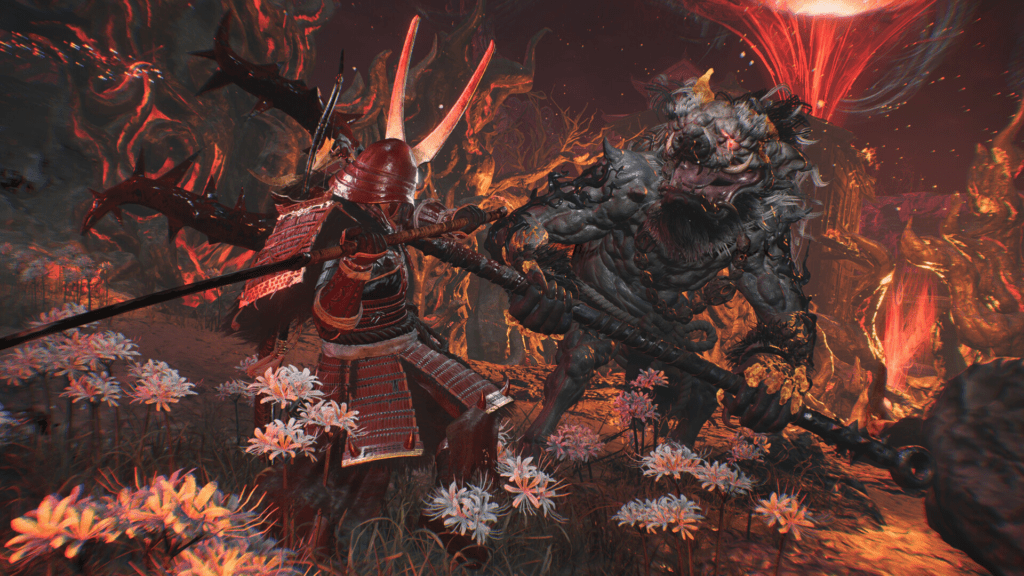
By now, everyone knows that the first Nioh was Team Ninja’s attempt at creating a soulslike, not just an attempt, but a major success. However, thanks to its mechanics, rules, and progression systems, it ultimately formed something unique that is now recognizable as distinctly Nioh. At its core, Nioh 3 remains an action game with soulslike elements, leveling systems, shrine checkpoints that function as save and rest points, and the familiar structural framework. Small elements place it within that subgenre, yet it retains so much originality that it stands right at its edge rather than blending into it. But unlike Nioh 1 and 2, Nioh 3 introduces a major new and dynamic element: two completely separate combat styles.
When you start the game, the entire tutorial is designed not only to teach you the mechanics but also to explain these two drastically different styles. First, there’s the Samurai style, classic Nioh. Depending on your equipment loadout, you can be extremely slow but powerful like a tank, or moderately slow but still devastating. Speed in Nioh has always been relative to how you build your character, but you were never truly lightning-fast like in Ninja Gaiden or Rise of the Ronin. The Samurai style revolves around Ki Pulse, just like before — timing your R1 press to recharge your precious stamina during combat. The better you master this, the easier enemies fall. And of course, you’ll be showered with weapons constantly, as Nioh games love to do. Still, once you find something that suits your playstyle, you’ll likely stick with it until something significantly better drops.
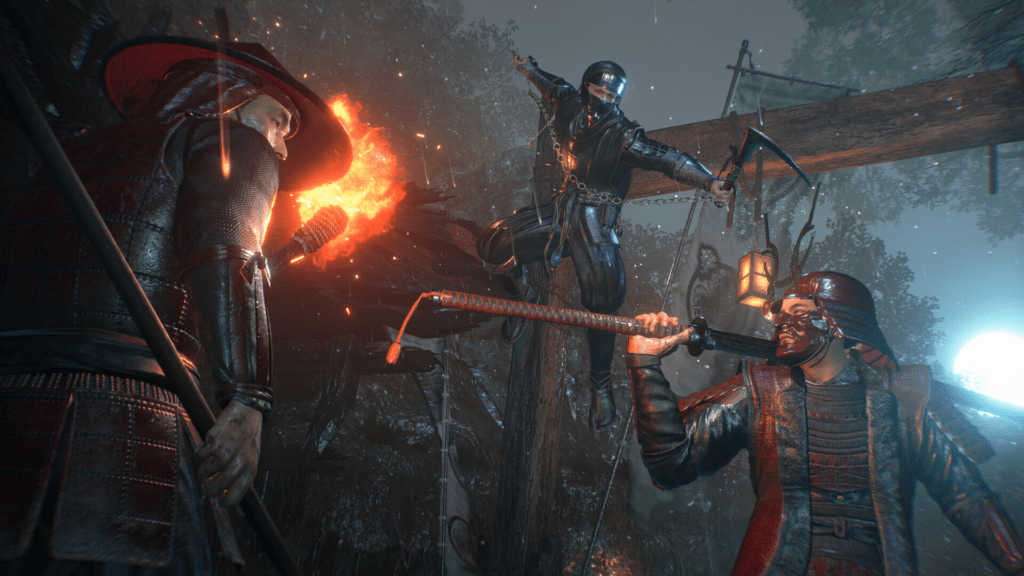
But to properly talk about mechanics, I have to mention the second style, the biggest innovation in Nioh 3.Alongside being a Samurai, you are also a Ninja. And the best part? Switching between the two styles is done instantly with a single button, R2.
The Ninja style is essentially everything that was missing from previous Nioh games. It’s the complete opposite of Samurai combat. As a Ninja, you are fast, agile, and precise. You don’t hit as hard, but that’s not the point. The philosophy is to get in close, land a few strikes, retreat, recharge stamina, and repeat. Instead of Ki Pulse, you use Shadow Dash, which allows you to evade while leaving afterimages that distract enemies. They attack your shadow while you step out of danger to recover stamina or heal. The dynamic between these two diametrically opposed styles is a fantastic addition, and easily my favorite innovation in the game. The Ninja style allows you to approach the game in a completely different way, and most importantly, it’s incredibly fun and satisfying. Yes, it reminds me a bit of Ninja Gaiden, a bit of Wo Long. Honestly, it feels like Team Ninja took everything they learned from developing their previous titles and shaped it into the ultimate form of an action game. And no, I’m not exaggerating, few games are this satisfying.
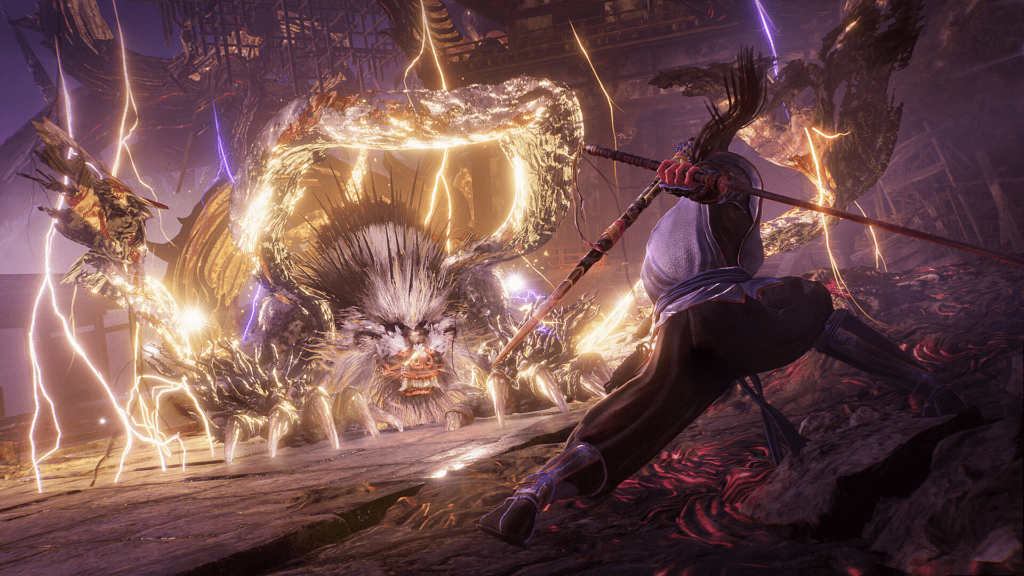
The Samurai has access to Parry early on, and when it’s time to go head-to-head while dodging left and right, another mechanic helps tremendously with countering powerful enemy attacks. When an enemy performs a Charged Attack — a red, unblockable strike, pressing R2 to switch styles instantly triggers a counter. The animation, the move set, the transition — it looks absolutely spectacular. It genuinely feels like switching characters mid-combo. Once you get the hang of it, combat becomes fluid, elegant, almost like a deadly ballet of combos and style changes.
And that’s the biggest strength of Nioh 3. Every game has combat, of course. But in Nioh 3, not a single fight feels dull. Not against regular mobs. Not against bosses. There are no boring moments. Everything is executed at an incredibly high level, engaging from beginning to end. The adrenaline keeps flowing as you watch lethal combos unfold before your eyes. Very few studios can replicate this level of combat design — and Team Ninja proves once again why they stand at the top.
You don’t always have to smash your head against enemies either. The two styles allow experimentation in approach. As a Ninja, you can climb rooftops with ease and silently eliminate troublesome enemies. You can clear entire sections without direct confrontation if combat isn’t going your way. Stealth kills from behind, bows as tools — it’s all viable. When I was clearing certain rooftops, I felt like a true Ninja — but at times, I also felt like I was cheating because it almost seemed too easy. Of course, level design dictates where and when that’s possible.
Now for something much more serious: progression.
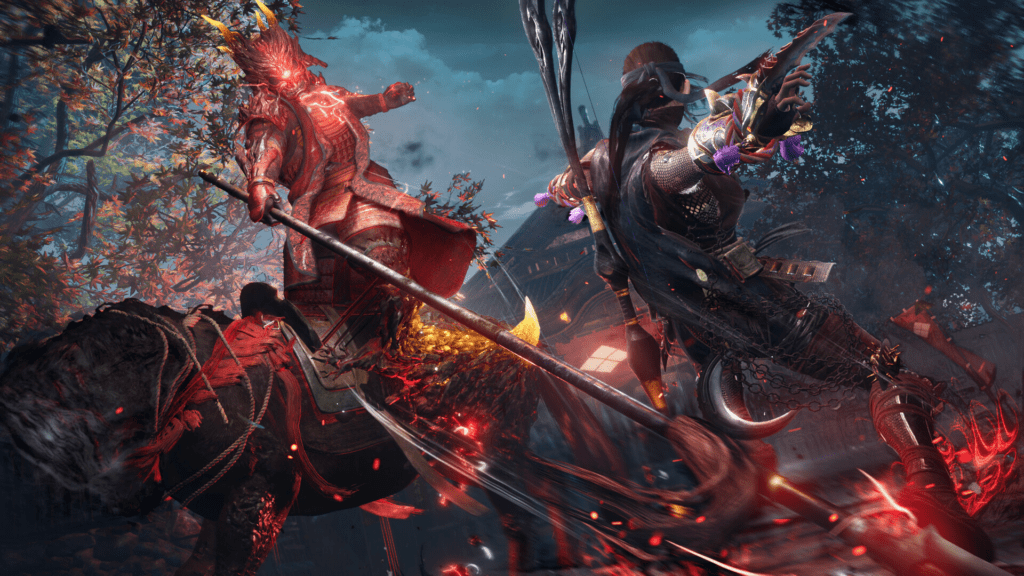
And believe me when I say, Nioh 3 can feel overwhelming at first. The first ten hours may be too much for some players until everything clicks. But once it does, everything falls perfectly into place. Progression doesn’t force you to choose between Samurai and Ninja as separate classes. On the contrary, the system is designed for you to combine Samurai and Ninja abilities within a single build — and that’s where the true depth lies. Samurai skills bring structured combat, stance control, Ki management, and powerful weapon combos. Ninja (ninjutsu) abilities introduce agility, traps, projectiles, and tactical tools that alter the tempo of battle. You’re not forced into one path. You can build a character who aggressively engages with katana stance pressure, then retreats using ninjutsu tools to control space. As you invest skill points, you unlock abilities in both trees and decide how much to emphasize each approach. That synergy is what makes the difference.
Progression isn’t linear power growth, it’s arsenal expansion. The more you combine both branches, the more real combat options you unlock. And in Nioh 3, options mean survival. The game rewards not just raw damage output, but intelligent system usage. It’s easily the most flexible progression system in any Nioh game, arguably in any Team Ninja title.
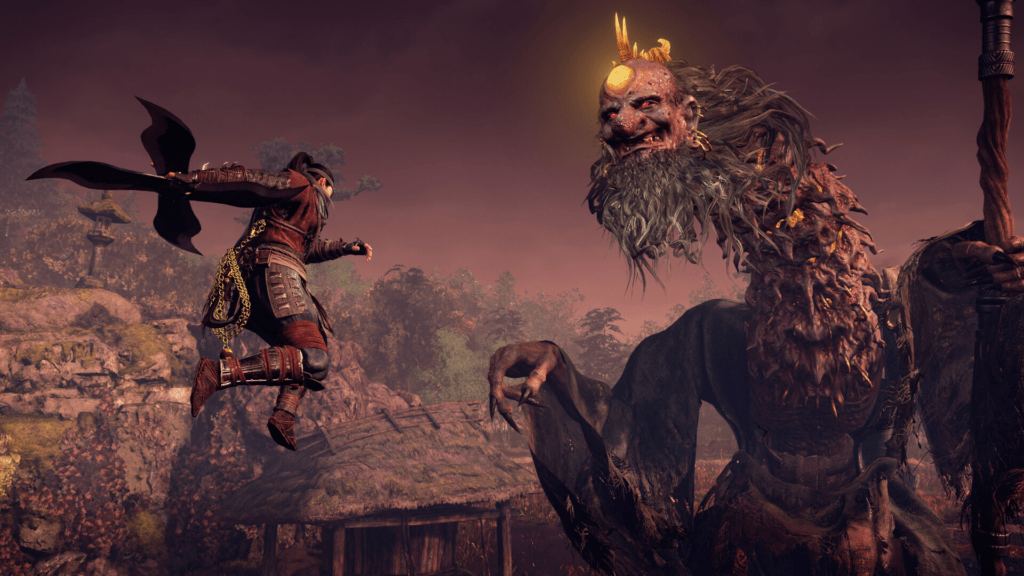
As for world design, this isn’t fully open-world. The developers call it “open field.” Large interconnected maps filled with main and side quests. Shrines are generously placed for leveling and saving progress. Each area is clearly balanced for specific progression levels, so you won’t accidentally wander into something far beyond you. Exploration is heavily rewarded, more weapons, more skills, more tools for your journey. The more time you spend exploring, the more prepared you’ll be for the next major or mini-boss. The entire system is intelligently and thoughtfully designed, all you need to do is absorb it and let yourself sink into progression.
Visually, Nioh 3 looks better than any previous Nioh title and even surpasses other Team Ninja games. It runs beautifully on PlayStation 5. No matter how chaotic the screen becomes, I never experienced noticeable frame drops. The music and sound design are equally impressive, from ambient audio to voice acting.
We would like to thank Koei Tecmo for providing us with a copy of the game for review purposes.
Nioh 3 (PlayStation 5)
In the end, Nioh 3 isn’t just another action game. It rises so far above the competition that it almost defines its own subgenre. The gameplay has never been more addictive, the story more engaging, and the presentation more polished. We’re only in the second month of the year, but right now, Nioh 3 is not only the best action game released so far. It might just remain the best by the time the year ends.


